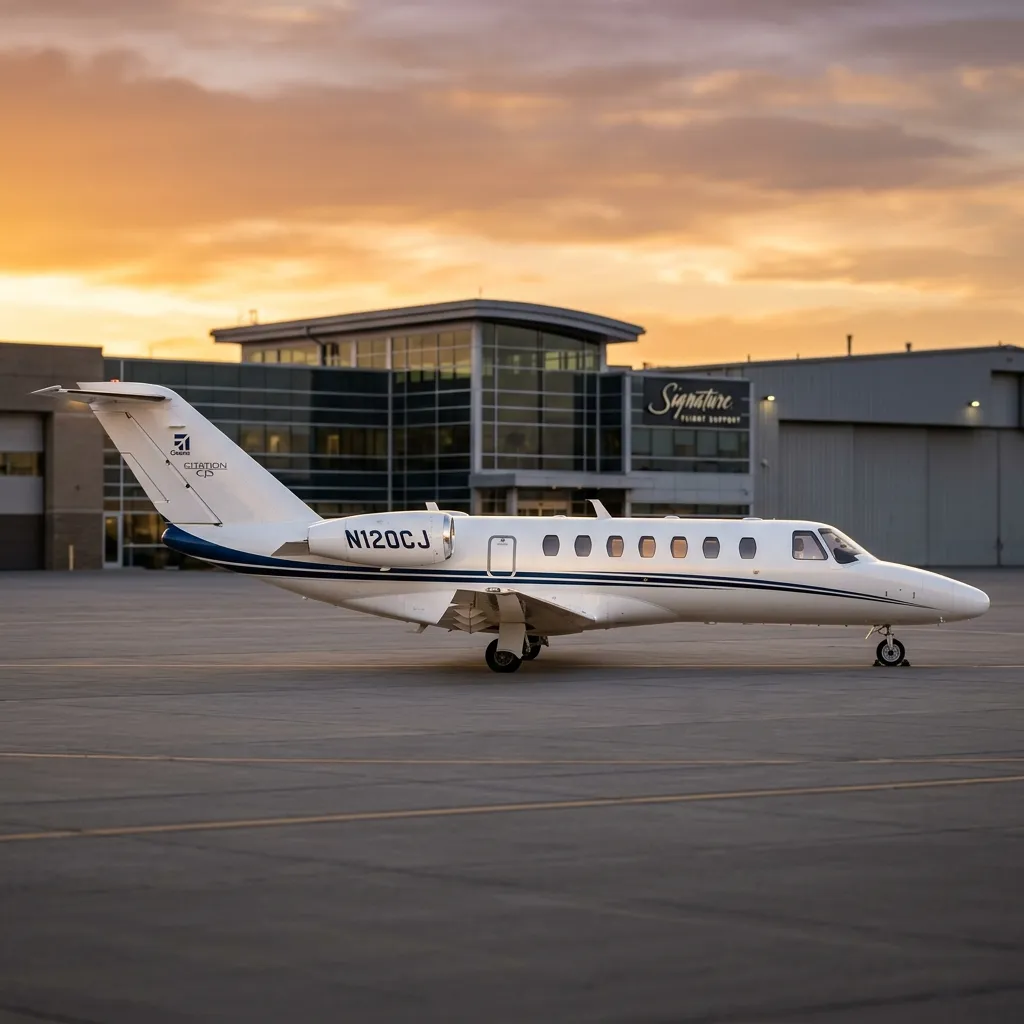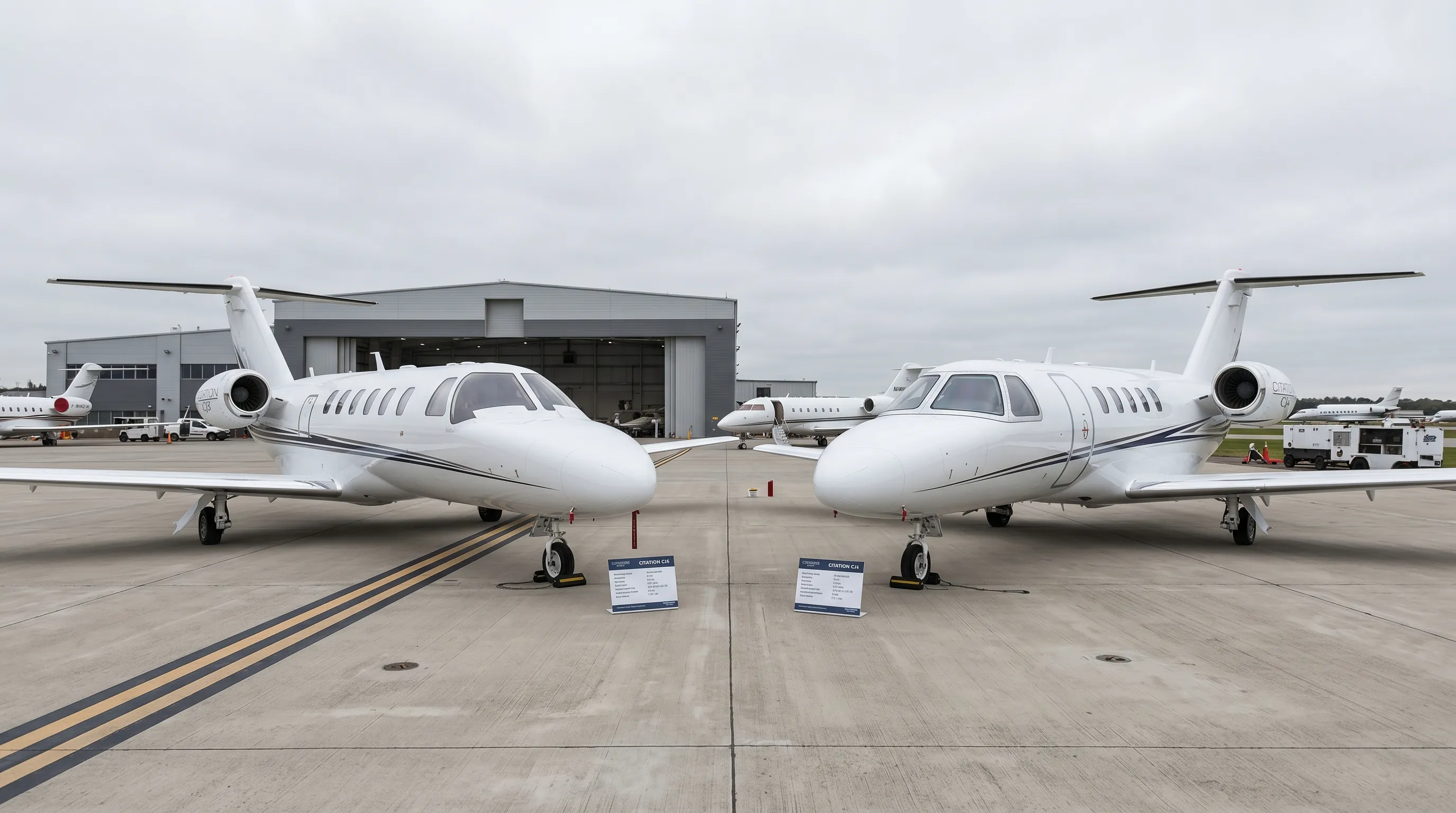
Two Cessna Citation jets parked side by side on airport ramp

Citation CJ3 vs Citation CJ4: Stepping Up in the CJ Line

The CJ4 adds 35 ktas cruise speed, 125 NM range, and 1.6 ft more cabin over the CJ3. Full comparison of specs, charter rates, and owner-operator economics.

In This Article

Two Jets, One Lineage, Different Missions Performance: Speed, Range, and Altitude Cabin Dimensions and Passenger Experience Charter Rate Comparison: What You Pay Per Hour Avionics and Single-Pilot Certification Pre-Owned Market and Acquisition Costs Frequently Asked Questions

Two Jets, One Lineage, Different Missions

The Citation CJ3 and CJ4 share a common design lineage, the Cessna 525 platform, but serve different operational niches. The CJ3 entered service in 2004 as a light jet optimized for owner-pilots flying 2-4 passengers on regional trips under 1,500 nautical miles. The CJ4 arrived in 2010 as the most capable single-pilot-certified jet in production, stretching the CJ platform's cabin by 1.6 feet, adding 841 pounds of additional engine thrust per side, and pushing cruise speed to 451 ktas. Cessna positioned the CJ4 as a bridge between the light jet category and midsize jets like the Citation XLS.

In 2026, both types remain active on the charter market and the pre-owned sales market. The CJ3 (and its upgraded CJ3+ variant with Garmin G3000 avionics) appeals to buyers and operators who want a simple, efficient, low-operating-cost light jet. The CJ4 (and the current-production CJ4 Gen2) appeals to operators who want near-midsize capability without the crew and operating costs of a true midsize airframe.

Performance: Speed, Range, and Altitude

The CJ4's Williams FJ44-4A engines produce 3,621 pounds of thrust each, compared to 2,780 pounds from the CJ3's FJ44-3A. That 30% thrust increase translates directly to performance. The CJ4 cruises at 451 ktas (Mach 0.77), 35 knots faster than the CJ3's 416 ktas. On a 1,000-mile trip, the CJ4 arrives approximately 12 minutes earlier. Both jets share a 45,000-foot service ceiling and IFR certification.

The CJ3 holds one meaningful performance advantage: takeoff distance. At 3,180 feet sea level, the CJ3 can operate from shorter runways that the CJ4 (3,410 feet) cannot. This matters at airports like Aspen (runway 7,006 feet but 7,820 feet elevation), where density altitude erodes performance margins, and at small regional airports with 4,000-foot runways where the CJ3 operates comfortably and the CJ4 requires careful weight planning.

Cabin Dimensions and Passenger Experience

Both aircraft share an identical cabin cross-section: 4.8 feet wide and 4.8 feet tall. Neither allows most adults to stand upright. The difference is length. The CJ4's cabin stretches 17.3 feet compared to 15.7 feet in the CJ3. That 1.6-foot extension accommodates a seventh and eighth seat (or ninth and tenth in high-density configurations) and provides approximately 30% more legroom for the rear-most passengers.

Baggage and Storage

The CJ4 offers 77 cubic feet of baggage capacity versus 66 cubic feet in the CJ3. Both feature external baggage compartments accessible from outside the aircraft, loaded before departure. Neither has an in-flight-accessible baggage area large enough for golf clubs, skis, or other oversized items without pre-planning. For ski trips, both aircraft require bags to be loaded in the external compartment, which is temperature-controlled but not pressurized.

The CJ3 seats 4-6 passengers in genuine comfort. The CJ4 seats 6-8. The cabin width is identical, so the difference is purely longitudinal. If your typical trip involves 4 passengers, the CJ3 is the right answer. If you regularly fly 6 or more, the CJ4 eliminates the compromise.

Need a Charter Quote?

Contact our team for a personalized quote.

Get a Quote

Charter Rate Comparison: What You Pay Per Hour

The CJ3 charters between $2,200 and $3,000 per flight hour. The CJ4 charters between $2,400 and $3,300. That $200-$300 hourly premium reflects the CJ4's higher fuel burn (165 GPH vs 130 GPH), higher engine overhaul reserves, and greater passenger capacity. On a typical 2-hour domestic flight, the CJ4 costs $400-$600 more than a CJ3 booking.

416 vs 451
Max Speed (kts)
2,040 vs 2,165
Range (NM)
$2,200 vs $2,400
Charter $/hr Low End
9 vs 10
Max Passengers

Per-Passenger Economics

The CJ4 becomes the better value when passenger count exceeds five. A CJ3 carrying 6 passengers on a $6,000 flight costs $1,000 per passenger. A CJ4 carrying 8 passengers on a $7,200 flight costs $900 per passenger. The crossover point is at 5 passengers, where the per-seat economics of the larger aircraft offset its higher hourly rate. Below 5 passengers, the CJ3's lower operating cost wins.

Avionics and Single-Pilot Certification

Both jets are certified for single-pilot operations under Part 91 and Part 135, a critical differentiator from midsize jets that typically require two-pilot crews. Single-pilot certification reduces crew cost by approximately $400-$600 per flight hour, which is the primary reason both CJ models charter at rates well below midsize jets with similar cabin sizes.

The original CJ3 shipped with Rockwell Collins Pro Line 21 avionics. The CJ3+ (2014-present) upgraded to the Garmin G3000, adding touchscreen interfaces, synthetic vision, and improved situational awareness displays. The CJ4 has always featured Collins Pro Line 21, and the CJ4 Gen2 (2022-present) added autothrottles and enhanced envelope protection. For charter passengers, avionics differences are invisible. For owner-pilots evaluating purchases, the avionics suite drives significant training and transition time differences.

Pre-Owned Market and Acquisition Costs

The pre-owned CJ3 market prices between $3.2 million and $5.5 million depending on year, total time, and avionics configuration. CJ3+ models (2014-2019) hold values between $5.5 million and $7.5 million. The CJ4 starts at $4.5 million for early 2010-2012 airframes and ranges to $8.5 million for low-time 2018-2020 models. CJ4 Gen2 aircraft, all 2022 or newer, trade between $10 million and $12 million.

Annual operating costs for an owner-operator running 300 hours per year average $450,000-$550,000 for the CJ3 and $550,000-$700,000 for the CJ4. The CJ4's higher fuel burn, heavier insurance premiums (due to higher hull value), and more expensive maintenance intervals account for the $100,000-$150,000 annual cost delta. Both types generate $150,000-$250,000 in annual charter revenue when placed on Part 135 certificates, partially offsetting ownership costs.

Brian Galvan

Written By

Brian Galvan

Founder, The Jet Finder · Private Aviation Operations & Technology

Former Director of Technology at FlyUSA (Inc. 5000 fastest-growing private jet company). Decade of hands-on experience across Part 135 operations, charter sales, fleet management, and aviation data systems.

LinkedInRead Full Profile →
Common Questions

Frequently Asked Questions


7 questions about chartering this aircraft

Yes. The CJ4 is one of the most capable single-pilot-certified jets available for Part 135 operations. Most charter operators do fly the CJ4 with a single pilot on domestic trips under 3 hours, and some operators add a second pilot for longer legs or international flights as a matter of company policy rather than regulatory requirement.

The CJ4 has demonstrated stronger value retention. Early CJ4 models (2010-2012) lost approximately 5-7% of value per year over their first decade. CJ3 models from the same era lost 7-9% annually. The CJ4's stronger retention reflects its unique market position: no other single-pilot jet offers comparable speed and range, giving it less direct competition on the resale market.

The CJ3 uses the FJ44-3A (2,780 lbs thrust, 4,000-hour TBO). The CJ4 uses the FJ44-4A (3,621 lbs thrust, 5,000-hour TBO). The CJ4's longer TBO interval partially offsets its higher overhaul cost. Per-engine overhaul runs approximately $400,000 for the FJ44-3A and $500,000 for the FJ44-4A.

Annual hull and liability insurance runs $25,000-$40,000 for the CJ3 and $35,000-$55,000 for the CJ4. The CJ4's higher premiums reflect its greater hull value, higher performance envelope, and slightly higher loss history per aircraft in the fleet. Pilot experience significantly affects premiums: a 2,000-hour CJ4 pilot pays 20-30% less than a 500-hour pilot transitioning into the type.

The CJ3 has the advantage. Its lighter weight and shorter takeoff distance (3,180 ft sea level) provide better margins at density altitude. At Eagle County (6,540 ft MSL) on a 90°F day, the CJ3 departs within its performance envelope with 4-5 passengers. The CJ4 requires weight restrictions (fewer passengers or reduced fuel) at the same airport on the same day.

Both aircraft measure approximately 72-76 dB in the cabin during cruise, comparable to a busy restaurant. The CJ4 is marginally quieter at cruise altitude because its FJ44-4A engines are rated for higher thrust but operate at a lower percentage of maximum during cruise. Neither aircraft requires hearing protection, and both support normal conversation without raising voices. The shared 525-series fuselage insulation is identical between models.

Neither can reliably fly coast-to-coast nonstop with maximum passengers. New York to Los Angeles is approximately 2,150 NM. The CJ4's 2,165 NM range is with 4 passengers and NBAA IFR reserves. At 8 passengers, range drops to approximately 1,700 NM, requiring a fuel stop in Denver or Kansas City. The CJ3 at 2,040 NM range requires a fuel stop even with 4 passengers on this route under IFR reserves.

Continue Reading

Related Articles


Your Next Mission

Ready to Fly?


Whether you need a charter quote or want to explore aircraft options, our team is here.

Contact Us