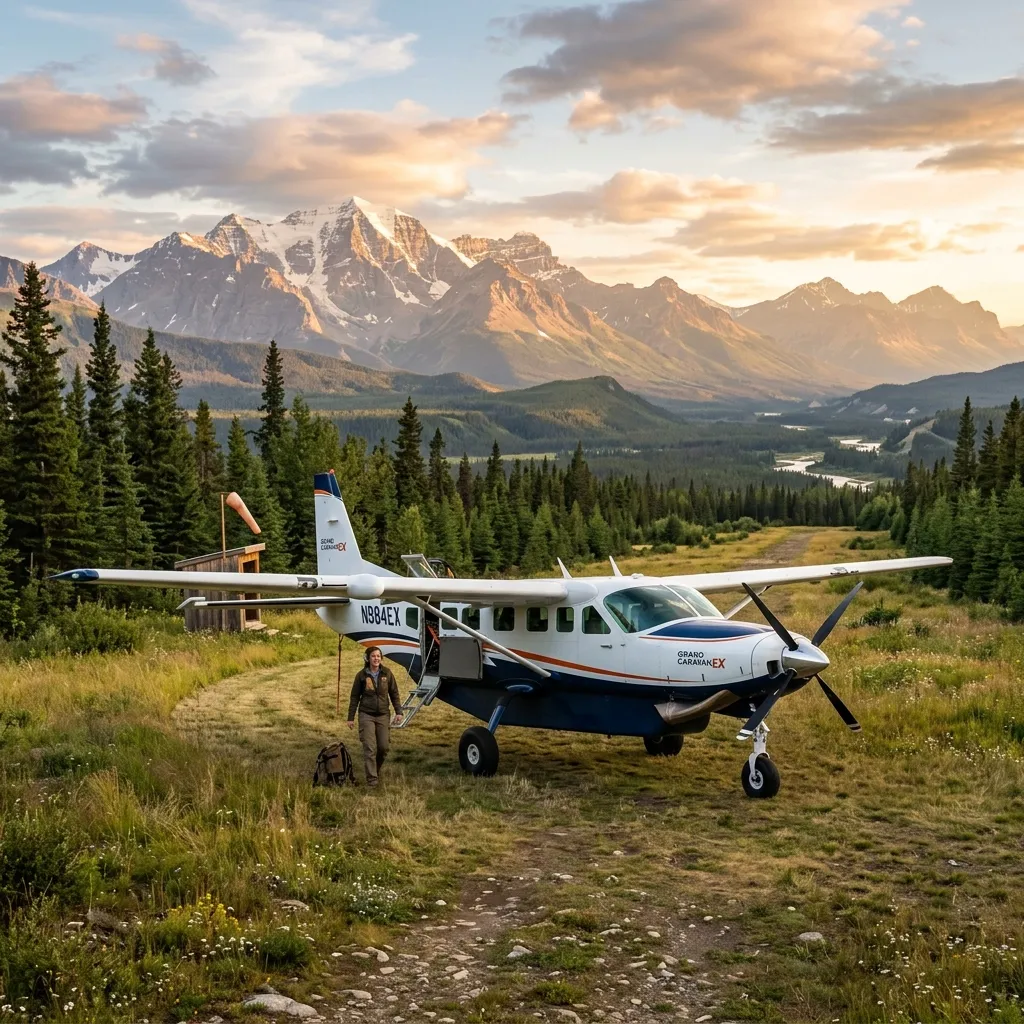
Cessna Grand Caravan EX turboprop on a remote grass airstrip with mountains in the background

The Cessna Caravan 208B: 3,000+ Delivered, One Engine, and the Most Versatile Turboprop Ever Built

undefined

In This Article

Aviation's Swiss Army Knife Performance: One Engine, Maximum Utility Mission Profiles: From FedEx to Floatplanes Operating Economics and Ownership Frequently Asked Questions

Aviation's Swiss Army Knife

The Cessna Caravan 208B (1986-present) has delivered over 3,000 aircraft across 100+ countries, making it the best-selling utility turboprop in aviation history. Where most aircraft serve a single mission, the Caravan serves all of them: scheduled airline service (FedEx operates 240+ Caravans for feeder cargo), air charter, skydiving operations, float plane missions, bush flying, air ambulance, aerial survey, and military ISR (intelligence, surveillance, reconnaissance). No other aircraft in production crosses as many mission boundaries.

The current production variant, the Grand Caravan EX, features the Pratt & Whitney Canada PT6A-140 engine (867 SHP), Garmin G1000 NXi avionics, and a maximum payload of 3,530 lbs. Textron Aviation lists the Grand Caravan EX at approximately $2.8 million new, making it one of the most affordable turbine aircraft available. Pre-owned Caravans (2005-2015 vintage) trade at $1.2-$2.0 million depending on configuration and engine time.

Performance: One Engine, Maximum Utility

The Caravan is not the fastest or longest-range turboprop. The Pilatus PC-12 cruises 100+ knots faster and flies 730 NM farther. The King Air 350 carries passengers in a pressurized cabin with more comfort. But neither competitor matches the Caravan's combination of low acquisition cost, massive payload capacity, short-field performance, and adaptability. The Caravan's 2,055-foot takeoff distance opens bush strips, grass runways, and remote airfields that reject most competitors.

The Caravan's unpressurized cabin limits practical cruise altitude to 10,000-12,500 feet (above 12,500 ft, supplemental oxygen is required). This altitude restriction means the Caravan flies below most weather and turbulence rather than above it. For the Caravan's typical mission profile (flights under 2 hours, 400-600 NM), the altitude limitation is manageable. For longer routes, the pressurized PC-12 or King Air provides a more comfortable passenger experience.

Need a Charter Quote?

Contact our team for a personalized quote.

Get a Quote

Mission Profiles: From FedEx to Floatplanes

FedEx Express operates 240+ Cessna Caravans as cargo feeders, connecting small and medium cities to the FedEx hub network. These aircraft fly 4-6 short legs per night, carrying up to 3,530 lbs of packages. FedEx's Caravan fleet accumulates some of the highest annual utilization in business aviation: 1,200-1,500 hours per year per airframe. The reliability data from FedEx operations (dispatch reliability above 99.5%) has established the Caravan as one of the most proven single-engine turboprops ever built.

Float-equipped Caravans serve lake and river access communities across Canada, Alaska, Scandinavia, and the South Pacific. Wipaire floats convert the Caravan into a heavy-lift floatplane capable of carrying 8-10 passengers and gear to remote fishing lodges, mining camps, and island communities with no runway. Cargo pod modifications add 80 cubic feet of external storage for bulky loads. Skydiving operators use the Caravan's large cargo door and high-altitude capability to carry 15-18 skydivers per load to 13,000-14,000 feet.

Air ambulance Caravans serve rural and island communities where twin-engine aircraft are cost-prohibitive. The wide cabin (5.3 ft) accommodates a stretcher, medical equipment, and 2 attendants. Aerial survey operators use Caravans for photogrammetric mapping, LiDAR scanning, and geophysical survey, taking advantage of the stable low-speed flight characteristics and long endurance. The Caravan's mission diversity is unmatched: no other aircraft transitions from overnight cargo hauler to daytime charter aircraft to weekend skydiving platform.

Operating Economics and Ownership

The Caravan's operating economics are its strongest competitive advantage. Variable costs run $800-$1,200 per flight hour, approximately 40% less than a King Air 350 and 50% less than a PC-12. The single PT6A engine (versus two on the King Air) halves engine maintenance exposure. PT6A overhaul costs run $250,000-$350,000 every 3,600 hours, with P&WC's Eagle Service Plan available at $80-$110 per engine flight hour for predictable budgeting.

Annual fixed costs for an owner-operated Caravan run $80,000-$120,000 including hangar, insurance, annual inspection, and avionics subscriptions. For a Part 135 charter operator, annual fixed costs increase to $120,000-$180,000 including crew salary, training, and additional insurance. The Caravan's low operating costs make it profitable on routes and missions that would be uneconomical in a more expensive aircraft, which explains why more Caravans are in commercial service than any comparable type.

Brian Galvan

Written By

Brian Galvan

Founder, The Jet Finder ยท Private Aviation Operations & Technology

Former Director of Technology at FlyUSA (Inc. 5000 fastest-growing private jet company). Decade of hands-on experience across Part 135 operations, charter sales, fleet management, and aviation data systems.

LinkedInRead Full Profile →
Common Questions

Frequently Asked Questions


8 questions about chartering this aircraft

FAA and EASA safety data show that modern single-engine turboprops (Caravan, PC-12, TBM) have accident rates comparable to or lower than twin-engine turboprops (King Air, Conquest). The PT6A family has accumulated over 400 million flight hours with an in-flight shutdown rate below 1 per 100,000 hours. The Caravan's glide ratio (approximately 11:1 at best glide speed) provides meaningful glide distance for emergency landing in case of engine failure. Single-engine safety concerns are based on historical perceptions that are not supported by contemporary data.

FedEx's fleet is the single largest driver of Caravan parts inventory and maintenance infrastructure. Parts availability for the 208B is among the best of any turboprop due to the 3,000+ aircraft in service and FedEx's demand for rapid AOG (aircraft on ground) support. Maintenance facilities qualified for Caravan work exist in virtually every state and most countries. FedEx's utilization also drives a robust used parts market: overhauled components are readily available at 40-60% of new pricing. The Caravan's maintenance ecosystem is deeper than any competing turboprop.

At $2.8M acquisition, $100,000 annual fixed costs, and $1,000/hour variable costs, the Caravan's annual operating cost at 300 hours is approximately $400,000 (excluding depreciation). Caravan charter pricing averages $1,500-$2,000 per hour occupied. At 300 charter hours, the cost would be $450,000-$600,000. Ownership becomes cheaper per hour than charter at approximately 200-250 annual flight hours, making the Caravan one of the most accessible turboprop ownership propositions in aviation.

At 10,000 feet in an unpressurized Caravan, the cabin altitude equals the flight altitude (10,000 feet). Most passengers experience no physiological effects at this altitude, though some may notice mild ear pressure changes. Noise levels are higher than in a pressurized King Air (the Caravan cabin is approximately 80-85 dB versus 72-78 dB in a King Air 350). Temperature control relies on engine bleed air heating and ambient ventilation rather than a pressurized environmental system. For flights under 2 hours, most passengers report the experience as acceptable. Above 2 hours, cabin fatigue is noticeable compared to a pressurized aircraft.

Wipaire 8750 floats for the Caravan cost approximately $250,000-$350,000 installed, including structural modifications and STC compliance. Float installation reduces cruise speed by approximately 15-20 knots (from 186 to 165-170 ktas) and reduces useful load by approximately 400-500 lbs due to float weight. Takeoff distance on water increases to approximately 2,400-2,800 feet depending on conditions. The float-equipped Caravan remains one of the highest-payload floatplanes available, carrying 2,500-3,000 lbs of passengers and cargo on water operations.

The PT6A-140 on the Grand Caravan EX provides 28% more shaft horsepower than the PT6A-114A, which translates to better takeoff performance (shorter rolls, steeper climbs), improved hot-and-high capability, and faster cruise speed (186 vs 170 ktas). For operators in mountainous terrain, tropical heat, or high-altitude airports, the -140 engine provides meaningful safety margin improvements. For flat-terrain, sea-level operators flying light loads, the performance difference is less critical. Pre-owned PT6A-114A Caravans remain excellent aircraft at $400,000-$800,000 less than a Grand Caravan EX.

Skydiving Caravans remove all passenger seats and install a flat floor with bench seating along the fuselage walls, accommodating 15-18 skydivers sitting knee-to-knee. A large cargo door (aft fuselage, 4.2 x 4.2 ft) is modified for in-flight opening, allowing jumpers to exit at 13,000-14,000 feet. The aircraft climbs at approximately 1,000-1,200 feet per minute, reaching jump altitude in 12-15 minutes. Skydiving operators typically fly 6-10 loads per day, accumulating 800-1,200 annual hours. The Caravan's reliability at these utilization rates is one reason it dominates the global skydiving market.

The G1000 NXi on the Grand Caravan EX provides dual 12-inch PFD/MFD displays, synthetic vision, ADS-B In/Out, WAAS LPV approaches to 200-foot minimums, integrated flight planning, engine monitoring, and wireless cockpit connectivity. Older Caravans (pre-2008) were delivered with Honeywell Bendix/King analog avionics or early Garmin GNS units. Retrofitting an older Caravan with G1000 NXi costs $120,000-$180,000 and provides near-equivalent avionics capability to a new aircraft. Many 2000-2010 vintage Caravans have been upgraded, which supports their resale value and operational capability.

Continue Reading

Related Articles


Your Next Mission

Ready to Fly?


Whether you need a charter quote or want to explore aircraft options, our team is here.

Contact Us