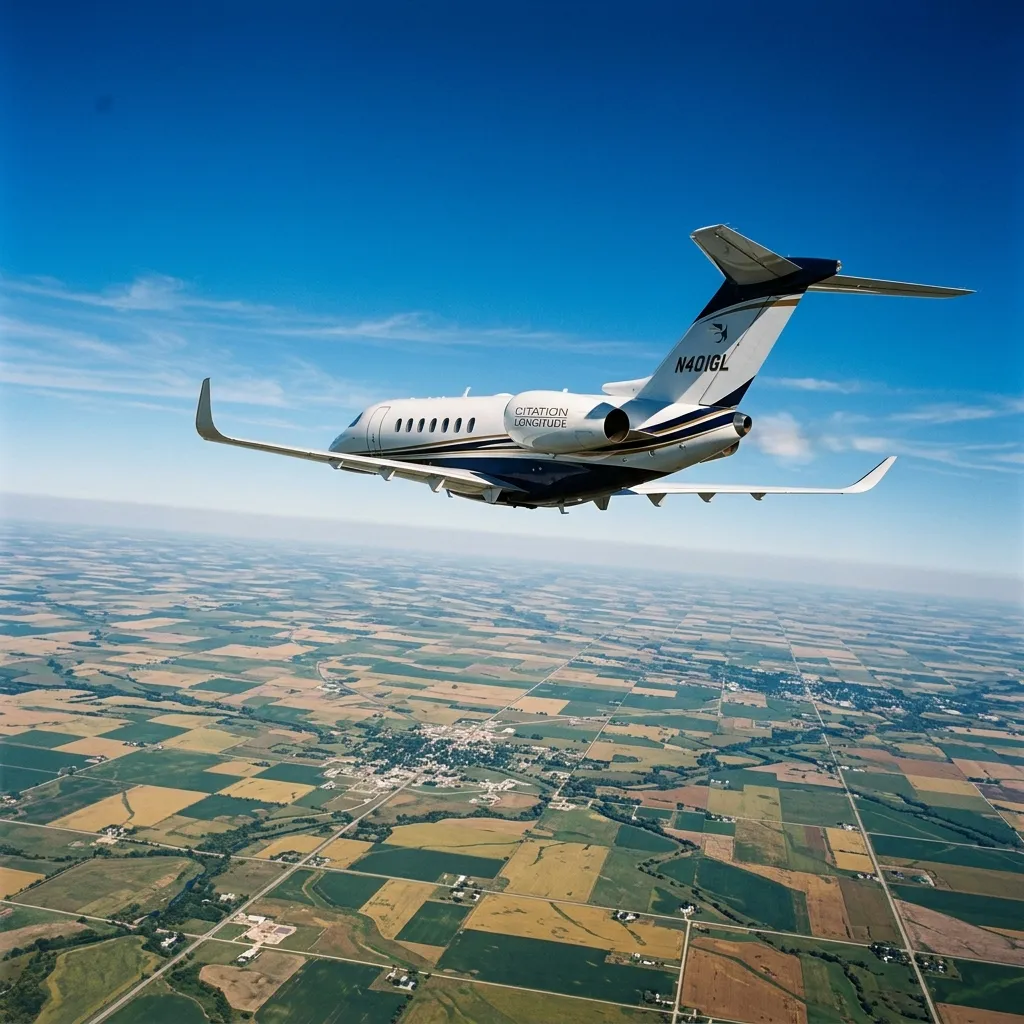
The Transcontinental Threshold: 2,700 Nautical Miles
The New York to Los Angeles corridor measures 2,450 nautical miles by great circle. Add IFR reserves, ATC routing deviations, and jet stream avoidance, and the mission requires approximately 2,600-2,700 nm of effective range. That threshold eliminates every light jet (1,000-1,800 nm range) and most midsize jets (2,000-2,400 nm range) from nonstop consideration. Of the 22,000+ business jets registered in the United States, approximately 8,500 have the range to fly coast-to-coast without a fuel stop.
Eastbound (VNY to TEB) is 30-45 minutes shorter than westbound because prevailing westerly jet stream winds push the aircraft. An aircraft marginal on range westbound may complete the eastbound leg comfortably. This asymmetry matters for operators planning round-trip charters: the outbound leg may require a fuel stop while the return does not.
Tier 1: The Coast-to-Coast Workhorses
These aircraft were designed for the transcontinental mission. They handle TEB-VNY nonstop in all seasons, all wind conditions, with full passenger loads.
The Challenger 350 is the most-chartered aircraft on this route. Bombardier delivered over 400 units, creating deep charter inventory in both New York and Los Angeles. Its 3,200 nm range provides 500 nm of reserve beyond the TEB-VNY mission, enough to handle winter headwinds without fuel planning anxiety. The cabin seats 8-10 passengers with a stand-up height of 6 feet, adequate for 5-hour flights.
The Praetor 600 offers the most range in the super-midsize category at 3,900 nm, providing 1,200 nm of reserve over TEB-VNY. This margin is relevant for passengers connecting beyond Los Angeles to Hawaii (additional 2,200 nm) or for operators who want to avoid any fuel stop risk regardless of conditions. The Praetor 600's range is closer to heavy jet territory at a super-midsize operating cost.
Tier 2: Heavy Jets That Dominate the Route
Heavy jets are not required for the transcontinental mission on range alone, but passengers who fly TEB-VNY weekly choose them for cabin comfort. Five hours in a super-midsize jet is manageable. Five hours in a Gulfstream G550 with a flat-floor cabin 6 feet 2 inches tall, a full galley, and a private aft lavatory is a different experience.
The Gulfstream G550 is the most popular heavy jet on the TEB-VNY corridor. Its 6,750 nm range is excessive for a 2,450 nm mission, but the cabin, speed (Mach 0.85 cruise), and reliability make it the default choice for frequent coast-to-coast travelers. Charter availability is strong in both markets. One-way pricing runs $37,000-$48,000 on a G550; empty legs on this route appear regularly at $15,000-$22,000.
Need a Charter Quote?
Contact our team for a personalized quote.
Get a Quote →What About Midsize Jets?
True midsize jets (Citation XLS+, Hawker 800XP, Learjet 60XR) have NBAA IFR ranges of 1,800-2,400 nm. None can fly TEB-VNY nonstop. The Citation XLS+ at 2,100 nm needs a fuel stop at approximately the 3.5-hour mark, typically in Kansas (ICT), Oklahoma City (OKC), or Amarillo (AMA). The fuel stop adds 35-45 minutes including approach, taxi, refueling, taxi, and departure.
For budget-conscious travelers, a midsize jet with a fuel stop can save $8,000-$15,000 compared to a super-midsize nonstop. A Citation XLS+ charters at $3,800-$4,800 per hour; the 6.5-hour total time (including fuel stop) costs $24,700-$31,200 versus $26,000-$35,000 for a nonstop super-midsize. The savings narrow when the fuel stop cost (landing fees, handling fees at the fuel stop FBO) is included.
The fuel stop on a midsize jet adds 45 minutes to total travel time but saves $5,000-$10,000 versus a super-midsize nonstop. For time-sensitive travelers, the nonstop is worth the premium. For price-sensitive travelers, the fuel stop is barely noticeable.
Seasonal Factors: Winter Headwinds Change the Math
Jet stream winds between November and March run 100-200 knots from west to east across the central United States at FL400-FL450. A westbound TEB-to-VNY flight against these winds adds 30-60 minutes of flight time and burns 15-25% more fuel than the same route in calm summer conditions. Aircraft with range margins under 500 nm above the mission distance may require a fuel stop westbound in winter while completing the same route nonstop in summer.
The Challenger 350 (3,200 nm range) typically handles westbound winter missions without a stop. The Citation Sovereign+ (3,200 nm, but slower cruise speed burning more time-based fuel) is more marginal. The Gulfstream G280 (3,600 nm) has sufficient margin in all conditions. Operators flying the corridor regularly know which aircraft need winter fuel stops and plan accordingly. Passengers should ask: 'Can this aircraft make TEB-VNY nonstop westbound in January?' The answer separates the truly transcontinental-capable aircraft from the ones that are marginal.
The Coast-to-Coast Charter Booking Strategy
The TEB-VNY corridor is one of the highest-volume charter routes in the United States, which creates both pricing competition and empty leg availability. Major fleet operators (NetJets, XO, Flexjet) position aircraft in both markets, and one-directional demand patterns create regular empty legs. Sunday evening eastbound (entertainment industry returning to NYC) and Monday morning westbound (entertainment industry heading to LA) produce the most empty legs in the opposite direction.
For price-sensitive travelers, monitoring empty leg platforms for TEB-VNY and VNY-TEB availability can yield 50-70% savings. A G550 empty leg on this route sells for ,000-,000 versus ,000-,000 for a standard charter. The trade-off: fixed schedules, limited flexibility on departure times, and potential cancellation if the primary trip changes.
For time-sensitive travelers who need guaranteed departures, booking a super-midsize nonstop with 7+ days lead time produces the best value. Operators can schedule the aircraft to end its prior trip at or near TEB, minimizing positioning fees. A Challenger 350 booked 10 days ahead from TEB to VNY typically quotes ,000-,000, approximately ,000-,000 less than a 48-hour booking where the nearest available aircraft may require significant repositioning.