What 'International Capable' Actually Requires
International private jet travel is not simply a long domestic flight over water. It involves three requirements that filter out most of the business jet fleet: sufficient range to cover ocean crossings nonstop (or with minimal fuel stops), overwater redundancy (ETOPS certification for twin-engine jets or tri-engine configuration), and a cabin that keeps passengers functional after 8-14 hours in the air.
The North Atlantic crossing from Teterboro (TEB) to London Luton (LTN) covers 3,440 nautical miles. Paris Le Bourget (LBG) is 3,630 NM. Geneva (GVA) from Miami is 4,560 NM. The Pacific crossing from Los Angeles to Tokyo Narita is 4,830 NM. Any jet with less than 3,500 NM of range is eliminated from transatlantic consideration. Anything under 4,800 NM cannot cross the Pacific from the West Coast.
This range threshold reduces the eligible fleet from 11,692 U.S.-registered business jets to approximately 2,800 airframes: the heavy and ultra-long-range categories.
Tier 1: The Nonstop-Anywhere Jets (6,000+ NM Range)
Four aircraft types cover virtually every international route nonstop from the continental United States to Europe, the Middle East, and most of Asia:
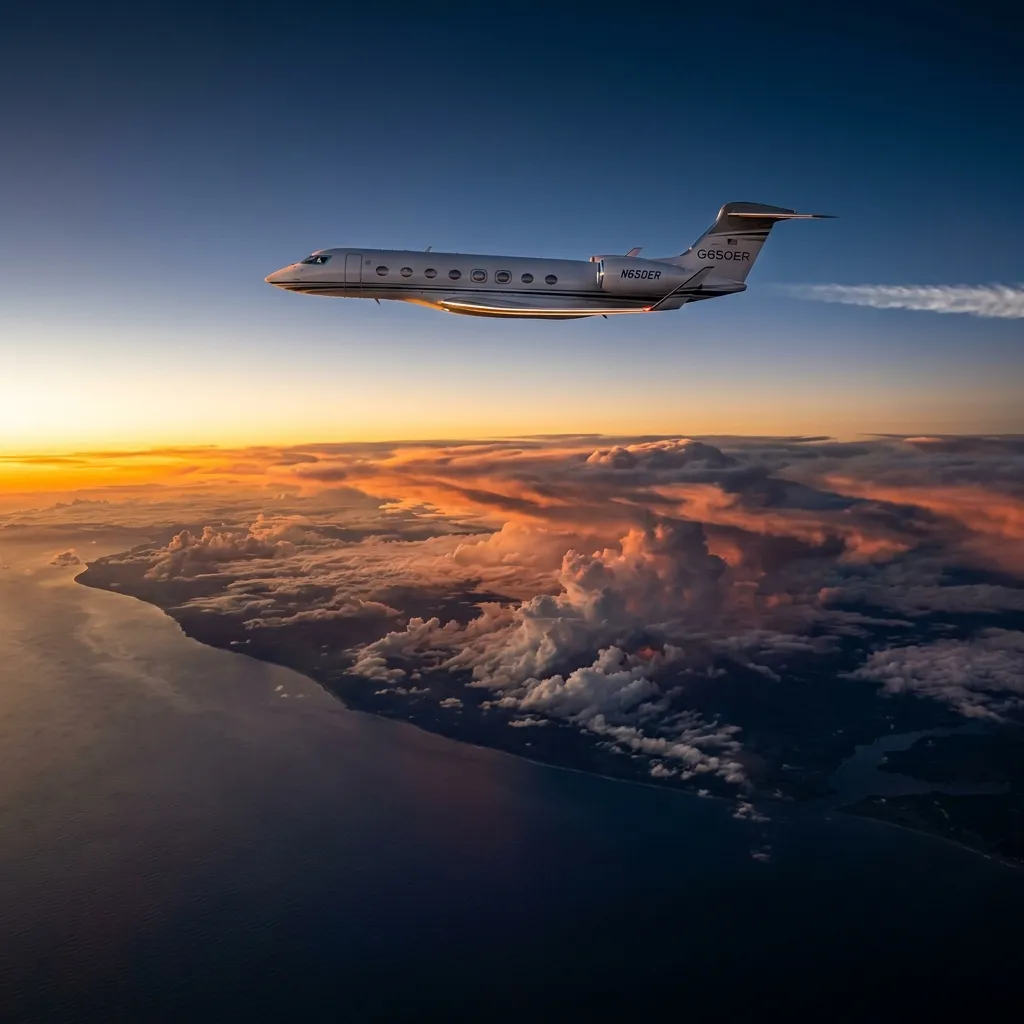
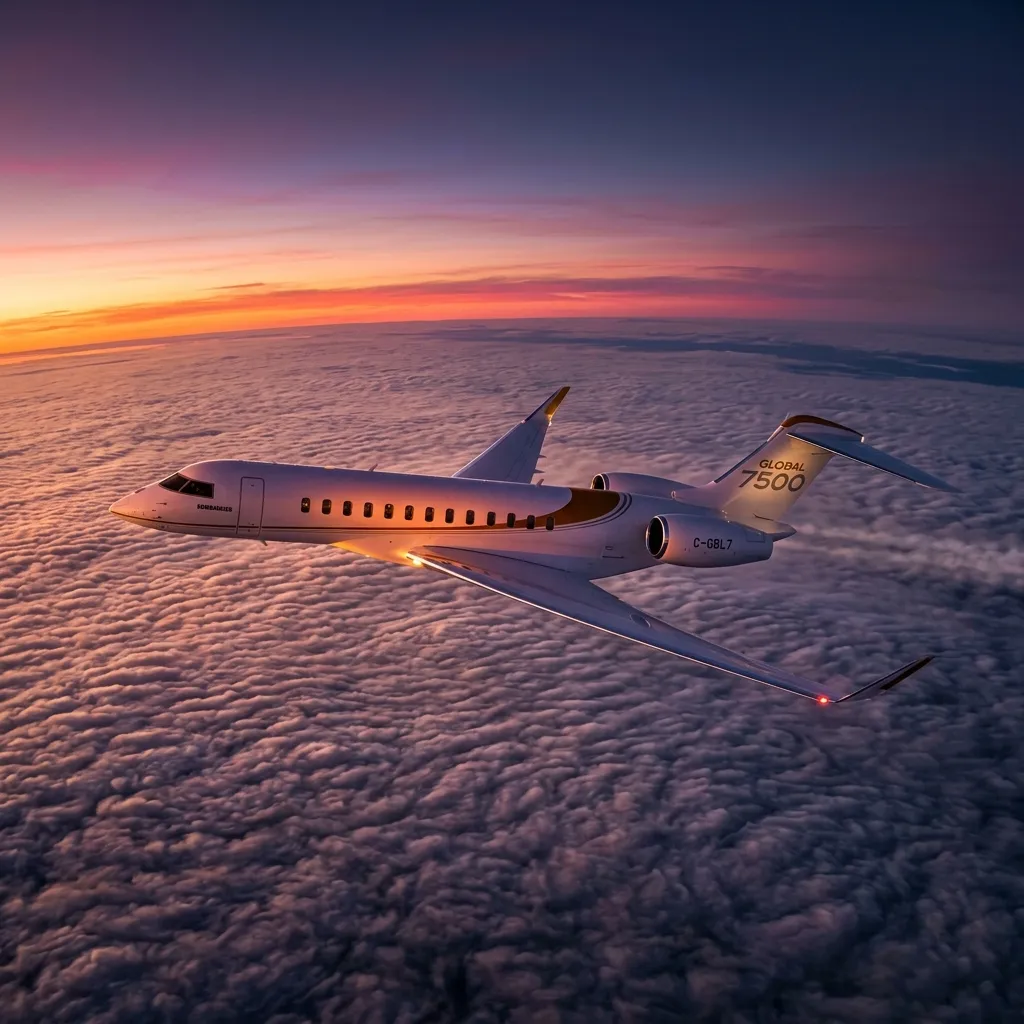
The Global 7500 and G700 are the flagships. Both cover New York to Dubai, Los Angeles to London, and Singapore to San Francisco with a single fuel stop. The G650ER matches their range at 7,500 NM with a wider cabin. The Falcon 8X trades 1,000+ NM of range for tri-engine redundancy and short-field access to airports like London City.
If your international travel is exclusively transatlantic (U.S. to Europe), the Falcon 8X at $6,000-$8,500 per hour is the most cost-efficient option with full-size cabin capability. Paying $2,000-$4,000 per hour more for a G650ER buys range you will never use on a 3,500 NM crossing.
Tier 2: The Transatlantic Workhorses (4,000-6,000 NM Range)
For passengers whose international travel is primarily between North America and Western Europe, several heavy jets cover these routes nonstop at lower charter rates than the flagships:
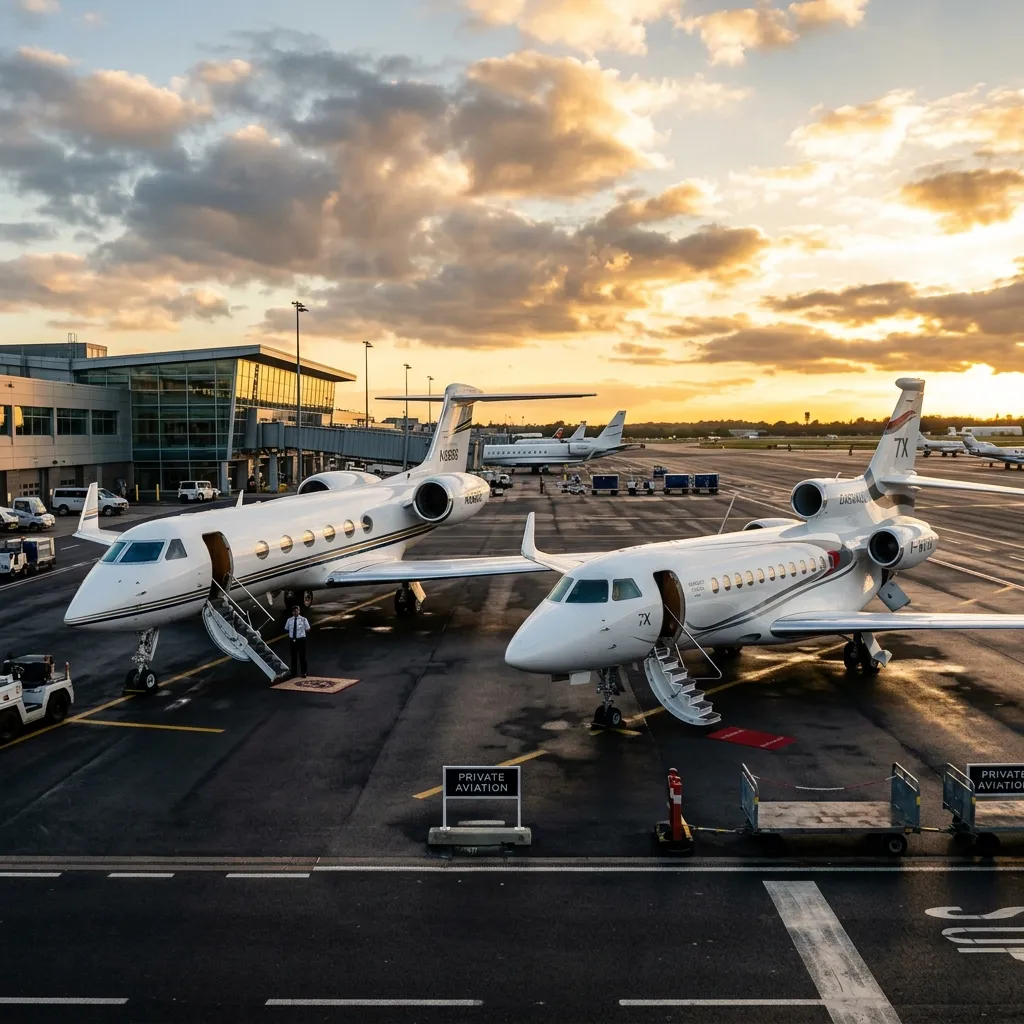
The G550 is the most common transatlantic charter aircraft in the U.S. fleet. With 6,750 NM of range, it covers every U.S.-to-Europe route nonstop with substantial reserves. The Falcon 7X matches it on range with tri-engine overwater redundancy. The Global 5500 offers the widest cabin (8.2 ft) in this tier.
The Challenger 650 and G450 are the budget transatlantic options. Both can fly New York to London nonstop, but range margins are tighter and eastbound headwinds in winter may require payload reductions or a fuel stop in Iceland or Newfoundland on certain days. For passengers who fly to London and Paris but not further, the Challenger 650 at $4,500-$6,500 per hour saves $1,000-$3,000 per hour compared to the G550.
Need a Charter Quote?
Contact our team for a personalized quote.
Get a Quote →Cabin Altitude: The Factor Nobody Talks About Until Hour Six
On a 2-hour domestic flight, cabin altitude is irrelevant. On a 10-hour transatlantic crossing, it determines whether passengers arrive functional or exhausted. Cabin altitude is the simulated altitude inside the pressurized cabin while the aircraft flies at cruise altitude. Lower cabin altitude means more oxygen, less dehydration, and better sleep.
3,500+ NM
Minimum Range for Atlantic
4,800+ NM
Minimum Range for Pacific
6.0+ ft
Minimum Cabin Height
$5,500-$10,500/hr
Charter Rate Range
The Gulfstream G700 maintains the lowest cabin altitude of any production business jet: 2,916 feet at FL510. The G650 holds 3,000 feet at FL410. The Falcon 8X maintains 3,900 feet at FL510. By comparison, a Boeing 787 Dreamliner (the best commercial aircraft for cabin altitude) holds 6,000 feet, and older 767s and 777s hold 6,500-8,000 feet.
The physiological difference is measurable. At 3,000 feet cabin altitude, blood oxygen saturation remains above 95%. At 6,500 feet (typical commercial), it drops to 90-92%. Over 10 hours, that 3-5% difference manifests as fatigue, headaches, dry eyes, and the general malaise that commercial passengers call 'jet lag' but is partly altitude-induced hypoxia. Business jet passengers who arrive in London feeling 'fine' are experiencing the benefit of a 3,000-foot cabin without realizing it.
Customs and Regulatory Considerations
International private jet travel involves regulatory requirements that domestic flights do not:
Overflight Permits
Many countries require advance overflight or landing permits for private aircraft. European countries are generally open, but Russia (closed to most Western operators since 2022), China, India, Saudi Arabia, and several African nations require permits filed 3-10 business days in advance. The charter operator's international dispatch team handles permit filing, but passengers should be aware that last-minute international itinerary changes may not be feasible.
Customs and eAPIS
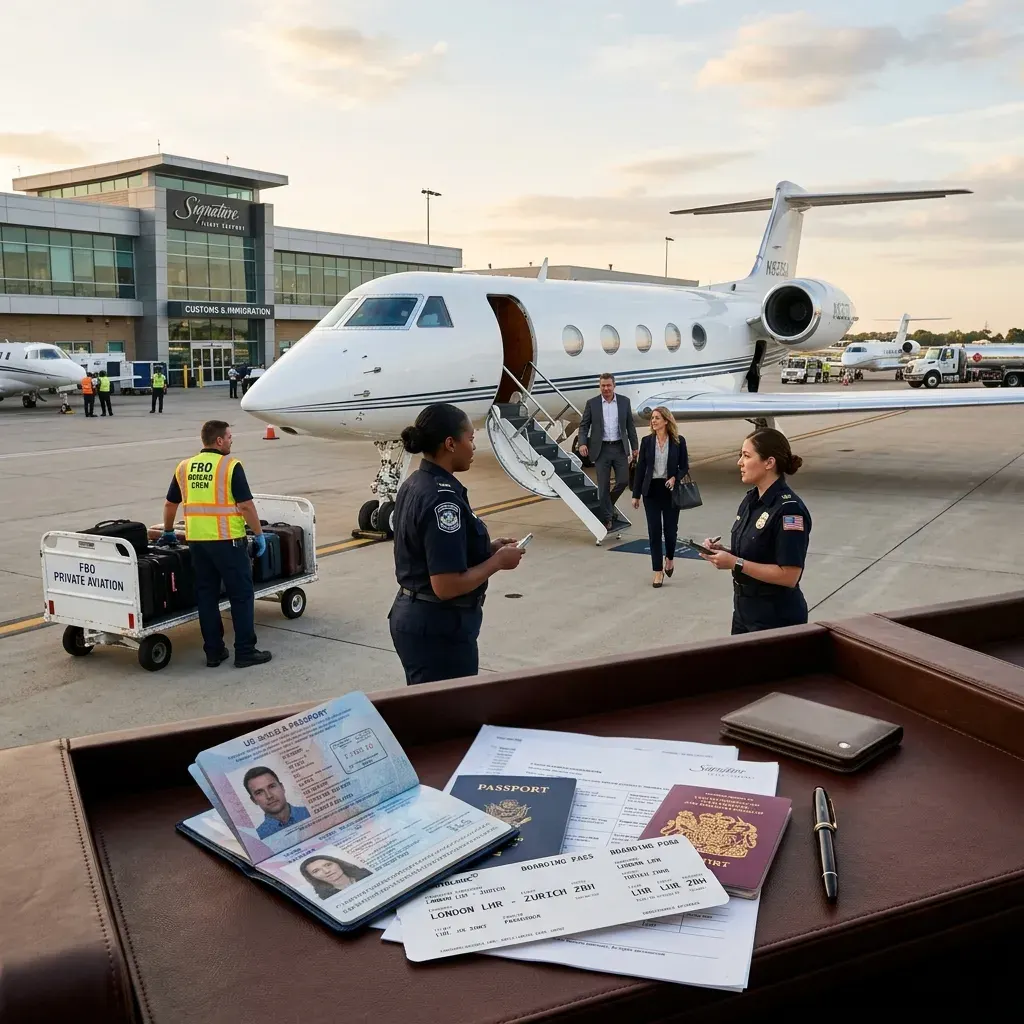
All private aircraft entering or departing the United States must file an eAPIS (Electronic Advance Passenger Information System) manifest with CBP at least 60 minutes before departure. Passengers must provide passport information to the operator in advance. At the destination, private jet customs clearance happens at the FBO rather than a commercial terminal, typically taking 15-45 minutes.
Cabotage Restrictions
Most countries prohibit foreign-registered aircraft from conducting domestic flights within their borders (cabotage). A U.S.-registered G650 can fly from New York to London, but it generally cannot fly passengers from London to Paris without violating EU cabotage rules. Operators must use locally registered aircraft for intra-European, intra-Asian, or intra-African legs.
When a Fuel Stop Is Not a Failure
Passengers sometimes view fuel stops as a deficiency. On certain routes, they are the rational choice.
A G550 can fly nonstop from New York to Mumbai (6,900 NM) with reduced payload in favorable winds. Or it can stop in Shannon, Ireland (2,900 NM from New York), refuel in 25 minutes, and complete the remaining 4,000 NM to Mumbai with full payload and substantial reserves. The fuel stop adds 40 minutes to the total trip time but eliminates the payload restriction and provides a safety margin that the nonstop attempt does not.
Common fuel stop airports for transatlantic and transpacific routes: Shannon (SNN) and Keflavik (KEF) for Atlantic crossings, Anchorage (ANC) for Pacific routes to Asia, and Gander (YQX) for North Atlantic routing in winter when headwinds are strongest. These airports have 24-hour FBO services, customs clearance, and rapid-turn fuel capability. A well-planned fuel stop at Shannon takes 25-30 minutes on the ground.
An operator who recommends a fuel stop on a borderline-range route is demonstrating judgment, not a limitation. The operator who pushes a nonstop attempt to impress the passenger at the cost of reserve fuel is the one to worry about.