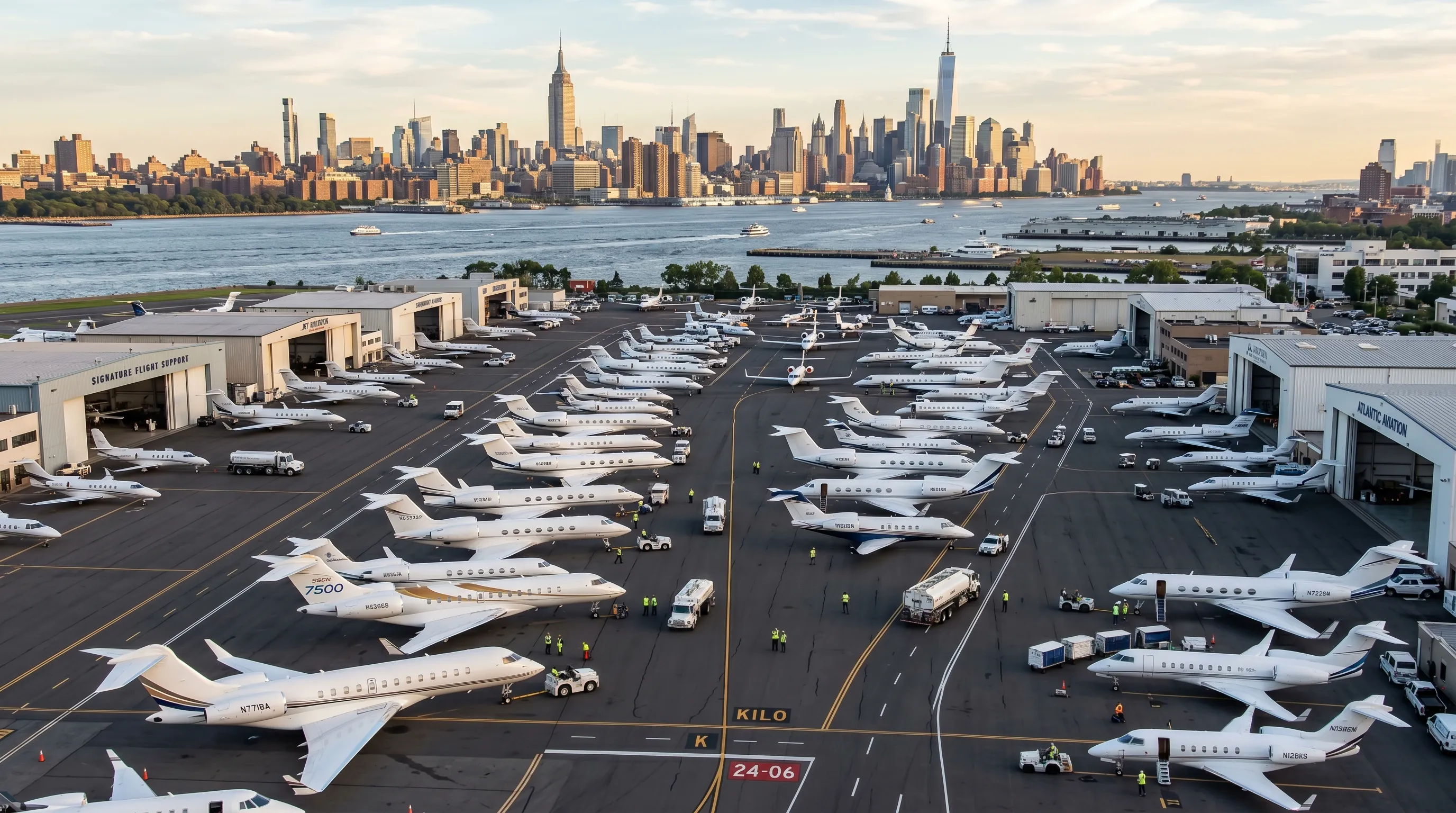
Split view of Teterboro and Westchester County airports with business jets on both ramps

White Plains vs Teterboro: Which New York Airport Is Right for You?

Teterboro Airport (TEB) processed 167,000 operations in 2025, making it the busiest general aviation airport on the Eastern Seaboard. Westchester County Airport (HPN) in White Plains logged approximately 120,000 operations the same year. Both serve New York City. The 21-mile distance between them creates fundamentally different travel experiences depending on where in the metro area your final destination sits.

In This Article

Location: Where Are You Actually Going? Teterboro: Capacity, Congestion, and Slot Restrictions White Plains (HPN): Easier Operations, Fewer Constraints Helicopter Transfers: Equalizing the Ground Game When Neither Airport Works: Other NYC Options Frequently Asked Questions

Location: Where Are You Actually Going?

Teterboro sits in Bergen County, New Jersey, 12 miles from Midtown Manhattan. The drive into the city via the George Washington Bridge or Lincoln Tunnel takes 25-45 minutes in normal traffic and 60-90 minutes during rush hour. Westchester County Airport sits in White Plains, New York, 33 miles north of Midtown. The drive via I-287/Hutchinson River Parkway/FDR Drive takes 40-60 minutes in normal traffic and 75-120 minutes during rush hour.

The decision framework is geographic. If your final destination is Manhattan south of 96th Street, New Jersey, or JFK-area hotels, TEB saves 15-30 minutes. If your destination is Westchester County, Fairfield County (Greenwich, Stamford, Darien), or anywhere in Connecticut, HPN saves 30-60 minutes. For the Upper East Side, the advantage is minimal; helicopter transfers from either airport equalize the ground time.

Teterboro: Capacity, Congestion, and Slot Restrictions

TEB operates two runways (7,000 ft and 6,013 ft) and three FBOs: Signature Flight Support, Atlantic Aviation, and Meridian. The airport imposes a slot reservation system during peak hours (7-9 AM and 4-7 PM weekdays) to manage congestion. Operators must request arrival and departure slots through the PANYNJ (Port Authority) reservation system. Slots during peak hours fill 24-48 hours ahead. Missing a slot results in a 30-60 minute hold in the air or on the ground.

TEB's noise abatement program restricts operations between 11 PM and 6 AM. Nighttime departures require prior approval and incur noise fines. Arrivals after 11 PM are generally accepted but face increased scrutiny. For travelers arriving on red-eye transatlantic flights or departing before dawn, the noise restrictions make TEB impractical during curfew hours.

The three FBOs create competition that benefits passengers. Fuel pricing at TEB averages $7.50-$8.50 per gallon for Jet A, higher than national averages but competitive for the Northeast corridor. Signature operates the largest facility with 200,000+ square feet of hangar space. Atlantic Aviation completed a terminal renovation in 2024. Meridian, the locally owned FBO, offers a more personalized experience with lower overhead.

White Plains (HPN): Easier Operations, Fewer Constraints

HPN operates one primary runway (6,549 feet) with two FBOs: Signature Flight Support and Million Air. The airport does not use a slot reservation system, making scheduling more flexible than TEB. Arrivals and departures during peak hours face less congestion. The 6,549-foot runway accepts all business jets up to super-midsize without restriction. Heavy jets (G550, G650) operate at HPN but may face payload restrictions on hot days at the shorter runway.

HPN has its own noise restrictions: voluntary curfew between 12 AM and 6 AM, and mandatory noise monitoring with fines for aircraft exceeding 90 dB during Stage 3 departures. The restrictions are less aggressive than TEB's. Late-night operations are more practical at HPN than TEB, though neither is a 24/7 facility in practice.

Fuel pricing at HPN averages $7.00-$8.00 per gallon, approximately $0.50 less than TEB. The two-FBO environment provides some competition. Million Air at HPN has invested in facility upgrades and offers competitive pricing to attract traffic from TEB. For operators doing fuel-sensitive calculations, the $0.50 per gallon savings on a 500-gallon uplift equals $250 per stop.

Need a Charter Quote?

Contact our team for a personalized quote.

Get a Quote

Helicopter Transfers: Equalizing the Ground Game

BLADE, HeliFlite, and other operators offer helicopter transfers from both TEB and HPN to Manhattan heliports (Downtown Manhattan Heliport, East 34th Street Heliport, West 30th Street Heliport). Transfer time: 8-12 minutes from either airport. Cost: $795-$1,200 per seat on shared services, $3,000-$5,000 for private helicopter charters.

Helicopter transfers eliminate the ground transportation variable entirely. Whether you land at TEB or HPN, an 8-minute helicopter flight delivers you to a Manhattan heliport within blocks of your destination. For time-critical passengers who cannot afford 60-90 minutes in a car, the helicopter equalizes the two airports. The choice then shifts to aircraft availability, FBO preference, and runway requirements rather than ground distance.

When Neither Airport Works: Other NYC Options

Morristown Municipal Airport (MMU) in New Jersey offers a third option: 5,999-foot runway, two FBOs (Signature and Atlantic), and a 38-mile drive to Midtown Manhattan. MMU is less congested than TEB, has no slot restrictions, and fuel pricing runs $0.30-$0.50 below TEB. For passengers heading to northern New Jersey, MMU saves 15-30 minutes of ground time versus TEB.

Republic Airport (FRG) on Long Island serves passengers heading to the Hamptons, Long Island Gold Coast, or JFK-area hotels. FRG's 6,827-foot runway accepts all business jets. Drive time to the Hamptons: 90-120 minutes (versus 3-4 hours from TEB). For summer weekend travel to the East End, FRG is the clear winner over both TEB and HPN.

Stewart International Airport (SWF) in Newburgh, 60 miles north of Manhattan, provides an overflow option when TEB and HPN are capacity-constrained. Its 11,818-foot runway accepts any aircraft. FBO services are basic compared to TEB and HPN, but availability is rarely an issue. SWF works for passengers heading to the Hudson Valley, West Point, or upstate New York destinations.

Brian Galvan

Written By

Brian Galvan

Founder, The Jet Finder ยท Private Aviation Operations & Technology

Former Director of Technology at FlyUSA (Inc. 5000 fastest-growing private jet company). Decade of hands-on experience across Part 135 operations, charter sales, fleet management, and aviation data systems.

LinkedInRead Full Profile →
Common Questions

Frequently Asked Questions


6 questions about choosing between Teterboro and White Plains airports for private jet travel to New York City

From Teterboro, passengers have car service (25-45 min to Midtown), helicopter to Manhattan heliports (8-12 min, $795-$1,200/seat shared), and water taxi from the FBO to Manhattan piers (seasonal, 35 min). From White Plains, options are car service (40-60 min to Midtown), helicopter (8-12 min, similar pricing), and Metro-North train from White Plains station (35 min to Grand Central, $12.75 peak fare). The train option from HPN is unique and useful when traffic is unpredictable.

TEB requires slot reservations during peak hours (7-9 AM and 4-7 PM weekdays) through the Port Authority system. Slots during peak periods fill 24-48 hours ahead, meaning a last-minute (same-day) charter departure from TEB during rush hour may not be possible if no slot is available. The aircraft would need to wait for an off-peak window or depart from an alternate airport (HPN, MMU, FRG) where no slot system exists. Off-peak slots at TEB are generally available on short notice.

Yes, but with considerations. HPN's 6,549-foot runway accommodates the G650 (which requires approximately 6,000 feet at typical operating weights) under standard conditions. On hot days at full fuel load, the G650 may face payload restrictions. Pilots verify runway performance during flight planning. Most G650 operators serving New York use TEB (7,000-foot runway) for more comfortable margins, particularly on outbound flights requiring maximum fuel for long-range sectors.

TEB has three FBOs (Signature, Atlantic, Meridian) with combined ramp space for approximately 150 transient aircraft. During peak periods (Thanksgiving week, Masters weekend, holiday seasons), ramp space fills and aircraft may be directed to overflow parking. HPN has two FBOs (Signature, Million Air) with combined capacity for approximately 80 transient aircraft. HPN reaches capacity less frequently because total traffic volume is 28% lower than TEB. Million Air at HPN completed facility upgrades in 2024 and offers competitive pricing to attract TEB overflow traffic.

TEB restricts operations between 11 PM and 6 AM through a noise abatement program. Nighttime departures require prior approval from the Port Authority and may incur noise surcharges. Arrivals after 11 PM are generally accepted but face scrutiny. For travelers needing late-night or early-morning operations, White Plains (HPN) has a voluntary curfew (midnight to 6 AM) that is less strictly enforced, making late operations more practical.

Helicopter transfers from either airport take 8-12 minutes to Manhattan heliports, effectively eliminating the ground transportation advantage of TEB over HPN. Cost runs $795-$1,200 per seat on shared BLADE services or $3,000-$5,000 for a private helicopter. For time-critical travelers during rush hour (when ground transfers can take 60-120 minutes from either airport), a helicopter transfer makes the TEB-versus-HPN debate irrelevant. Choose based on aircraft availability and FBO preference instead.

Continue Reading

Related Articles


Your Next Mission

Ready to Fly?


Whether you need a charter quote or want to explore aircraft options, our team is here.

Contact Us