Decibels Are Not Linear: Why the Numbers Mislead
Cabin noise in current production business jets ranges from 49 dB in the Gulfstream G700's forward cabin to 72 dB in legacy midsize aircraft like the Hawker 800XP. The decibel scale is logarithmic, not linear. A 10 dB increase represents a perceived doubling of loudness. That means the Hawker cabin is roughly five times louder to the human ear than the G700's forward section. Manufacturers publish cabin noise figures that appear close together (52 dB vs 58 dB) but represent meaningfully different passenger experiences.
For reference: a quiet library measures approximately 30 dB. Normal conversation occurs at 60 dB. A residential dishwasher runs at 45 dB. The quietest business jets in production achieve cabin noise levels comparable to a modern dishwasher running in the next room. Light jets sit closer to normal conversation volume, which means passengers must raise their voices slightly on a four-hour flight.
Cabin Noise Rankings: Current Production Aircraft
The top five quietest production jets are all ultra-long-range or large-cabin aircraft priced above $45 million. Cabin noise reduction is expensive: acoustic insulation adds 200 to 400 pounds of weight, active noise cancellation systems cost $1 million to develop and certify, and vibration-dampening engine mounts require custom engineering for each airframe. These investments scale with aircraft price because the margin exists to absorb them.
Why Large Jets Are Quieter Than Small Jets
Three engineering factors create the noise gap between aircraft categories:
1. Distance from Engines
Sound intensity decreases with the square of the distance from the source. In a Gulfstream G700 (96-foot fuselage), the forward cabin sits 50 feet from the engines. In a Citation CJ3 (42-foot fuselage), the forward seats are 15 feet from the engines. The G700's forward passengers experience one-ninth the sound energy of the CJ3's forward passengers, purely from distance.
2. Fuselage Mass
Heavier fuselage structures transmit less vibration. The G700's fuselage skin is thicker and backed by more insulation blankets than a light jet's thinner shell. Mass dampens acoustic energy. A 45,000-pound aircraft absorbs structural noise that passes through a 12,000-pound aircraft.
3. Investment in Acoustic Engineering
Gulfstream spends approximately $50 million per aircraft program on cabin acoustics research. The G700 uses active noise cancellation sensors placed throughout the cabin that detect engine-frequency sound waves and generate counter-phase audio to cancel them, the same principle used in Bose noise-cancelling headphones but applied to an entire fuselage. Light jet manufacturers cannot justify this expense on a $5 million aircraft.
A passenger who flies exclusively on G700s and then boards a Phenom 300 for a short hop will immediately notice the difference. It is not subtle. It is the difference between a quiet office and a moderately busy restaurant. Both are tolerable. One is dramatically more comfortable for a 4-hour work session.
Need a Charter Quote?
Contact our team for a personalized quote.
Get a Quote →Light and Midsize Jets: The Noise Reality
The Phenom 300E at 65 dB represents the current benchmark for light jet cabin acoustics. Embraer invested heavily in reducing structure-borne noise through damped engine mounts and cabin insulation panels. The result is a cabin that allows normal conversation without voice raising on flights up to 4 hours. Older aircraft like the Hawker 800XP (72 dB) and legacy Learjets require passengers to speak notably louder.
How Cabin Noise Is Measured (and Why Published Numbers Vary)
Manufacturers measure cabin noise using weighted decibel scales (dBA) that filter out frequencies the human ear perceives poorly. Measurements are taken at cruise altitude (FL410 to FL510), at standard cruise power settings, with the cabin in typical passenger configuration. However, measurement locations vary: Gulfstream measures at the forward cabin's quietest point. Bombardier publishes an average across all cabin zones. This inconsistency makes direct comparisons imperfect.
Independent measurements from aviation publications and acoustic consultants occasionally differ from manufacturer data by 2 to 4 dB. Cabin configuration affects results: a fully furnished interior with carpet, headliner, and upholstered seats absorbs 3 to 5 dB more sound energy than a green (unfurnished) interior. Aircraft age also matters. Insulation materials degrade over 15 to 20 years, and a 10-year-old G550 may measure 3 dB higher than when it was new due to insulation compression and seal deterioration.
- dBA weighting: Filters low-frequency engine drone that the ear perceives poorly. Most manufacturer figures use dBA.
- Measurement location: Forward cabin (Gulfstream standard), mid-cabin (Bombardier standard), or aft cabin (rarely published because it is always loudest).
- Cruise power setting: High-speed cruise produces 2 to 3 dB more noise than long-range cruise at reduced thrust.
- Pressurization system: Air conditioning packs and pressurization outflow valves add 2 to 5 dB of broadband noise that is often excluded from published specifications.
Practical Impact: When Cabin Noise Affects the Trip
Cabin noise matters most during three scenarios:
- Phone calls and video conferences: Below 55 dB, phone calls sound natural to the person on the other end. Above 62 dB, callers hear background noise that identifies you as being on an aircraft. For executives who take calls during flight, the sub-55 dB environment of ultra-long-range jets eliminates the issue entirely.
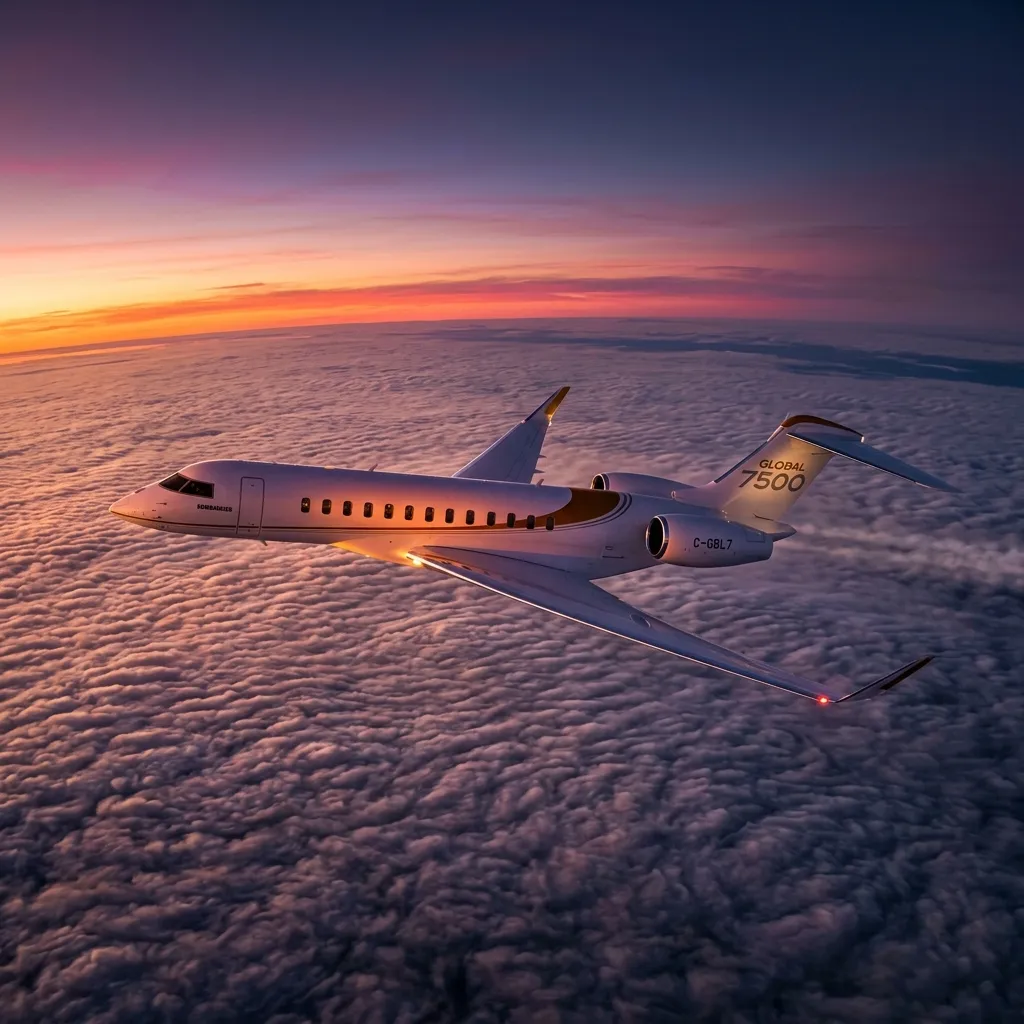
- Sleep quality on long flights: Research from the Journal of the Acoustical Society of America shows that sleep onset time increases by 12 minutes for every 5 dB of ambient noise above 45 dB. A passenger trying to sleep in a 52 dB Global 7500 cabin falls asleep 12 to 15 minutes faster than in a 65 dB Phenom 300.
- Sustained concentration and fatigue: Continuous exposure to noise above 60 dB increases cortisol levels and accelerates mental fatigue. A four-hour flight at 70 dB produces measurably more fatigue than the same duration at 52 dB. For passengers working throughout the flight, the quieter cabin delivers a fresher arrival.
If your primary use case is one-hour flights with two passengers, cabin noise is irrelevant. If your use case is six-hour flights with ongoing work sessions and client calls, cabin noise becomes the specification that determines whether you arrive productive or depleted.