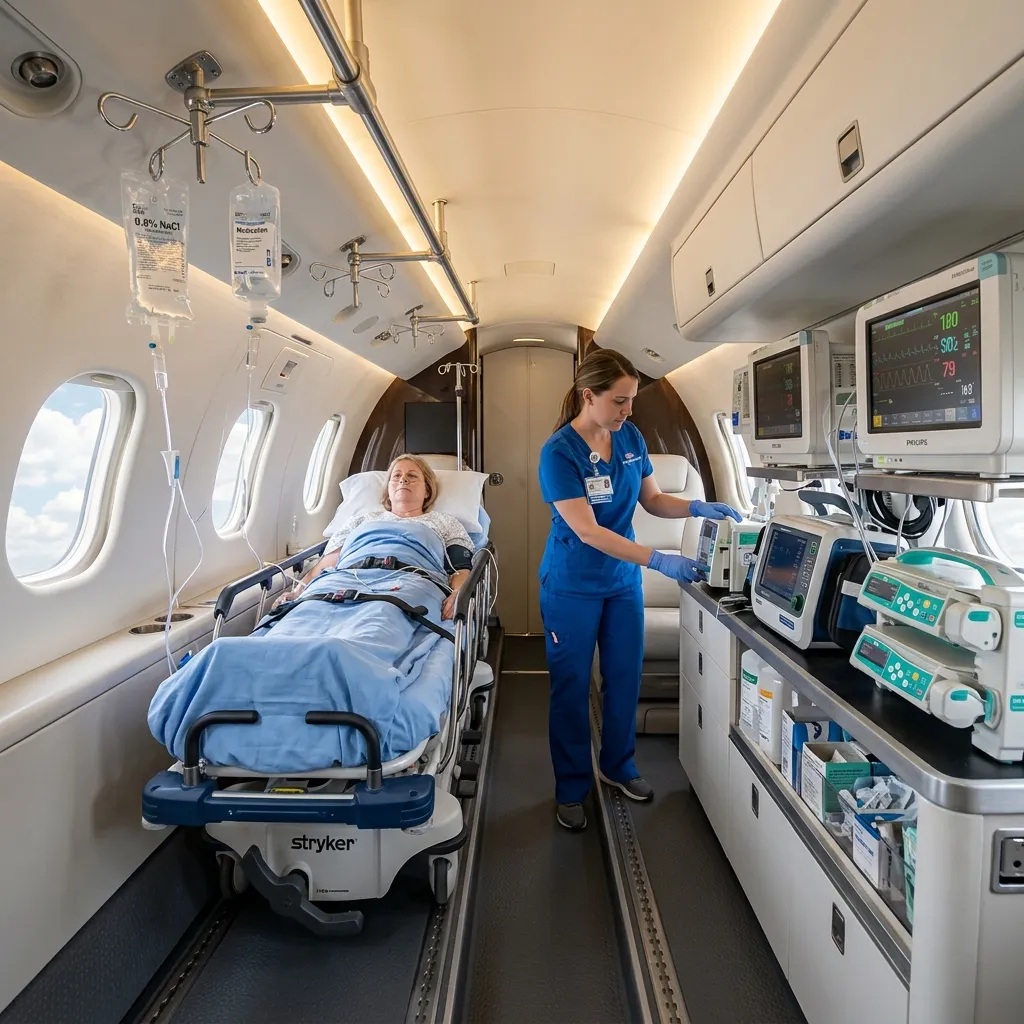
When Commercial Airlines Are Not an Option
Approximately 500,000 non-emergency medical transport flights occur annually in the United States. These are not air ambulance missions with sirens and emergency landings. They are planned patient transfers: a cancer patient flying to MD Anderson for treatment, a stroke recovery patient returning home after rehabilitation, or an elderly family member relocating closer to caregivers. The patients are medically stable but cannot tolerate the conditions of commercial air travel: long security lines, crowded cabins, fixed schedules, seat configurations that do not accommodate mobility limitations, and cabin pressurization profiles that affect certain medical conditions.
Private jet medical transport bridges the gap between ground ambulance and helicopter air ambulance. The patient travels in a controlled cabin environment with medical professionals, supplemental oxygen if needed, and the ability to adjust cabin altitude during flight. Departure and arrival happen on the patient's schedule, not the airline's. The aircraft parks at FBO ramps where ground ambulances or wheelchair vans access the patient directly, eliminating terminal navigation entirely.
Cabin Pressurization and Altitude: The Medical Factor
Business jets pressurize to cabin altitudes of 6,000-8,000 feet at typical cruise altitudes (FL390-FL450). Commercial airlines pressurize to 6,000-8,000 feet under normal conditions, with some newer aircraft (Boeing 787, Airbus A350) achieving lower cabin altitudes of 5,500-6,000 feet. The difference: private jet crews can request lower cruise altitudes from ATC to reduce cabin altitude further, and some aircraft (Citation Latitude, Praetor 600) offer sea-level cabin pressure below FL400.
Cabin altitude matters for patients with pulmonary conditions, recent surgical wounds, cardiovascular disease, sickle cell anemia, and decompression-sensitive conditions. At 8,000 feet cabin altitude, blood oxygen saturation drops from approximately 97% at sea level to 90-93% in healthy adults. For patients with existing respiratory compromise, this drop can trigger hypoxemia. Flying at lower cabin altitudes or with supplemental oxygen mitigates this risk. Private jets offer both options; commercial flights typically offer neither.
$15K-$75K
Typical Flight Cost
8,000 ft
Max Cabin Altitude
24-48 hrs
Typical Lead Time
Medical Crew
Included On Board
Aircraft Configuration for Medical Transport
Dedicated air ambulance operators (Angel MedFlight, AirCARE1, Air Ambulance Worldwide) maintain aircraft with permanent medical interiors: stretcher mounts, IV hangers, medical gas systems, cardiac monitors, and suction units. These aircraft are configured as flying ICUs and carry flight nurse and paramedic teams. For non-emergency transfers where the patient does not require ICU-level monitoring, a standard charter jet with temporary medical modifications can serve the same purpose at 40-60% lower cost.
The most common configuration for non-emergency transport is a midsize or super-midsize jet with one club seat removed to accommodate a portable stretcher, supplemental oxygen system, and a flight nurse seated adjacent to the patient. The remaining seats accommodate family members. This configuration works for patients who are stable but cannot sit upright for extended periods: post-surgical recovery, spinal conditions, advanced cancer, or late-stage mobility limitations.
Need a Charter Quote?
Contact our team for a personalized quote.
Get a Quote →Insurance, Medicare, and Payment Realities
Health insurance coverage for non-emergency air medical transport varies by plan and carrier. Most commercial health insurance policies do not cover non-emergency patient flights unless the treating physician documents that air ambulance transport is medically necessary and that no equivalent treatment facility exists within reasonable ground transport distance. Medicare Part B covers air ambulance services when the patient's condition requires transport by air (medical necessity documentation required), but reimbursement rates often fall 30-50% below actual costs.
- Private health insurance: Coverage varies; pre-authorization required in most cases
- Medicare Part B: Covers air ambulance if medically necessary; patient pays 20% coinsurance
- Medicaid: State-dependent; some states cover air medical transport, others do not
- Air ambulance membership programs: AirMedCare Network, MASA, AMCN cover or reduce patient costs
- Travel insurance: Some policies cover medical evacuation; read exclusions carefully
- Out-of-pocket: Most non-emergency medical flights are paid by the patient or family directly
- No Surprises Act: Applies to emergency air ambulance only, not non-emergency transfers
The financial reality: most non-emergency medical flights are out-of-pocket expenses. Families paying $25,000-$50,000 for a medical transport flight should request detailed invoices, document medical necessity with their physician, and file insurance claims even if pre-authorization was denied. Approximately 15-20% of initially denied claims are reversed on appeal when adequate medical documentation is provided. Air ambulance membership programs ($85-$395 per year) are worth carrying if there is any likelihood of medical transport needs.
Planning a Medical Transport Flight: Timeline and Logistics
Non-emergency medical flights typically require 24-48 hours of advance coordination. The process involves: medical records review by the transport company's medical director, physician-to-physician communication between the sending and receiving facilities, ground ambulance coordination at both ends (FBO ramp to hospital), insurance pre-authorization attempts, aircraft selection based on patient condition and route distance, and crew briefing on patient-specific needs. For straightforward transfers (stable patient, domestic routing), turnaround can be as fast as 12-18 hours.
Bed-to-bed coordination is the operational standard. The transport company arranges ground ambulance from the patient's hospital or residence to the departure FBO, manages the in-flight care, and provides ground ambulance from the arrival FBO to the receiving hospital or residence. This seamless handoff eliminates the family from having to coordinate multiple service providers independently. The transport company assigns a case manager who serves as the single point of contact throughout the process.
- Step 1: Contact transport company with patient diagnosis, current location, and destination
- Step 2: Medical director reviews records and determines transport requirements
- Step 3: Physician-to-physician coordination between sending and receiving doctors
- Step 4: Insurance pre-authorization (if applicable) and payment arrangements
- Step 5: Aircraft and medical crew assigned; ground ambulance booked at both ends
- Step 6: Patient transport day: ground ambulance → FBO → flight → FBO → ground ambulance
- Step 7: Post-transport handoff to receiving medical team with complete transport records