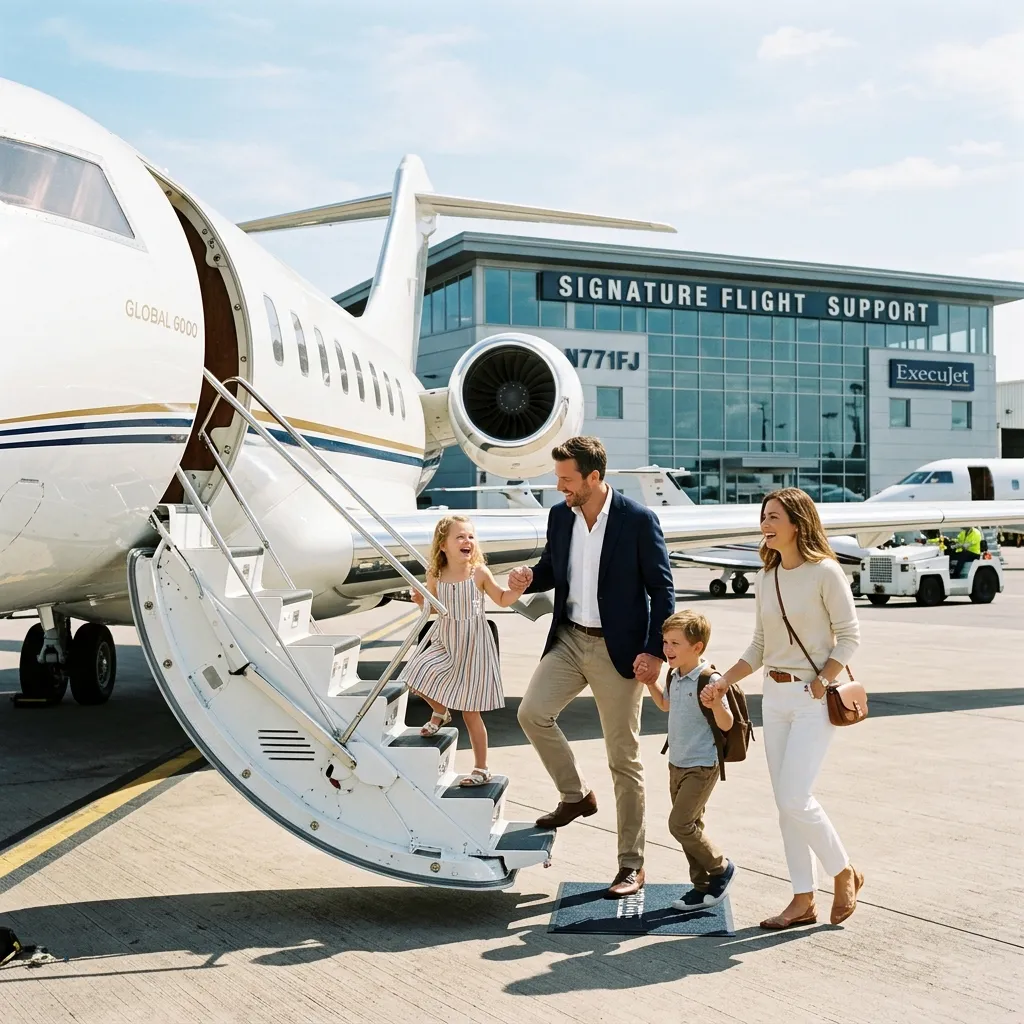
Why Private Makes Sense for Families
The case for private aviation with children is not about luxury. It is about logistics. A family of four with two children under six, traveling commercial from Teterboro to Palm Beach, spends 45 minutes driving to Newark, 90 minutes in security and boarding, 3 hours in flight, and 30 minutes collecting baggage. Total door-to-door: 5.5-6 hours, assuming no delays. The same trip by private jet from Teterboro: 15 minutes at the FBO, 2.5 hours in flight, car meets at the aircraft. Door-to-door: 3.5 hours. The time savings are substantial, but the stress reduction is the real value.
There are no age restrictions on private aviation. Infants, toddlers, and children of any age fly without limitations. There is no lap-infant policy to navigate, no bassinet reservation to compete for, and no adjacent-seat lottery. The entire cabin belongs to your family. If the two-year-old screams for 20 minutes after takeoff, no one is judging you except the pilots behind a closed cockpit door.
15 min
Arrive Before Departure
Flexible
Schedule Around Naps
Car Seats, Bassinets, and Restraint Systems
FAA regulations for private aviation (Part 91 and Part 135) require children under two years old to be held by an adult or secured in an approved child restraint system during takeoff, landing, and turbulence. The regulations do not require car seats for children over two, but experienced operators strongly recommend them for children under 40 pounds. Business jet seats are designed for adult body geometry, and a four-year-old sitting unrestrained in a club seat during unexpected turbulence is a safety risk.
Most charter operators allow passengers to bring their own FAA-approved car seats. The CARES harness system (an FAA-approved alternative to a traditional car seat) works well in business jet cabin seats because it attaches to the existing lap belt without requiring the LATCH system. For infants, some larger jets accommodate airline-type bassinets that mount to forward bulkheads, though availability varies by aircraft type.
Bring the car seat you use in your car. It fits in business jet seats. The CARES harness is the most practical option for families who do not want to carry a full car seat through the FBO. Tell your operator in advance so they confirm compatibility with the aircraft's seat configuration.
Catering and Meals for Children
Standard charter catering accommodates children's preferences, but you need to communicate them. Tell your operator or broker what your children eat, specifically. 'Kid-friendly' is not a useful instruction to a caterer who does not know whether your child eats chicken nuggets or sushi. Provide exact meal requests: peanut butter and jelly on white bread, grapes cut in half, apple juice boxes, goldfish crackers. The more specific you are, the better the result.
Allergies require explicit communication at booking time, not at the aircraft door. Charter operators can source allergen-free catering, but it requires lead time. Nut allergies, dairy sensitivities, and gluten restrictions are manageable with 48-72 hours notice. The aircraft will be cleaned, and catering will be sourced from providers who handle allergen protocols.
- Communicate exact food preferences at booking, not general categories
- Specify allergies in writing at least 48-72 hours before departure
- Bring backup snacks for toddlers who reject unfamiliar food
- Bottles and formula can be warmed on board (confirm galley equipment in advance)
- Juice boxes and pouches travel better than open cups on light jets
Need a Charter Quote?
Contact our team for a personalized quote.
Get a Quote →Entertainment and Activity Planning
Most modern business jets offer Wi-Fi, though connection speed varies from streaming-capable to email-only depending on the aircraft's equipment. Larger jets with Ka-band or Viasat connectivity support tablet streaming. Older aircraft with legacy SwiftBroadband may not support video streaming reliably. Ask your operator about the aircraft's Wi-Fi capability before relying on streaming for children's entertainment.
Download content to tablets before departure. Load movies, shows, games, and music to local storage regardless of the aircraft's Wi-Fi capability. Bring headphones sized for children's ears. Pack coloring books, sticker sheets, and small toys that do not have loose pieces that disappear into seat tracks. For toddlers, bring a favorite stuffed animal or blanket that signals 'rest time' on longer flights.
The cabin layout matters for entertainment management. A club-four configuration allows a parent to sit across from a child, managing activities face-to-face. A forward-facing layout requires turning around to assist. If you are traveling with children under four, request a club-seat configuration when booking.
Scheduling Around Children's Routines
This is the single largest advantage of private aviation for families: you set the departure time. A 2 PM departure that aligns with nap time means the child sleeps through the flight. A 7 PM departure after dinner means the child is fed, tired, and likely to settle quickly. Commercial aviation forces families into airline schedules that rarely align with children's routines. Private aviation inverts that dynamic.
Engine noise and cabin vibration work in your favor. The white noise environment of a turboprop or jet at cruise altitude puts most children under five to sleep within 15-20 minutes. Parents who strategically time departures around nap schedules report that children sleep for 60-80% of flights under three hours.
For international flights with time zone changes, the ability to depart at an unconventional hour reduces jet lag impact on children's sleep cycles. A New York to London departure at 10 PM arrives at 10 AM local time, aligning reasonably with a child's wake cycle. The same trip on a commercial flight at 7 PM creates a more disruptive transition.
What the Crew Handles vs What You Handle
Charter flight crews are professional and accommodating, but they are not childcare providers. The pilots manage the aircraft. If a flight attendant is on board (standard on heavy jets, optional on light and midsize), they handle meal service, cabin temperature, and safety briefings. They will warm a bottle, retrieve a fallen toy, and help manage cabin lighting for sleep. They will not supervise children while parents use the lavatory or nap.
Parents are responsible for children throughout the flight. On light jets without a flight attendant, parents handle all cabin management. Confirm whether your aircraft includes a flight attendant at booking if this is important to your travel experience. Most midsize and all heavy jet charters include at least one cabin crew member.
Ground handling at the FBO is family-friendly by default. FBOs are accustomed to families with children, strollers, car seats, and excessive luggage. The crew will help load car seats onto the aircraft. Ground handlers will transfer strollers to the baggage compartment. The process is seamless if you communicate the equipment list to your operator in advance.