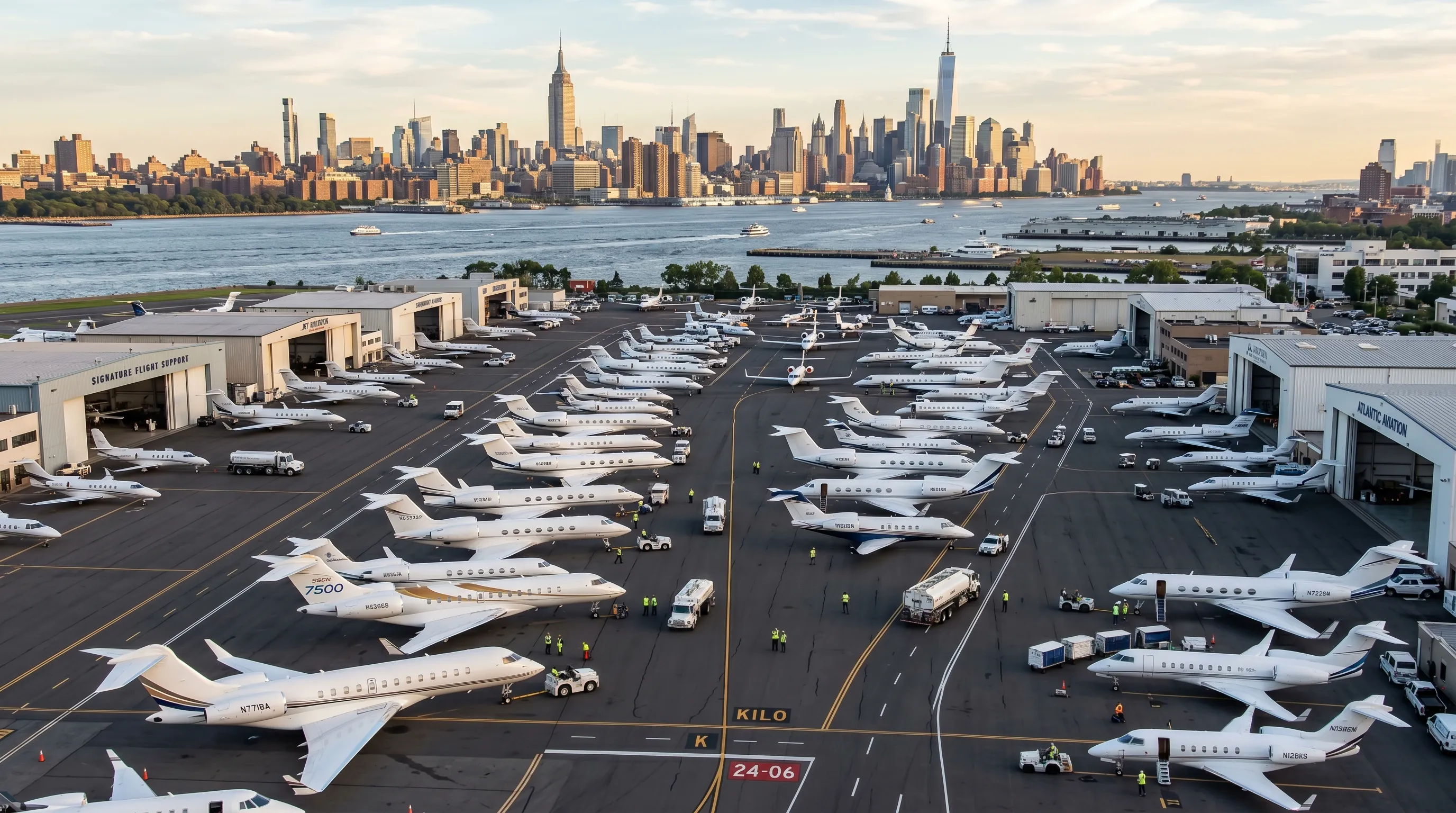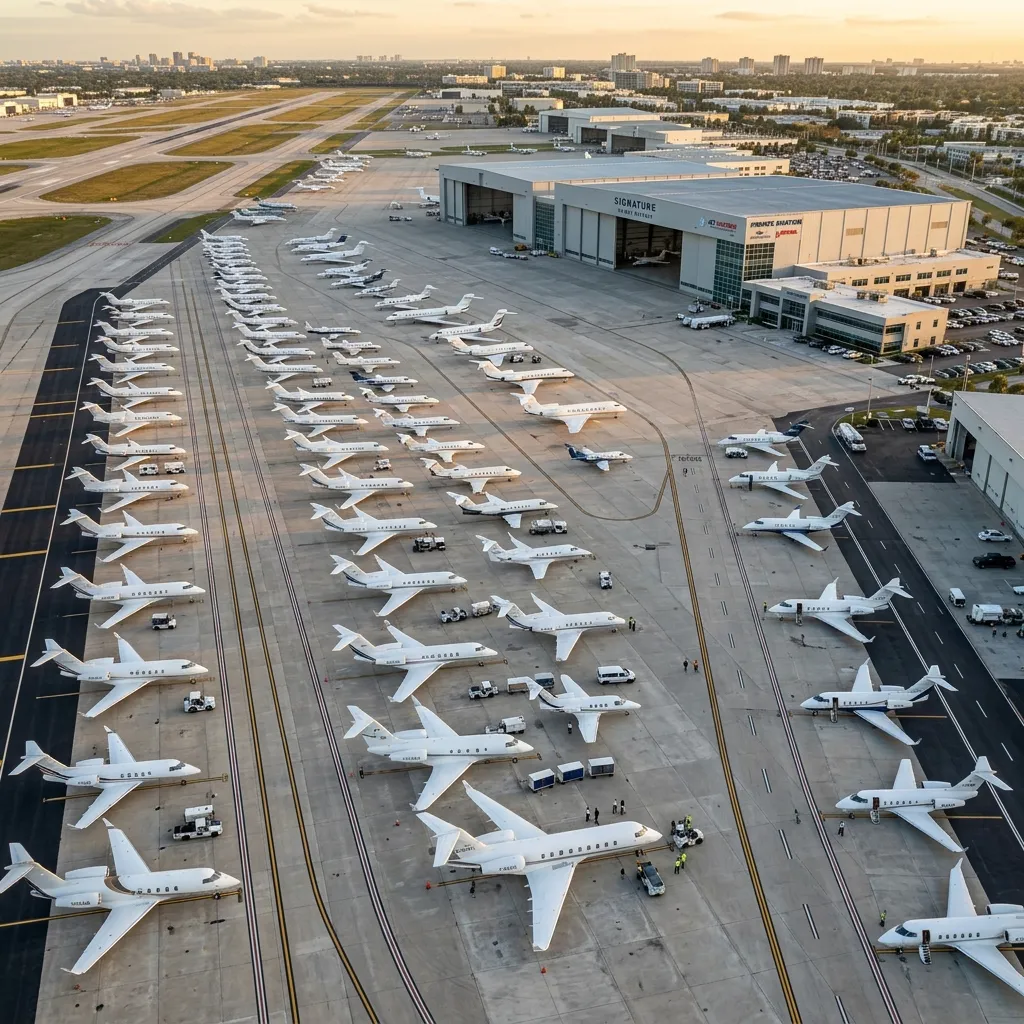
Aerial view of a busy private aviation ramp showing dozens of business jets parked at an FBO

Private Jet Density by Metro Area: Where Business Jets Are Actually Based

The New York metropolitan area, spanning Teterboro (TEB), Westchester (HPN), Morristown (MMU), and Republic (FRG), hosts more than 1,200 registered business jets. South Florida follows with 900+, distributed across Fort Lauderdale Executive (FXE), Opa-locka (OPF), Boca Raton (BCT), and Palm Beach (PBI). These two regions account for approximately 15% of all U.S.-registered business jets despite representing less than 8% of the national population.

In This Article

The Top 15 Metro Areas by Registered Business Jets What Drives Concentration: The Three Factors The Fastest-Growing Markets Markets Losing Jet Density What Density Means for Charter Availability Per-Capita Jet Density: The Real Concentration Story Frequently Asked Questions

The Top 15 Metro Areas by Registered Business Jets

The New York metropolitan area, spanning Teterboro (TEB), Westchester (HPN), Morristown (MMU), and Republic (FRG), hosts more than 1,200 registered business jets, making it the densest private aviation market in the United States. South Florida follows with 900+ jets distributed across Fort Lauderdale Executive (FXE), Opa-locka (OPF), Boca Raton (BCT), and Palm Beach (PBI). These two regions account for approximately 15% of all 22,000+ U.S.-registered business jets despite representing less than 8% of the national population.

The concentration follows predictable economic patterns. New York's dominance reflects Wall Street, hedge fund, and private equity ownership. South Florida combines year-round flying weather with a large population of high-net-worth retirees and real estate entrepreneurs. Dallas-Fort Worth benefits from the energy industry, corporate headquarters (AT&T, American Airlines parent, Texas Instruments), and no state income tax attracting out-of-state wealth.

What Drives Concentration: The Three Factors

1. Owner Wealth Density

The correlation between billionaire concentration and business jet density is nearly 1:1. Forbes data shows New York (135+ billionaires), California (190+ billionaires), Florida (85+ billionaires), and Texas (75+ billionaires) lead both lists. However, per-capita jet density tells a different story. Wyoming has fewer than 100 business jets, but with a population of 576,000, its per-capita jet density (1 jet per 5,760 people) exceeds New York's (1 jet per 16,000 people). Jackson Hole alone concentrates approximately 45 business jets among a permanent population of 11,000.

2. Airport Infrastructure

Metro areas with multiple reliever airports support larger fleets because hangar space distributes across facilities. New York's four primary business aviation airports (TEB, HPN, MMU, FRG) offer approximately 2.5 million square feet of combined hangar space. Markets with a single general aviation airport, like Nashville (BNA/JWN) or Charlotte (CLT/JQF), face hangar waitlists that constrain growth. Hangar availability is the physical bottleneck on fleet size in many metros.

3. Corporate Flight Department Clustering

Corporate flight departments tend to cluster near industry headquarters. Wichita, Kansas hosts Textron Aviation, Spirit AeroSystems, and multiple aviation service providers, resulting in a disproportionate number of business jets for a metro area of 650,000 people. Similarly, Savannah (Georgia) concentrates jets due to Gulfstream's manufacturing and delivery center, where new aircraft complete test flights and customer acceptance from SAV.

The Fastest-Growing Markets

Between 2020 and 2026, the fastest growth in business jet registrations occurred in four metro areas: Austin (estimated 40% growth), Nashville (35% growth), Miami/South Florida (30% growth), and Scottsdale/Phoenix (25% growth). All four markets share two characteristics: high inbound migration of wealthy individuals from higher-tax states and significant new hangar construction during the period.

Austin's growth correlates directly with tech industry expansion and Elon Musk's relocation of Tesla and SpaceX operations to Central Texas. The city added approximately 120 registered business jets between 2020 and 2026, with most new registrations tied to tech founders, venture capital principals, and corporate flight departments relocating from Silicon Valley.

Jet registrations follow wealth migration with a 12-18 month lag. When a principal relocates, the aircraft re-registration paperwork takes months. The owner's address changes first, then the aircraft address catches up.

Need a Charter Quote?

Contact our team for a personalized quote.

Get a Quote

Markets Losing Jet Density

San Francisco and Silicon Valley have seen a net decline in registered business jets since 2020, despite continued wealth creation. The migration of tech founders to Austin, Miami, and Tahoe reduced Bay Area registrations by an estimated 8-12%. The jets did not disappear; they re-registered at the owner's new primary address.

Connecticut's Fairfield County (home to Greenwich hedge funds) has also seen slight declines as fund managers relocate to South Florida. The Teterboro-Westchester corridor still dominates, but the growth rate has stalled as new registrations in Palm Beach and Naples absorb departing Connecticut principals.

Northeast seasonal patterns amplify the data. Many business jets registered in Florida spend May through October operating from Northeast airports. The registration address is Florida (for tax purposes), but the aircraft is physically based at Teterboro or Westchester for half the year. This creates an optical inflation of Florida density and a corresponding deflation of Northeast density that does not reflect actual aircraft utilization patterns.

What Density Means for Charter Availability

High jet density directly correlates with charter availability and pricing. Markets with 500+ registered jets (New York, South Florida, Dallas, Los Angeles, Houston) have the deepest charter inventory, the most competitive pricing, and the highest probability of empty leg availability. A one-way charter from Teterboro to South Florida produces an empty leg in one direction, creating $4,000-$8,000 deals on a route that normally costs $15,000-$22,000.

Conversely, markets with fewer than 100 registered jets (Boise, Albuquerque, Reno, Memphis) face positioning fee premiums because the nearest available charter aircraft may be 200-400 nm away. A charter originating in Boise may incur $3,000-$5,000 in positioning costs because the operator bases its fleet in Salt Lake City or Seattle.

Per-Capita Jet Density: The Real Concentration Story

Raw jet counts favor large metros. Per-capita density reveals different leaders. Wyoming has fewer than 100 registered business jets, but with a population of 576,000, its density is 1 jet per 5,760 residents. Jackson Hole alone concentrates approximately 45 business jets among a permanent population of 11,000, producing a density of 1 jet per 244 residents, the highest in the nation.

Nantucket, Massachusetts (population 14,000, approximately 25 based jets) and Aspen, Colorado (population 7,400, approximately 30 based jets) produce similarly extreme per-capita ratios. These resort communities attract seasonal wealth that distorts the numbers, but the concentration is real: during peak season, Aspen-Pitkin County Airport (ASE) processes more daily business jet operations than airports serving metro areas 50 times larger.

The per-capita lens also reveals underserved markets. Memphis (population 1.3 million, approximately 80 jets) and Cleveland (population 2.1 million, approximately 90 jets) have per-capita densities below the national average despite significant corporate presence. FedEx dominates Memphis aviation but operates Part 121, not business jets. Cleveland lost corporate flight departments as Fortune 500 headquarters relocated. These markets represent potential charter growth opportunities because demand exists but local supply does not.

Brian Galvan

Written By

Brian Galvan

Founder, The Jet Finder ยท Private Aviation Operations & Technology

Former Director of Technology at FlyUSA (Inc. 5000 fastest-growing private jet company). Decade of hands-on experience across Part 135 operations, charter sales, fleet management, and aviation data systems.

LinkedInRead Full Profile →
Common Questions

Frequently Asked Questions


6 questions about private jet density and distribution across U.S. metropolitan areas

The New York metropolitan area leads with more than 1,200 registered business jets, distributed across Teterboro (TEB), Westchester County (HPN), Morristown (MMU), and Republic (FRG). South Florida ranks second with 900+ jets, followed by Dallas-Fort Worth (750+), Los Angeles (700+), and Houston (650+). These five metro areas account for approximately 30% of all U.S.-registered business jets.

Florida has no state income tax and no annual personal property tax on aircraft (unlike California, New York, and Texas, which impose annual ad valorem taxes on aircraft ranging from 0.5% to 2% of assessed value). An owner registering a $50 million G650 in Florida avoids $250,000-$1,000,000 in annual state tax versus registering in a high-tax state. This tax advantage, combined with year-round flying weather and proximity to Caribbean destinations, drives approximately 40% of new jet registrations to Florida addresses regardless of where the owner primarily lives.

Austin, Nashville, Miami, and Scottsdale/Phoenix have grown fastest between 2020 and 2026. Austin added approximately 120 new jet registrations (40% growth), driven by tech industry migration from Silicon Valley. Nashville grew 35%, fueled by healthcare industry expansion and entertainment wealth. All four markets benefit from low or zero state income tax and aggressive hangar construction programs.

High-density metro areas have more charter inventory, more competition among operators, and more empty leg availability, all of which reduce pricing. A one-way charter departing Teterboro or Van Nuys typically costs 15-25% less than the same aircraft type departing a low-density market like Boise or Albuquerque, primarily because positioning fees are lower when the aircraft is based nearby. Empty legs on high-traffic routes (TEB-PBI, VNY-LAS) can reduce one-way pricing by 50-70%.

Not always. Many business jets are registered to the owner's legal address (often Florida or Texas for tax benefits) but physically operate from a different location for much of the year. A jet registered in Palm Beach may spend May through October based at Teterboro, returning to Florida only for the winter season. Registration data reveals ownership patterns but can overstate density in tax-favorable states and understate it in high-tax states where jets physically spend significant operating time.

Hangar availability is the primary physical constraint. Metro areas like Nashville, Austin, and Charlotte have growing demand but limited GA airport infrastructure. Hangar waitlists at Addison (ADS) in Dallas and Centennial (APA) in Denver run 2-3 years. New hangar construction takes 18-24 months from permitting to completion. Some airports like Santa Monica (SMO) have permanently closed, eliminating capacity entirely. The jet demand exists; the infrastructure often does not.

Continue Reading

Related Articles


Your Next Mission

Ready to Fly?


Whether you need a charter quote or want to explore aircraft options, our team is here.

Contact Us