Why the Right Airport Matters More Than the Right Jet
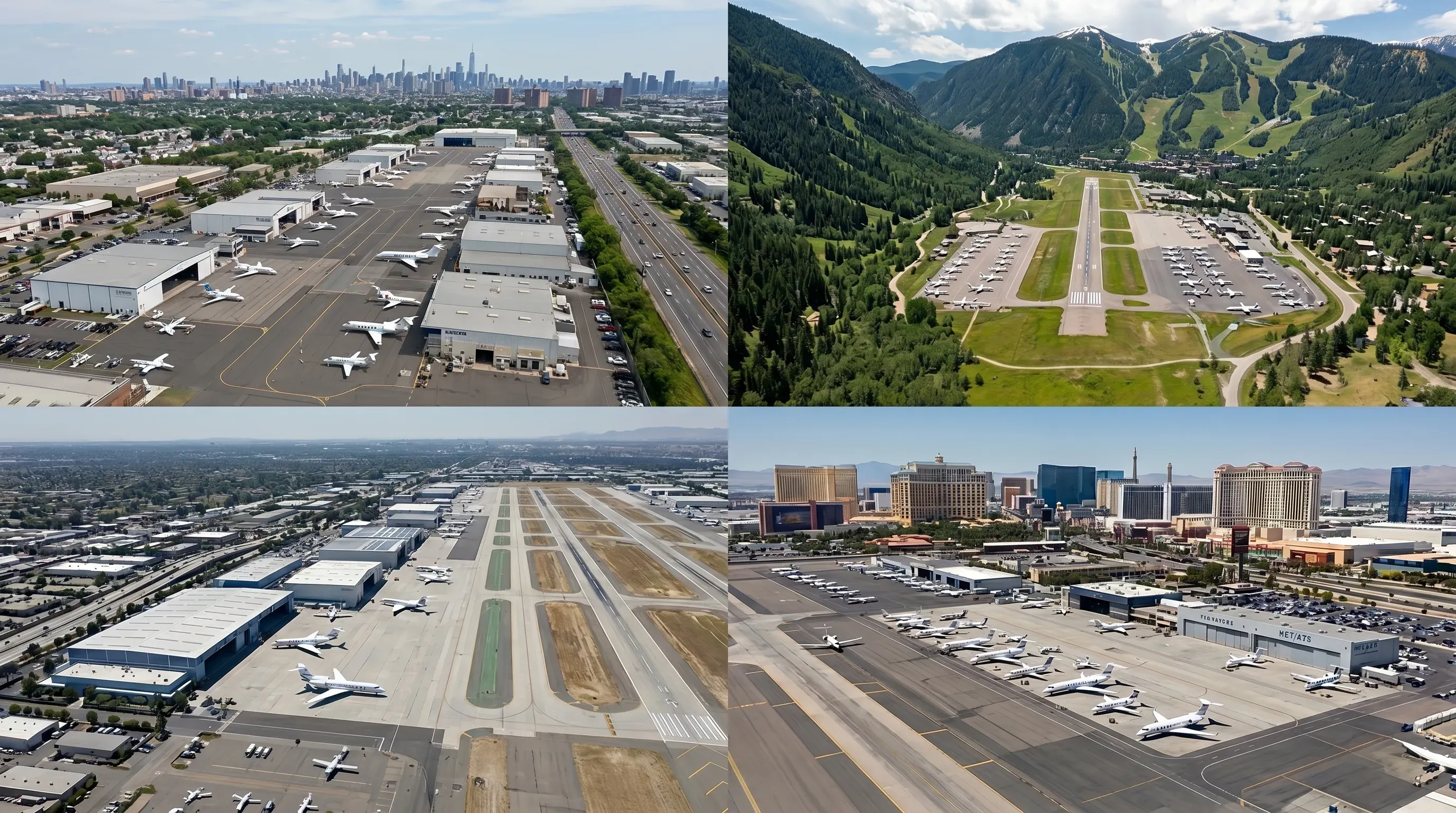
There are 5,080 public-use airports in the United States, but only approximately 520 handle regular business jet traffic. The airport you choose determines your ground time, FBO experience, fuel cost, and total door-to-door travel time. Selecting the wrong airport can add 60-90 minutes of driving to a trip that was supposed to save time versus commercial service. Every major U.S. metro area has between 2 and 8 airports that accept private jets, and each has different strengths.
This guide covers the primary private aviation airports serving the 30 largest U.S. metropolitan areas. For each city, we identify the airports by ICAO/FAA code, runway length, FBO count, approximate distance to the city center, and the specific advantages or limitations that affect charter passengers.
Northeast Corridor
New York City
Teterboro (TEB): The default New York private jet airport, 12 miles from Midtown Manhattan. Three FBOs (Jet Aviation, Signature, Atlantic). Slot-controlled with landing fees of $300-$800. Weight limit of 100,000 lbs MTOW prohibits Boeing BBJ and some G650ER configurations. Best for: Manhattan, northern New Jersey.
Westchester County (HPN): 33 miles north of Midtown, no slot restrictions, nighttime curfew (midnight to 6:30 AM). Best for: Westchester, Connecticut, northern suburbs. Republic (FRG): Long Island option, 42 miles east of Manhattan, no weight restrictions. Best for: Long Island, Hamptons connections.
Boston
Hanscom Field (BED): 18 miles northwest of downtown Boston, two FBOs (Signature, Rectrix), 7,001-ft runway. The primary private aviation airport for Greater Boston. Bedford is closer to the Route 128 tech corridor than Logan. Lawrence Municipal (LWM) and Norwood Memorial (OWD) serve as secondary options for smaller aircraft.
Washington, D.C.
Dulles (IAD): The only major D.C.-area airport with a dedicated GA terminal and no security restrictions beyond standard screening. 25 miles from the Capitol. Manassas Regional (HEF): 30 miles west, lower fees, 6,200-ft runway. College Park (CGS): Closest to D.C. but limited to small aircraft (2,600-ft runway). Reagan National (DCA) restricts all general aviation due to security zones.
Southeast and Florida
Miami
Opa-locka Executive (OPF): 15 miles north of downtown Miami, four FBOs, three runways (the longest at 8,002 ft). Handles more business jet operations than any other airport in South Florida. Fort Lauderdale Executive (FXE): 30 miles north, two FBOs, 6,002-ft runway. Both airports offer U.S. Customs for international arrivals.
Atlanta
DeKalb-Peachtree (PDK): 10 miles northeast of downtown, 6,001-ft runway, two FBOs. The primary GA airport for metro Atlanta. Handles approximately 180,000 operations annually, making it one of the busiest GA airports in the Southeast. Fulton County (FTY): 8 miles west of downtown, 5,798-ft runway. Cobb County (RYY) and Gwinnett County (LZU) serve as overflow.
Palm Beach and Naples
Palm Beach International (PBI): 3 miles west of Palm Beach, dedicated GA facilities despite commercial service. Seasonal surge December through April doubles traffic. Naples Municipal (APF): 2 miles north of downtown, 6,600-ft runway, primary access for Southwest Florida's Gulf Coast communities. Marco Island, Bonita Springs, and Estero are all within 30 minutes of APF.
Need a Charter Quote?
Contact our team for a personalized quote.
Get a Quote →Central and Mountain West
Dallas-Fort Worth
Dallas Love Field (DAL): 6 miles from downtown, commercial and GA operations coexist. Business aviation uses the Signature and Business Jet Center FBOs on the east side. Addison Airport (ADS): 13 miles north, dedicated GA airport with 7,202-ft runway and four FBOs. The preferred charter airport for northern Dallas and Plano. Fort Worth Meacham (FTW): West side access.
Denver
Centennial Airport (APA): 15 miles south of downtown, three FBOs, two runways (the longest at 10,002 ft). Centennial handles approximately 250,000 annual operations and is the third-busiest GA airport in the United States. Rocky Mountain Metropolitan (BJC): 12 miles northwest, 9,000-ft runway, less congested alternative. Both airports sit at approximately 5,800 ft elevation.
Phoenix-Scottsdale
Scottsdale Airport (SDL): 10 miles northeast of Phoenix, 8,249-ft runway, nighttime curfew (10:30 PM to 7:00 AM). The preferred airport for Paradise Valley, North Scottsdale, and resort destinations. Phoenix Deer Valley (DVT): Northwest Phoenix access. Phoenix-Mesa Gateway (IWA): East Valley alternative with no curfew and lower fees.
West Coast
Los Angeles
Van Nuys (VNY): The busiest general aviation airport in the world with approximately 250,000 annual operations. Located in the San Fernando Valley, 20 miles from downtown LA. Five FBOs including Signature, Clay Lacy, and Castle & Cooke. Runway 16R/34L at 8,001 ft handles all business jet types. Burbank (BUR) and Santa Monica (SMO, now closed to jets) serve as alternatives. John Wayne (SNA) serves Orange County.
San Francisco Bay Area
Oakland (OAK): 10 miles from downtown SF via Bay Bridge, dedicated GA facilities on the north field. The primary private aviation option for San Francisco proper. San Jose (SJC): 45 miles south, serves Silicon Valley with Signature and Atlantic FBOs. Hayward Executive (HWD): East Bay alternative for smaller aircraft. Half Moon Bay (HAF): Coastal approach, 5,000-ft runway, limited to light jets and turboprops.
Seattle
Boeing Field (BFI): 5 miles south of downtown Seattle, 10,000-ft runway, primary GA airport for the metro area. Paine Field (PAE): 28 miles north in Everett, closer to tech campuses in the northern corridor. Both airports handle all aircraft types. BFI's proximity to downtown and multiple FBO options make it the default for most charter operations.
Choosing Between Multiple Airport Options
When a metro area has multiple private aviation airports, selection should be based on four factors in order of priority:
- Proximity to final destination: The airport closest to where you are actually going, not the city center
- Runway length: Ensure the airport can accommodate your aircraft type at the expected operating weight
- FBO quality and fuel pricing: Fuel cost differences between airports in the same metro can reach $1.50-$2.00 per gallon
- Operating hours and curfews: Confirm the airport is open when you plan to arrive and depart
Your charter operator or broker should recommend the optimal airport based on your specific itinerary. If they default to the most obvious airport without asking where you are heading after landing, they are not optimizing your trip. The difference between the right and wrong airport in a major metro area can be 30-60 minutes of ground time each way.