Same Category, Different Ambitions
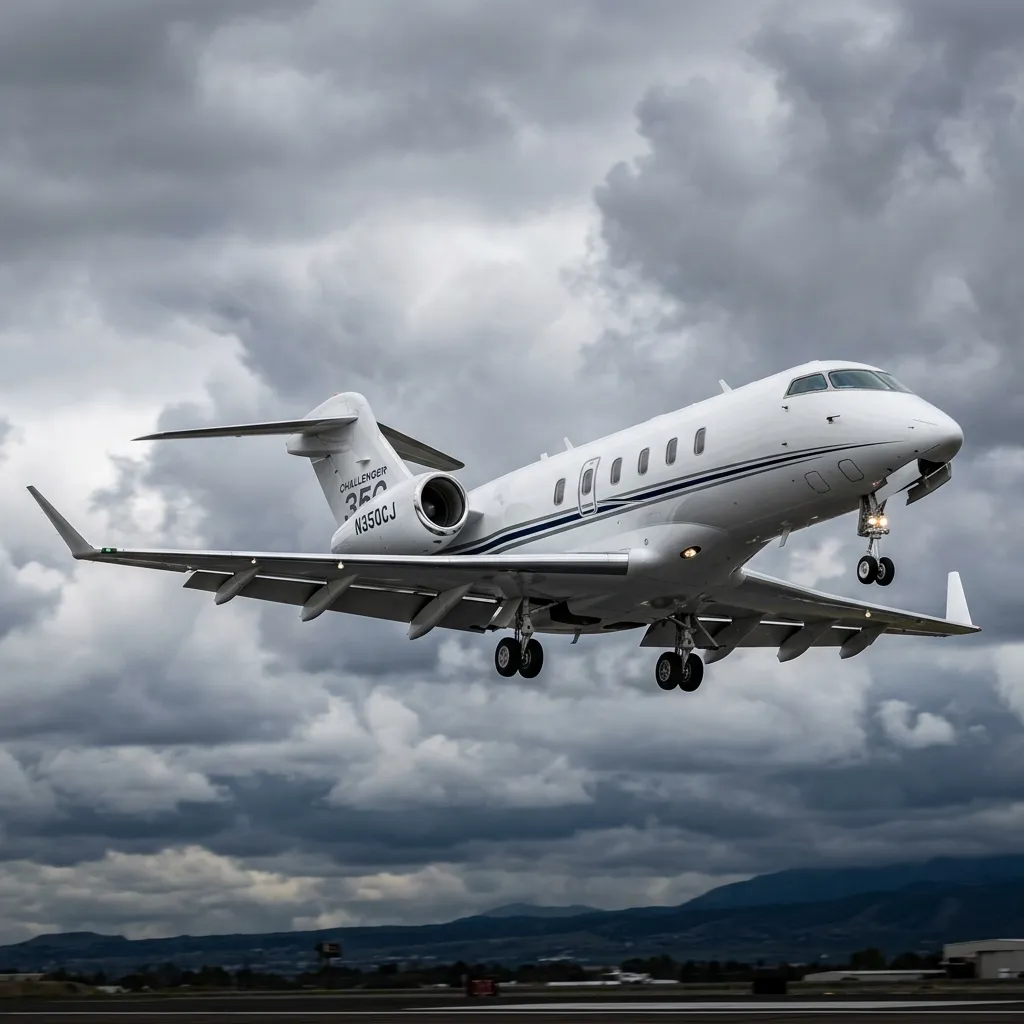
The Embraer Praetor 600 and Bombardier Challenger 350 both sit in the super-midsize category, both carry 8-12 passengers, and both charter for roughly $4,200-$5,800 per flight hour. That is where the similarities end. The Praetor 600 was engineered as a range machine: 4,018 nm with NBAA IFR reserves puts it in a class closer to heavy jets than traditional super-mids. The Challenger 350 was engineered as a cabin machine: its 7.2-foot-wide fuselage is the widest in the category and feels closer to a large-cabin jet than anything else at its price point.
This is not a comparison where one jet wins and the other loses. It is a comparison where your mission profile picks the winner for you. If you need to fly New York to London nonstop with eight passengers and moderate winds, the Praetor 600 can do it. The Challenger 350 cannot. If you need the widest possible cabin for a four-hour domestic flight, the Challenger 350 wins. The Praetor 600's 6.9-foot cabin width is excellent, but three inches narrower at shoulder height.
Specifications Head to Head
On paper, the Praetor 600 wins nearly every measurable category except cabin width and height. But paper specs miss context. The Challenger 350's 7.2-foot width creates a cabin cross-section that allows four passengers to sit facing each other in a club arrangement without knee contact. The Praetor 600's narrower but longer cabin compensates with a more spacious aft galley and larger lavatory. Different priorities, different strengths.
Range: Where the Praetor 600 Changes the Conversation
The 818-nm range gap between these two jets is not marginal. It is the difference between making New York to London nonstop and stopping in Goose Bay, Labrador for fuel. The Praetor 600 at 4,018 nm can fly KTEB to EGGW (Luton) with NBAA IFR reserves under typical winter westbound wind conditions. The Challenger 350 at 3,200 nm needs a fuel stop. That stop adds 90 minutes of flight time, $8,000-$12,000 in landing and handling fees, and a crew rest calculation that may push your arrival to the next day.
For domestic U.S. operations, this gap rarely matters. Both jets cover Los Angeles to New York, Miami to Seattle, and Chicago to San Juan without issue. The range advantage shows on transatlantic, transcontinental-with-headwinds, and South American missions. If your travel pattern stays within the continental U.S. and Caribbean, the Challenger 350's range is sufficient and its cabin width becomes the deciding factor.
The Praetor 600's range puts it in direct competition with jets one category above it. At 4,018 nm, it matches the Gulfstream G450 and Challenger 604, both heavy jets that cost $6,000-$8,000 per flight hour. If range is the primary requirement, the Praetor 600 delivers heavy-jet capability at super-midsize pricing. That is its singular sales pitch, and it is a strong one.
Need a Charter Quote?
Contact our team for a personalized quote.
Get a Quote →Cabin Experience: Three Inches That Matter
The Challenger 350's cabin is 7.2 feet wide and 6.1 feet tall. The Praetor 600 measures 6.9 feet wide and 6.0 feet tall. On a spec sheet, these differences appear trivial. In the cabin, they are not. The Challenger 350's width allows for wider individual seats (approximately 22 inches versus 20.5 inches in the Praetor), a more generous aisle, and a cross-section that feels closer to a large-cabin Gulfstream than a midsize Cessna.
The Praetor 600 counters with a longer cabin (27.5 feet versus 25.2 feet) and significantly more baggage volume (150 cubic feet versus 106). For passengers who prioritize legroom, a full-size aft lavatory, and the ability to bring golf bags, ski equipment, or large luggage without compromise, the Praetor wins. For passengers who care about seat width and shoulder room on four-hour flights, the Challenger wins.
Both jets offer flat-floor cabins with stand-up headroom for anyone under 6'1". Both offer in-flight connectivity. The Praetor 600 uses Viasat Ka-band with residential-speed Wi-Fi. The Challenger 350 offers GoGo AVANCE L5 or optional Ka-band. Neither cabin is cramped. The question is which dimension matters more for your typical passenger group.
Charter Availability and Fleet Size
The Challenger 350 dominates charter fleet availability. Bombardier has delivered over 400 Challenger 350/3500 aircraft since 2014, and the model is the most popular super-midsize jet on Part 135 certificates in the United States. Major operators including NetJets, Flexjet, and independent charter companies fly Challenger 350s. Finding one on short notice (24-48 hours) is realistic on most domestic routes.
The Praetor 600 fleet is younger and smaller. Embraer has delivered approximately 80-90 Praetor 600s since 2019. Fewer are on Part 135 certificates, and availability on the open charter market is more limited. Lead times of 3-5 days are typical. On international routes where the Praetor 600's range is the deciding factor, operators may need 7-10 days to position the aircraft.
If availability matters as much as specs, the Challenger 350 wins by volume. Three times the fleet size means three times the probability of finding one on your preferred date and route. The Praetor 600 is the better aircraft on paper, but the Challenger 350 is the easier aircraft to actually book.
The Verdict: Mission Decides
Choose the Praetor 600 if your missions regularly exceed 3,000 nm, if you need transatlantic capability without a fuel stop, if baggage volume matters, or if you value range over cabin width. The Praetor 600 is the right jet for clients who would otherwise charter a heavy jet and want to save $2,000-$3,000 per flight hour.
Choose the Challenger 350 if your missions stay under 3,000 nm, if cabin width is a priority for your passenger profile, if you need short-notice availability, or if you prefer the aircraft with the deepest operator bench and most consistent maintenance network. The Challenger 350 is the right jet for domestic and Caribbean operations where reliability and availability outweigh raw range.
Neither jet is the wrong choice. Both are excellent super-mids built for different mission profiles. The mistake is chartering either one without understanding which mission profile you actually fly.