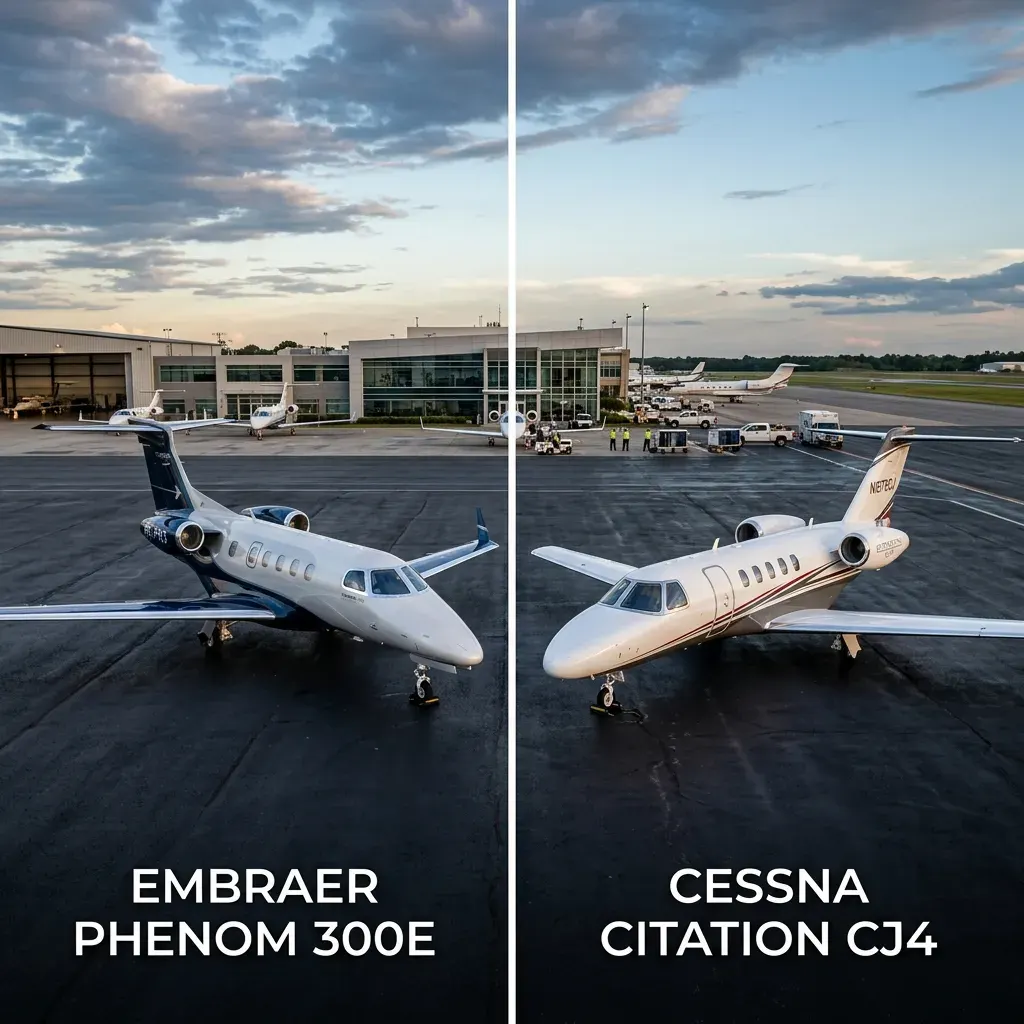
The Phenom 300E is faster by 13 knots in max cruise. The CJ4 Gen2 flies 155 nm farther. These differences are meaningful on paper and marginal in practice. On a 1,000 nm flight, the Phenom arrives 5 minutes sooner. On a 1,800 nm mission, the CJ4 makes it nonstop while the Phenom may need a fuel stop depending on winds and payload. Both aircraft reach FL450, which puts them above most weather and airline traffic.
The Phenom's shorter takeoff and landing distances give it access to roughly 200 more airports in the U.S. than the CJ4. This matters in mountain markets (Aspen, Telluride, Eagle) and island destinations (Nantucket, St. Barths) where every foot of runway counts. The CJ4's Williams engines produce more thrust per engine but the aircraft's higher approach speed requires more pavement.
Cabin Comparison
The Phenom 300E's cabin is 3 inches wider than the CJ4 Gen2. That does not sound like much until you sit in both back-to-back. The wider cabin allows for slightly larger seats, more elbow room in the club configuration, and a cabin that feels less tubular. Embraer's interior design team leveraged the company's commercial airline experience to create a cabin that punches above its class in perceived spaciousness.
The CJ4 Gen2 counters with Cessna's latest interior package, which includes redesigned seats, improved LED lighting, and wireless charging. The CJ4's cabin is functional and well-finished, but it does not generate the same initial impression as the Phenom's sculpted sidewalls and integrated technology panel. Both aircraft offer enclosed lavatories with belted seats, a feature that distinguishes them from smaller light jets in the CJ2/CJ3 range.
Operating Economics
Annual operating costs are within 1% of each other at 400 flight hours per year. The Phenom burns less fuel but carries higher maintenance costs due to Embraer's parts pricing and the Garmin Prodigy Touch avionics suite's component costs. The CJ4's Williams FJ44 engines have a strong reputation for reliability and lower per-cycle maintenance, partially offsetting the higher fuel burn.
Charter rates for both aircraft fall in the $3,800 to $4,800 per hour range. Operators report similar revenue per block hour. The Phenom commands a slight premium in markets where passengers specifically request it by name, which happens more frequently than with the CJ4. Brand recognition matters in charter: Embraer's marketing has made the Phenom 300 series one of the most recognized names in private aviation.
Fly Either Aircraft
Both the Phenom 300E and CJ4 Gen2 are available for charter through our operator network.
Get a Quote →Avionics and Pilot Perspective
The Phenom 300E uses the Garmin Prodigy Touch (based on Garmin G3000) flight deck with three 14.1-inch touchscreen displays. The CJ4 Gen2 uses the Collins Aerospace Pro Line 21 Advanced with four displays. Both are fully integrated EFIS systems with synthetic vision, ADS-B In/Out, CPDLC, and LPV approach capability. Pilots transitioning between the two report that the Garmin is more intuitive for single-pilot operations while the Collins system is more familiar to pilots coming from larger aircraft.
Both aircraft are approved for single-pilot operations under Part 91, though most charter operators staff them with two pilots for Part 135 compliance and insurance requirements. The CJ4 Gen2's autothrottle system, which the base CJ4 lacked, was a significant improvement in the Gen2 update and reduces pilot workload during approach and departure phases. Cessna's decision to add autothrottle addressed the most common complaint from original CJ4 operators and brought the aircraft to feature parity with the Phenom on the flight deck.
Resale and Market Position
Pre-owned Phenom 300 and 300E aircraft hold value exceptionally well. A 2019 Phenom 300E with 1,200 hours trades at $8.5 to $9.5 million, representing 75 to 85% value retention after 7 years. The CJ4 holds value at a similar percentage but from a lower starting point: a 2019 CJ4 with comparable hours trades at $7.0 to $8.0 million.
Market liquidity favors the Phenom. More Phenom 300 series aircraft trade annually than CJ4s, and time-on-market for used Phenoms averages 4 to 6 months versus 6 to 9 months for used CJ4s. Buyers searching in the light jet segment encounter more Phenom inventory because Embraer has delivered more units: over 700 Phenom 300/300E aircraft versus approximately 300 CJ4/CJ4 Gen2 aircraft.
Mission Profiles: Where Each Aircraft Excels
The Phenom 300E is the stronger choice for owner-pilots who want Garmin familiarity, shorter runway access, and the highest resale value in the light jet segment. It excels on 800 to 1,500 nm missions with 4 to 6 passengers, particularly routes involving mountain or island airports where its shorter ground roll provides genuine operational advantage.
The CJ4 Gen2 is the stronger choice for operators and owners who prioritize range on a single fuel load. Its 2,165 nm NBAA IFR range opens transcontinental missions that the Phenom cannot complete nonstop. Corporate flight departments with frequent East Coast to Mountain West routing find the CJ4's range reduces fuel stop frequency by 30 to 40% compared to the Phenom on westbound legs against prevailing winds.
For charter passengers, the choice is often made by the operator rather than the customer. Both aircraft deliver similar cabin experiences on flights under 3 hours. The meaningful differentiation appears on longer missions where the CJ4 eliminates a fuel stop, or on short-field routes where the Phenom accesses airports the CJ4 cannot. When requesting a light jet charter, specifying your preferred model ensures you get the aircraft that matches your specific routing requirements rather than whatever the operator has available.