What Makes an Airport of Entry
An Airport of Entry (AOE) is a U.S. airport where Customs and Border Protection officers are stationed or available to process international arrivals. The distinction matters because private jets arriving from outside the United States must land at a designated AOE before proceeding to their final domestic destination. Land at a non-AOE airport on an international flight plan, and you are looking at a federal violation, potential aircraft seizure, and fines starting at $5,000.
CBP designates airports at two levels. Full-service AOEs have permanent CBP staffing during published hours. Landing rights airports have CBP services available by advance arrangement, typically requiring 24 to 72 hours notice. Both handle private jet arrivals. The practical difference is scheduling flexibility: full-service AOEs accept arrivals during business hours without prior arrangement, while landing rights airports need confirmed appointments.
Key Airports of Entry by Region
South Florida dominates international general aviation arrivals. OPF, FXE, PBI, and MIA collectively process thousands of private jet entries per year from the Caribbean, Bahamas, and Latin America. The proximity to the Bahamas (35 nm from Fort Lauderdale to Nassau) makes international flying routine for South Florida operators.
eAPIS Filing: The Non-Negotiable
Every private jet arriving in or departing from the United States on an international flight must file an electronic Advance Passenger Information System (eAPIS) manifest with CBP. Filing must occur at least 60 minutes before departure. Most operators file 24 hours in advance to avoid last-minute system errors.
The eAPIS manifest includes full name, date of birth, citizenship, passport number, and travel document expiration for every person aboard, including crew. Missing or incorrect data triggers CBP holds on arrival. Passport numbers transposed, middle names omitted, or crew members added after filing are common errors that delay clearance.
Filing Mechanics
Operators file through the CBP's APIS system at eapis.cbp.dhs.gov. Flight management companies and dispatch services handle filing for most charter operations. The system generates a confirmation number that crew must have available on arrival. No confirmation number means the arrival was not filed, which means CBP has no record of the aircraft, which means the crew is explaining the situation on the ramp while everyone waits.
eAPIS filing is the one thing in international private jet operations that cannot be fixed with money after the fact. Miss the filing, and the consequences are immediate and public. Experienced operators treat it with the same gravity as a flight plan.
What Happens When You Land
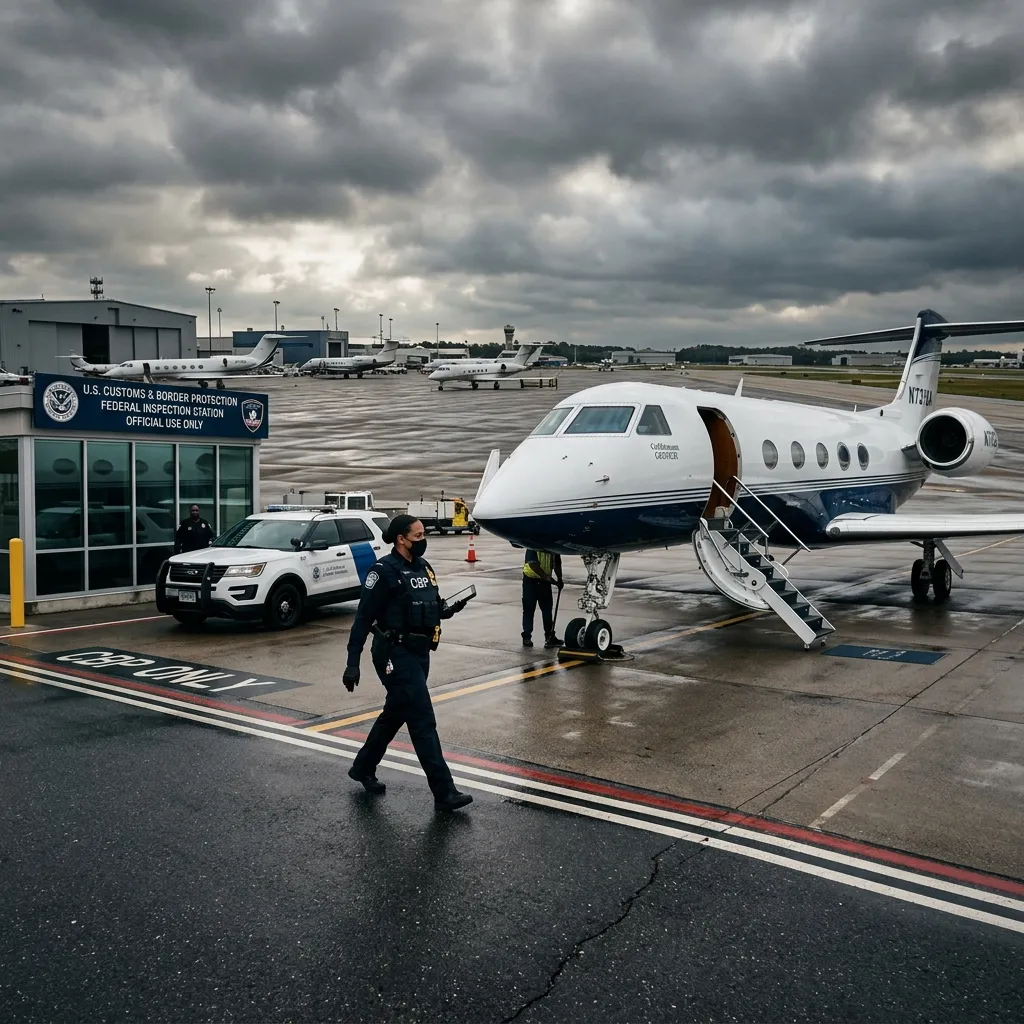
The aircraft taxis to the designated CBP inspection area, typically a specific ramp or FBO area designated for international arrivals. All passengers and crew remain aboard or within the inspection area until cleared. CBP officers board the aircraft, verify passports against the filed eAPIS manifest, and conduct a customs declaration review.
Total clearance time for a straightforward private jet arrival is 15 to 45 minutes. Aircraft with agricultural declarations, large quantities of purchased goods, or passengers with secondary inspection flags take longer. Flights arriving from countries on CBP's enhanced screening list may undergo more thorough inspection including canine screening of luggage and cabin.
Fees and Charges
The APHIS (Animal and Plant Health Inspection Service) user fee is $39.50 per arrival for private aircraft. The customs user fee is $27.50 per person. Both are typically included in the FBO's handling invoice. Some airports assess additional international arrival facility fees ranging from $100 to $500 per movement.