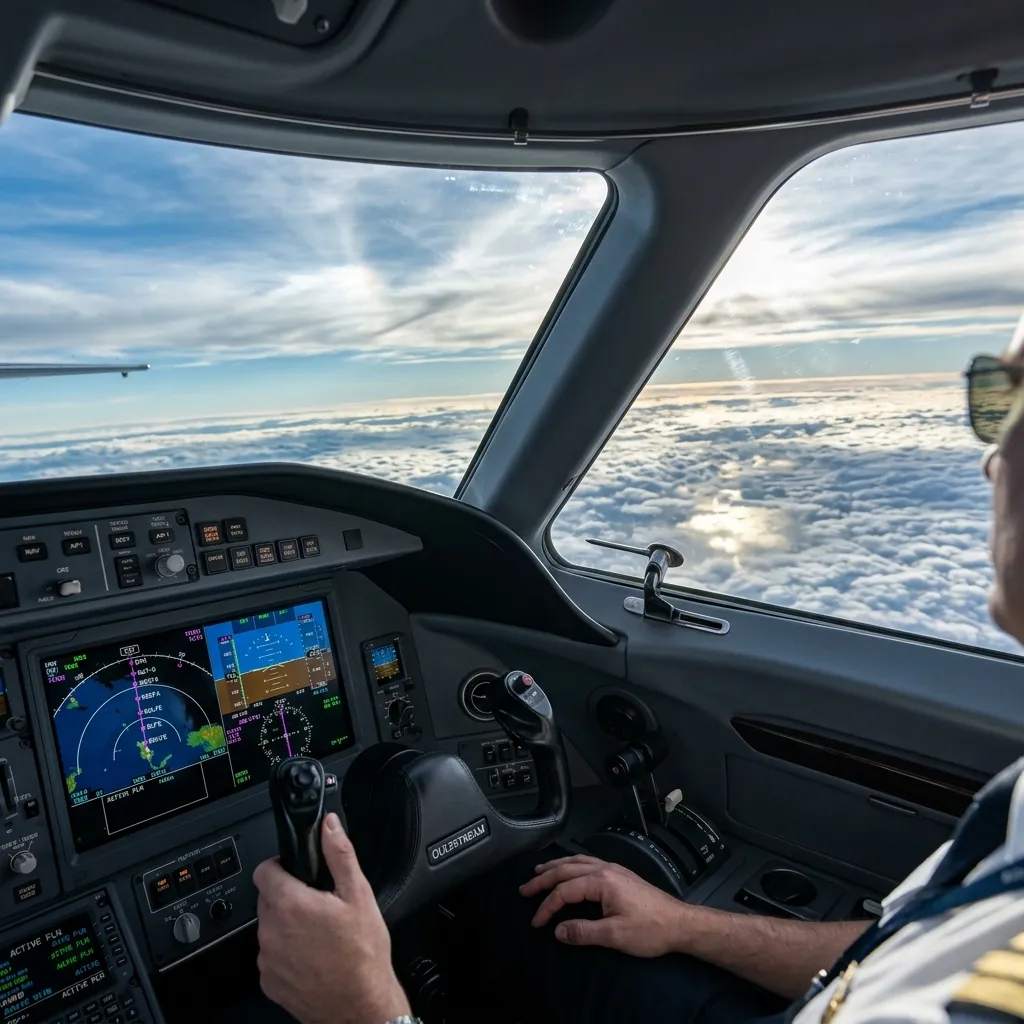
Business jet cruising at altitude above cloud layers with a long-range navigation display overlay

How Private Jet Range Is Really Calculated: NBAA IFR, Payload Trade-Offs, and Why Brochure Numbers Lie

undefined

In This Article

The Range Number You See Is Not the Range You Get NBAA IFR Range: The Industry Standard Methodology The Payload-Range Trade-Off: The Chart Your Broker Should Show You Wind: The Variable That Changes Everything What to Ask Before Booking or Buying Frequently Asked Questions

The Range Number You See Is Not the Range You Get

Every aircraft brochure publishes a range specification, and that number is technically accurate under the conditions it was measured. The problem is that those conditions rarely match real-world operations. The published range for a Challenger 350 is 3,200 NM. With 8 passengers, winter bags, headwinds, and NBAA IFR reserves (including a 200 NM alternate), the actual nonstop capability on a given day might be 2,600 NM. That 600 NM gap is the distance between New York and Tampa. It is the difference between nonstop and a fuel stop.

Understanding how range is calculated, what assumptions go into the published number, and how to interpret payload-range charts separates informed buyers from passengers who discover mid-flight that they need to stop for fuel in Kansas. This is not academic: range determines whether your aircraft fits your mission, and a mismatch costs time and money on every trip.

NBAA IFR Range: The Industry Standard Methodology

The National Business Aviation Association (NBAA) defines the standard range measurement protocol used by virtually all manufacturers. NBAA IFR range assumes the following conditions: 4 passengers at 200 lbs each (including baggage), international standard atmosphere (ISA) temperature, no wind, long-range cruise speed (which is slower than max cruise), NBAA IFR fuel reserves (enough to fly to the destination, then to an alternate airport 200 NM away, then hold for 30 minutes at 5,000 feet).

  • Passenger load: 4 passengers at 200 lbs each (800 lbs total payload), significantly below full-cabin weights
  • Weather: Standard atmosphere (ISA), no wind component. Real-world headwinds of 50-100 kts are common on east-to-west U.S. routes
  • Cruise speed: Long-range cruise (LRC), typically 15-30 kts slower than max cruise. Most operators fly at high-speed cruise, reducing range by 5-10%
  • Reserves: Fuel to reach destination + 200 NM alternate + 30-minute hold. This reserve requirement consumes 400-600 lbs of fuel
  • No ATC deviations: Assumes direct routing. Real-world routing adds 3-8% to distance flown
  • No taxi fuel: Ground operations at departure and arrival consume 15-30 minutes of fuel that is not included in range calculations

When a manufacturer publishes '3,200 NM range,' the implied conditions are: 4 passengers, long-range cruise, no wind, direct routing, ISA temperatures, NBAA reserves. Change any single variable, and the number changes. Add 4 more passengers: subtract 200-400 NM. Fly at max cruise instead of LRC: subtract 150-300 NM. Face 80-knot headwinds on a westbound transcontinental: subtract 400-600 NM. Stack all three variables, and the 3,200 NM aircraft becomes a 2,200 NM aircraft.

The Payload-Range Trade-Off: The Chart Your Broker Should Show You

Every aircraft has a maximum takeoff weight (MTOW). That weight is divided between the empty aircraft (operating empty weight, OEW), fuel, and payload (passengers + baggage + catering). The math is simple: MTOW minus OEW equals the available weight for fuel and payload combined. More passengers means less fuel. Less fuel means less range. This relationship is depicted in a payload-range chart, a graph that every manufacturer publishes but few brokers explain to clients.

The payload-range trade-off is most aggressive in light jets where the weight margins are tightest. A Citation CJ4 with published range of 2,165 NM carries 4 passengers at that range. With 8 passengers and bags, the CJ4's useful range drops to approximately 1,500-1,700 NM. A Gulfstream G650 with published range of 7,000 NM has enough structural margin to carry a full cabin (16 passengers) and still reach 5,500+ NM. Larger aircraft absorb the payload-range penalty more gracefully because the passenger weight represents a smaller percentage of total aircraft weight.


Need a Charter Quote?

Contact our team for a personalized quote.

Get a Quote

Wind: The Variable That Changes Everything

Published range assumes zero wind. In reality, the North American jet stream produces winds of 80-150 knots at FL350-FL450 during winter months. Westbound flights (New York to Los Angeles, Chicago to San Francisco) face direct headwinds that can reduce ground speed by 80-120 knots. An aircraft cruising at 480 ktas with a 100-knot headwind has an effective ground speed of 380 knots, burning the same fuel per hour but covering 20% less distance.

The wind impact on range is asymmetric and non-intuitive. A 100-knot headwind reduces range by approximately 20%. A 100-knot tailwind increases range by approximately 15%. The asymmetry exists because headwinds increase fuel burn per NM traveled (more time in the air for the same distance), while tailwinds reduce fuel burn per NM but the aircraft still burns the same minimum hourly fuel rate regardless of ground speed.

What to Ask Before Booking or Buying

The gap between published range and mission range is not a manufacturer's deception. It is a standardization convention that allows meaningful comparison between aircraft. The problem is when buyers, brokers, or operators cite the NBAA number as if it represents the aircraft's capability on any given day with any given load. It does not. Published range is a ceiling under ideal conditions. Mission range is the floor under real conditions.

Brian Galvan

Written By

Brian Galvan

Founder, The Jet Finder · Private Aviation Operations & Technology

Former Director of Technology at FlyUSA (Inc. 5000 fastest-growing private jet company). Decade of hands-on experience across Part 135 operations, charter sales, fleet management, and aviation data systems.

LinkedInRead Full Profile →
Common Questions

Frequently Asked Questions


8 questions about chartering this aircraft

Yes, comfortably. Teterboro to Miami is approximately 1,030 NM, well within the XLS+'s capability even at full cabin weight, high-speed cruise, and with significant headwinds. You would need headwinds exceeding 200 knots (which do not occur on this route) to require a fuel stop. The concern arises on longer routes: TEB to Los Angeles (2,150 NM) is beyond the XLS+'s reliable nonstop capability with 6+ passengers and any headwind component. Always evaluate range against your specific route, not in the abstract.

The 200 lb figure includes the passenger and their checked baggage. For a business traveler with a roller bag and briefcase, 200 lbs is reasonable. For passengers traveling with golf clubs (30-40 lbs), ski equipment (25-35 lbs), or excessive luggage, the actual per-passenger weight approaches 230-260 lbs. The difference matters at scale: 8 passengers at 250 lbs is 2,000 lbs total payload versus 1,600 lbs at 200 lbs each. That 400 lb difference reduces range by 100-250 NM depending on the aircraft type.

Long-range cruise produces the maximum range number, which is the most marketable figure. LRC is typically 15-30 knots slower than max cruise and optimizes the engine's specific fuel consumption (fuel burned per pound of thrust per hour) at the most efficient altitude. Most operators fly at high-speed cruise or max cruise to minimize flight time, accepting a 5-10% range reduction. Some manufacturers publish both LRC and HSC range figures, but the headline number in brochures is always LRC. Ask for both figures when evaluating an aircraft.

For a westbound transcontinental flight (TEB to VNY, approximately 2,150 NM) during January-March, budget for 80-120 knot headwinds at FL350-FL450. This reduces effective range by 15-25%. An aircraft with 2,500 NM published range may have 2,000-2,125 NM of real-world westbound capability during winter jet stream season. Eastbound return flights benefit from the same winds as tailwinds, extending range by 10-15%. Flight dispatchers calculate this daily using actual winds aloft forecasts. Always verify westbound winter range capability with your operator before confirming the flight.

Ground operations (engine start, taxi to runway, taxi after landing, engine shutdown) consume 15-30 minutes of fuel. For a midsize jet burning 220 GPH at cruise (lower at idle, approximately 60-80 GPH per engine), taxi operations consume 30-60 gallons total. At busy airports (TEB, VNY, MDW), taxi times of 15-20 minutes are common. At congested airports during peak hours, taxi can reach 30-40 minutes. This fuel consumption reduces available fuel for the enroute portion of the flight. Dispatchers account for taxi fuel in trip planning but it is not reflected in published NBAA range figures.

ATC-assigned routing typically adds 3-8% to the direct (great circle) distance between two airports. Standard instrument departure procedures (SIDs) and arrival procedures (STARs) add structured routing segments. ATC reroutes around weather, restricted airspace, and traffic conflicts add additional distance. On a 2,000 NM route, expect actual distance flown to be 2,060-2,160 NM. Oceanic routes (North Atlantic Tracks) can add 5-15% due to organized track system routing that follows optimal wind patterns rather than direct geography.

Yes. Pilots have several range extension techniques available: climb to a higher altitude (thinner air reduces drag and improves fuel efficiency), slow to long-range cruise speed (trading time for distance), reduce electrical load (dimming cabin lights and non-essential systems reduces generator load and marginally reduces fuel burn), and request direct routing from ATC to eliminate routing inefficiencies. In extreme cases, pilots can request step climbs as fuel burns off and the aircraft becomes lighter. These techniques can recover 50-200 NM of range depending on the aircraft and conditions, sometimes eliminating a marginal fuel stop.

Hot temperatures increase takeoff distance and reduce initial climb performance, but the effect on cruise range is modest (1-3% reduction). The primary hot-day concern is takeoff performance: an aircraft that needs 5,000 feet of runway at sea level and 59°F (ISA) may need 6,200-6,800 feet at the same airport at 100°F. If the departure airport has a short runway, the aircraft may need to reduce fuel load (and therefore range) to meet takeoff weight limits. This is the scenario where hot temperatures indirectly reduce range: not through cruise inefficiency, but through takeoff weight restrictions forcing a reduced fuel load.

Continue Reading

Related Articles


Your Next Mission

Ready to Fly?


Whether you need a charter quote or want to explore aircraft options, our team is here.

Contact Us