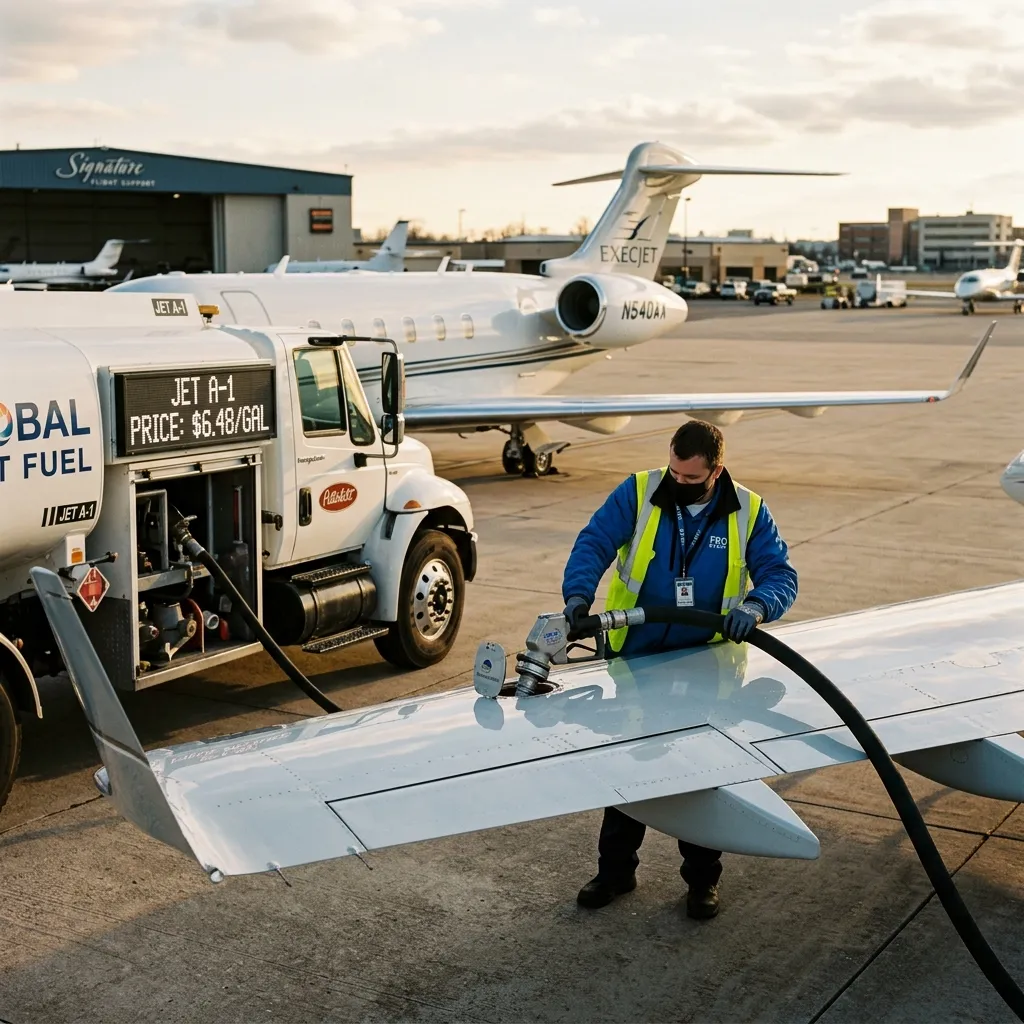
Fuel Is the Largest Single Variable in Every Charter Quote
In 2019, Jet-A averaged $4.85 per gallon at U.S. FBOs. In 2022, it peaked above $7.50. In May 2026, the national average sits at approximately $6.50-$7.50 per gallon, with coastal and island locations pushing above $9.00. This 60-80% price increase over seven years has added $30,000-$80,000 per year to the operating cost of a typical midsize jet flying 400 annual hours. For charter clients, the impact appears directly in every quote as a fuel cost component or fuel surcharge.
Fuel typically represents 35-50% of a charter flight's total variable cost, depending on aircraft size and mission length. A Citation CJ3 burning 150 gallons per hour at $7.00 per gallon generates $1,050 per hour in fuel cost. A Gulfstream G650 burning 450 gallons per hour at the same price generates $3,150 per hour. When fuel prices jump $1.00 per gallon, the CJ3's hourly cost increases $150 and the G650's increases $450. Over a 4-hour transcontinental flight, that $1.00 swing means $600-$1,800 in additional cost.
How Charter Operators Build Fuel Into Quotes
Charter operators use three primary methods to incorporate fuel costs into client quotes. The method determines whether fuel price changes affect the quoted price between booking and flight day.
Method 1: All-Inclusive Hourly Rate
The operator quotes a single hourly rate that includes fuel at a built-in assumed price. If fuel costs rise between the quote and the flight, the operator absorbs the difference. If fuel drops, the operator benefits. This method provides price certainty for the client but requires the operator to build a fuel price buffer into the rate. Most all-inclusive rates assume fuel at 10-15% above current market price to protect margins. This is the simplest model for the client but often the most expensive.
Method 2: Fuel-Pass-Through
The operator quotes a base hourly rate that excludes fuel, then adds the actual fuel cost at the point of sale based on the fuel price at the departure and arrival FBOs. This method gives the client the real fuel cost without a buffer. The drawback: the final price is not known until the fuel is purchased. Fuel-pass-through models are common on larger operators and for long-range flights where fuel cost is a significant portion of the total.
Method 3: Fuel Surcharge
The operator quotes a standard rate based on a reference fuel price (for example, $6.00 per gallon), then adds a surcharge if actual fuel exceeds the reference. The surcharge is calculated as the difference multiplied by estimated fuel burn. For example, if actual fuel is $7.50 and the reference is $6.00, the surcharge on a 4-hour flight burning 200 GPH is $1.50 x 800 gallons = $1,200. This model is transparent and adjustable but adds complexity to the invoice.