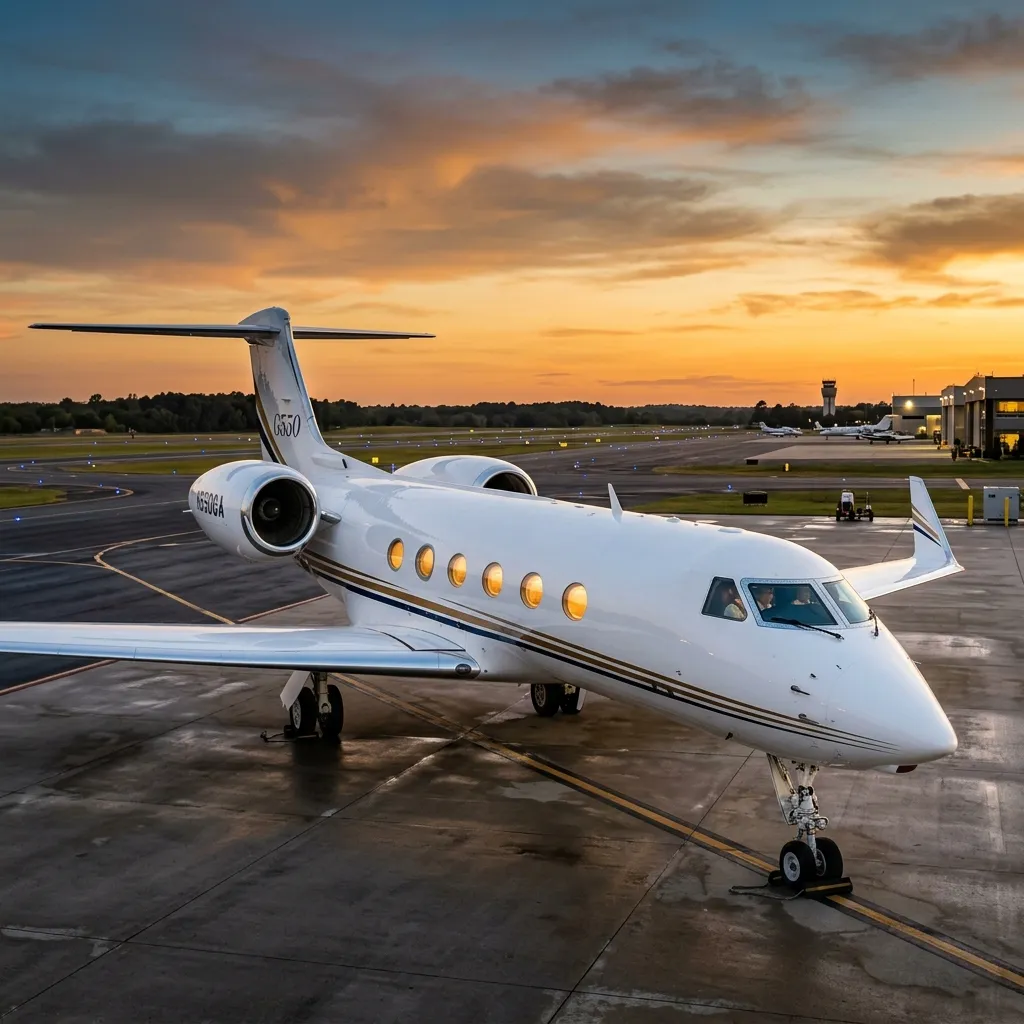
Gulfstream GIV-SP heavy jet parked on a runway with its distinctive oval windows and T-tail visible

The Gulfstream GIV: The Aircraft That Made Gulfstream a Verb

Between 1987 and 2003, Gulfstream delivered 560 GIV and GIV-SP aircraft. That production run established the template for every ultra-long-range business jet that followed: transatlantic range, stand-up cabin, Rolls-Royce power, and a $30+ million price tag that signaled arrival, not aspiration. Twenty years after the last GIV rolled off the Savannah production line, approximately 380 remain in active service worldwide.

In This Article

Production History: 1987 to 2003 Specifications and Performance The Tay Engine: Reliability and Limitations The Pre-Owned GIV Market in 2026 Legacy: Why the GIV Still Matters Frequently Asked Questions

Production History: 1987 to 2003

The original Gulfstream GIV (G-IV) entered service in 1987 with Rolls-Royce Tay 610 engines producing 13,850 lbs of thrust each. The aircraft delivered 4,000 nm range, a cabin 6 feet 1 inch tall and 7 feet 4 inches wide, and Mach 0.80 cruise speed. It was the first business jet capable of nonstop transatlantic crossings in both directions under standard wind conditions. That capability was not merely a performance milestone. It changed how corporations thought about international travel.

The GIV-SP (Special Performance) variant entered production in 1992 with upgraded Tay 611-8 engines producing 13,850 lbs of thrust (same rating but improved fuel efficiency), increased range to 4,220 nm, and reduced takeoff distance. The SP designation became the standard production model, and most surviving GIVs in active service today are SP variants. Of the 560 total GIV/GIV-SP produced, approximately 380 remain on civil registries worldwide.

Gulfstream produced the GIV at its Savannah, Georgia facility alongside the smaller GV, which debuted in 1997 and eventually replaced the GIV in the product line. The GV stretched the GIV fuselage, added Rolls-Royce BR710 engines, and pushed range to 5,800 nm. But the GIV's fundamental airframe design, cabin cross-section, and wing geometry carried forward through the GV, G550, and arguably into the current G500/G600 family.

Specifications and Performance

The GIV's cabin cross-section (7 feet 4 inches wide, 6 feet 1 inch tall) established the benchmark that competitors spent two decades trying to match. Bombardier's Challenger 604, launched in 1995, offered 7 feet 11 inches of width but only 6 feet of height. The Dassault Falcon 900, in production since 1986, offered 7 feet 8 inches of width but only 6 feet 2 inches of height. The GIV's combination of width, height, and 45-foot cabin length created a three-zone interior (forward galley, mid-cabin conference, aft stateroom) that became the standard heavy jet layout.

The Tay Engine: Reliability and Limitations

The Rolls-Royce Tay 610/611-8 engine is a derivative of the Rolls-Royce Spey, originally designed for military applications in the 1960s. The Tay added a new fan stage, improved turbine materials, and digital FADEC control. The engine compiled an excellent safety record across 560 GIV installations and additional use on the Fokker 70/100 regional jet family.

The Tay's limitation is fuel efficiency. Burning approximately 400-430 gallons per hour at cruise, the GIV-SP consumes roughly the same fuel as a modern G550 (which carries it 1,500 nm farther) and significantly more than a modern G500 (which matches the GIV's range on 280 gallons per hour). At $6.50 per gallon, the GIV-SP costs $2,600-$2,800 per hour in fuel alone. A G500 burns $1,820 per hour for equivalent mission capability.

Engine maintenance costs have increased as the Tay fleet ages. Rolls-Royce's CorporateCare program covers the GIV fleet, but hourly rates have risen as the pool of overhauled modules diminishes. Engine maintenance reserves run $450-$600 per flight hour on a power-by-the-hour plan. Hot section inspections occur at approximately 5,000-hour intervals. Full overhauls run $1.2-$1.8 million per engine.


Need a Charter Quote?

Contact our team for a personalized quote.

Get a Quote

The Pre-Owned GIV Market in 2026

Pre-owned GIV-SP pricing has compressed to $2.5-$6 million depending on total airframe hours, engine time remaining, avionics configuration, and interior condition. A 1997 GIV-SP with 10,000 hours, mid-time engines, and original Honeywell SPZ-8000 avionics trades at $2.5-$3.5 million. A 2002 GIV-SP with 7,000 hours, recently overhauled engines, and upgraded avionics (PlaneView or Garmin) trades at $4.5-$6 million.

The value proposition is direct: a GIV-SP delivers transatlantic range, a wide-body cabin, and a 45-foot interior for $3-$4 million. A comparably capable new jet (G500) lists at $45 million. The $40+ million savings comes with trade-offs: higher fuel burn ($800-$1,000 per hour above a G500), aging avionics and systems, and diminishing parts availability as the fleet contracts.

The GIV-SP at $3 million offers more cabin volume than any other aircraft at that price point. The question is not whether you can afford to buy it. The question is whether you can afford to feed it 430 gallons per hour.

Legacy: Why the GIV Still Matters

The GIV established three industry standards that persist today. First, transatlantic range as the baseline for heavy jets. Before the GIV, transatlantic business jet travel required fuel stops in Iceland, Greenland, or the Azores. The GIV eliminated those stops and made nonstop New York-London the expectation. Every heavy jet launched since has been measured against that benchmark.

Second, the GIV's cabin cross-section became the dimensional standard. The 7-foot-4-inch width and 6-foot-1-inch height defined what a 'large-cabin' aircraft meant. The G550, G650, and G700 expanded on these dimensions, but the GIV established the floor. Any aircraft with a narrower cabin was categorized below it.

Third, the GIV proved the economic model for ultra-long-range business aviation. At $30+ million new (in 1990s dollars), the GIV demonstrated that corporations and high-net-worth individuals would pay a significant premium for nonstop transatlantic capability. This market validation gave Gulfstream, Bombardier, and Dassault the confidence to develop even larger, longer-range aircraft, culminating in today's $75 million G700 and Global 7500.

Brian Galvan

Written By

Brian Galvan

Founder, The Jet Finder ยท Private Aviation Operations & Technology

Former Director of Technology at FlyUSA (Inc. 5000 fastest-growing private jet company). Decade of hands-on experience across Part 135 operations, charter sales, fleet management, and aviation data systems.

LinkedInRead Full Profile →
Common Questions

Frequently Asked Questions


6 questions about the Gulfstream GIV and GIV-SP heavy business jet

The GIV/GIV-SP fleet contracts by approximately 20-30 aircraft per year. The primary retirement driver is engine overhaul economics: a Tay 611-8 overhaul costs $1.2-$1.8 million per engine, which can exceed the hull value of older, high-time airframes trading at $2.5-$3.5 million. Secondary drivers include diminishing parts availability for legacy Honeywell avionics, increasing insurance costs on older airframes, and the growing availability of comparably capable newer aircraft at competitive pre-owned prices.

The GIV-SP (1992-2003 production) upgraded the Tay engines from 610 to 611-8 specification, adding 220 nm of range and reducing takeoff distance by 500 feet. The SP outsold the original GIV by approximately 3:1. Parts commonality and maintenance support favor SP variants. Pre-owned pricing reflects this: SP models command a $500,000-$1,000,000 premium at equivalent age and hours. The non-SP GIV is increasingly difficult to insure and maintain, making the SP the practical entry point.

The GIV-SP Tay 611-8 engine requires maintenance reserves of $450-$600 per flight hour on a power-by-the-hour plan through Rolls-Royce CorporateCare. By comparison, the G550 BR710 runs $350-$450 per hour, and the G500 Pearl 700 runs $300-$400 per hour. Hot section inspections occur at approximately 5,000-hour intervals on the Tay. Full overhauls run $1.2-$1.8 million per engine. These maintenance costs are the second-largest operating expense after fuel.

The GIV-SP requires a fuel stop westbound (London to New York, approximately 3,400 nm) when jet stream headwinds exceed 80-100 knots at cruise altitude, increasing effective distance beyond 4,000 nm. This occurs primarily during winter months (November through March) when the North Atlantic jet stream strengthens. Common fuel stops are Shannon (SNN) in Ireland or Keflavik (KEF) in Iceland, adding 45-90 minutes to the trip. Eastbound flights rarely require stops due to tailwinds.

The Gulfstream PlaneView ($1.5-$2.5 million installed) replaces the original Honeywell SPZ-8000 CRT displays with LCD screens in a Gulfstream-standard layout. It maintains commonality with G550 cockpit procedures, which benefits pilots transitioning between types. The Garmin G5000 ($2-$3 million installed) provides more modern touchscreen technology, synthetic vision, and better long-term support from Garmin. PlaneView is preferred by charter operators wanting G550 cockpit commonality. G5000 is preferred by owner-operators wanting the most current technology.

At 300 annual flight hours, the GIV-SP total cost of ownership (including $3.5 million acquisition, $5,500-$7,500/hr variable, $600,000 annual fixed) reaches approximately $22 million over 10 years. A G500 ($45 million acquisition, $4,000-$5,500/hr variable, $700,000 annual fixed) costs approximately $60 million over the same period. The GIV-SP costs roughly 37% as much to own over a decade, but the cabin is smaller, the fuel burn is 50% higher, and residual value at year 10 approaches zero versus $18-$22 million for the G500.

Continue Reading

Related Articles


Your Next Mission

Ready to Fly?


Whether you need a charter quote or want to explore aircraft options, our team is here.

Contact Us