The Two Flagships
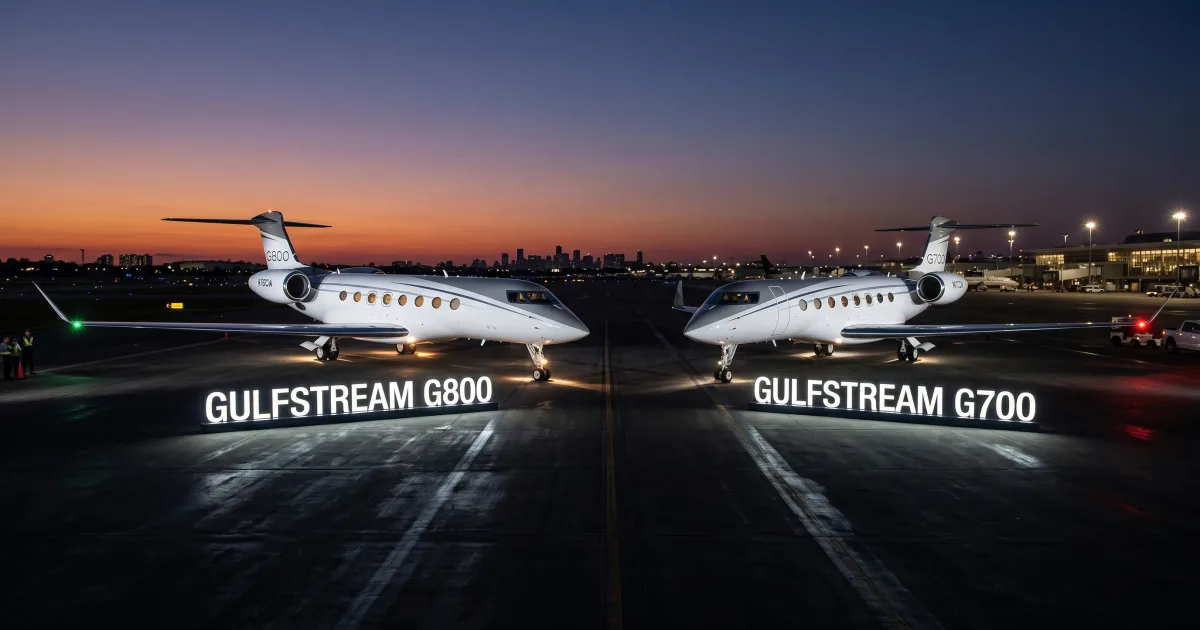
Gulfstream did something unusual with the G700 and G800: they released two ultra-long-range flagships simultaneously, each optimized for a different priority. The G700 maximizes cabin space. The G800 maximizes range. They share the same wing, the same engines, the same cockpit, and largely the same systems. The difference is in the fuselage and fuel capacity.
This creates a genuine decision for buyers, not a clear hierarchy. Neither aircraft is "better." They serve different mission profiles. Understanding which missions dominate your flight schedule determines which aircraft is the right acquisition.
Specifications Compared
| Specification | Gulfstream G800 | Gulfstream G700 |
|---|---|---|
| Range (Mach 0.85) | 8,000 nm | 7,750 nm |
| Max Speed | Mach 0.925 | Mach 0.925 |
| Cabin Length | 46 ft 10 in | 56 ft 11 in |
| Cabin Width | 8 ft 2 in | 8 ft 2 in |
| Cabin Height | 6 ft 3 in | 6 ft 3 in |
| Living Areas | Up to 4 | Up to 5 |
| Passengers (typical) | 13-17 | 13-19 |
| Sleeping Capacity | 6-8 | 8-10 |
| Baggage Volume | 150 cu ft | 195 cu ft |
| Engines | 2x Rolls-Royce Pearl 700 | 2x Rolls-Royce Pearl 700 |
| Ceiling | 51,000 ft | 51,000 ft |
| List Price (2026) | ~$72.5M | ~$75M |
Range: Where the G800 Wins
The G800's 8,000 nm range is not a marginal improvement. It opens specific city pairs that the G700 cannot reliably serve nonstop under all conditions. Wind, payload, and temperature all reduce effective range. The G800's additional 250 nm of published range translates to meaningful operational margin on the longest routes.
Routes where the G800's range advantage matters:
- New York to Mumbai (6,850 nm): G800 handles this comfortably. G700 may require a fuel stop depending on winds and payload.
- Dubai to Los Angeles (7,250 nm): G800 can make this nonstop westbound. G700 will likely need a tech stop in Bangor or Gander.
- Singapore to London (5,900 nm): Both handle this, but the G800 arrives with significantly more reserve fuel.
- São Paulo to Dubai (6,200 nm): G800 nonstop. G700 nonstop in favorable conditions.
If more than 20% of your annual flight hours involve transpacific or Gulf-to-Americas routing, the G800's range is not a luxury. It is operational necessity. A single fuel stop on a 15-hour mission adds 60-90 minutes to total travel time, requires crew duty time management, and introduces schedule risk.
Cabin: Where the G700 Wins
The G700's cabin is 10 feet longer than the G800's. That is not a cosmetic difference. Ten additional feet of cabin means a fifth living area, more sleeping berths, a larger galley, and meaningful separation between zones for privacy.
For owners who regularly travel with delegations of 10+, conduct inflight meetings, or need separate sleeping and working areas on 12+ hour flights, the G700's cabin makes a tangible operational difference. The G800's cabin is still excellent by any standard, but the G700 is genuinely in a class of its own for interior volume.
The G700 also carries 195 cubic feet of baggage compared to the G800's 150. For families traveling with extensive luggage, sporting equipment, or clients carrying presentation materials, that 30% increase in baggage space matters.
Performance and Engines
Both aircraft are powered by Rolls-Royce Pearl 700 engines producing 18,250 pounds of thrust each. Speed profiles are identical: Mach 0.925 maximum, Mach 0.90 high-speed cruise, Mach 0.85 long-range cruise. At 51,000 feet, both aircraft cruise above commercial traffic and most weather.
The Symmetry Flight Deck is standard on both, featuring active control sidesticks (a first in civil aviation), extensive use of touchscreen displays, and enhanced vision system with head-up display. Pilot type ratings are shared between the G700 and G800, simplifying fleet operations for owners or operators running both types.
Operating costs are similar: approximately $4,800-5,200 per flight hour for fuel, $1,200-1,500 per hour for maintenance reserves. The G700's larger cabin adds marginally to cleaning and interior maintenance costs, but the difference is negligible in the context of overall operating budgets.