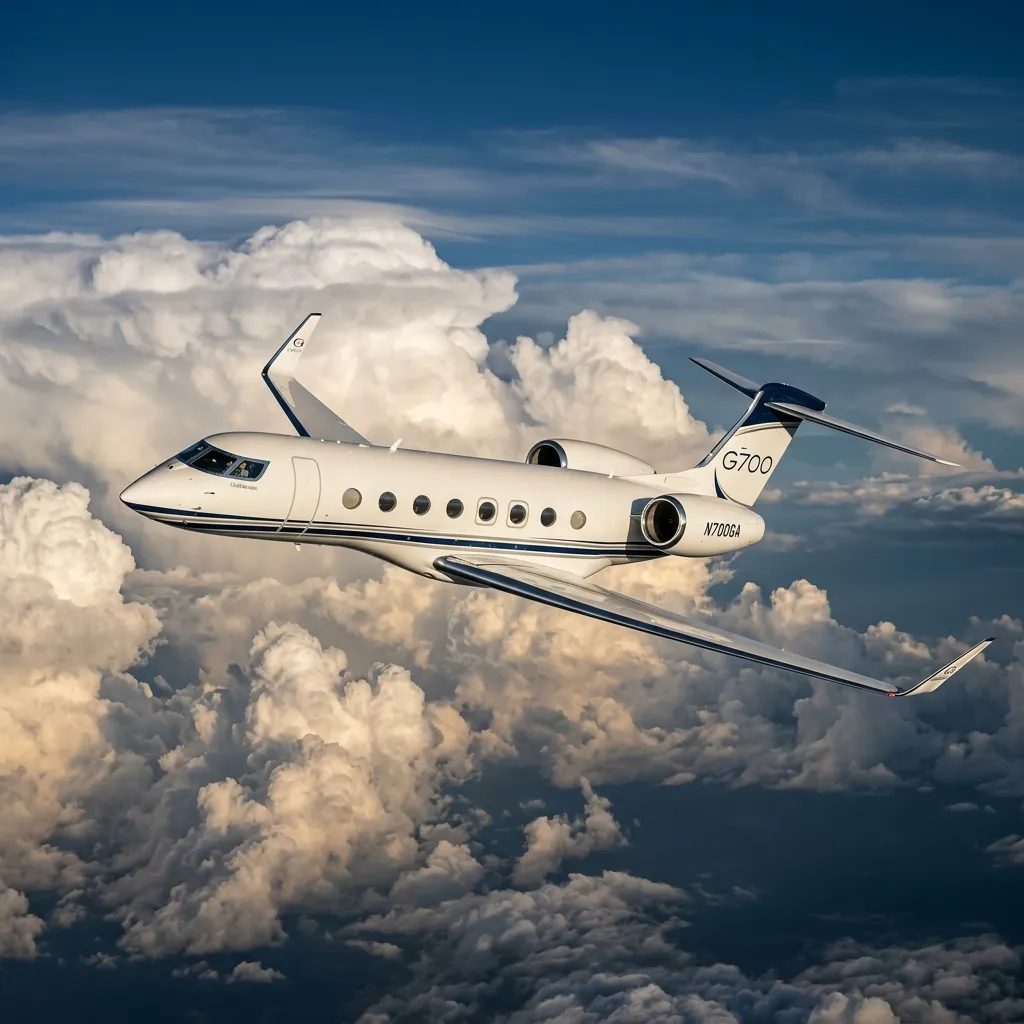
Gulfstream G700 ultra-long-range business jet in flight above cloud layers

The Gulfstream G700: The New Standard in Ultra-Long-Range Business Aviation

undefined

In This Article

Gulfstream's Answer to the Global 7500 Performance Specifications The Cabin: Five Living Areas in 57 Feet The Symmetry Flight Deck: PlaneView III Market Position and Pricing Frequently Asked Questions

Gulfstream's Answer to the Global 7500

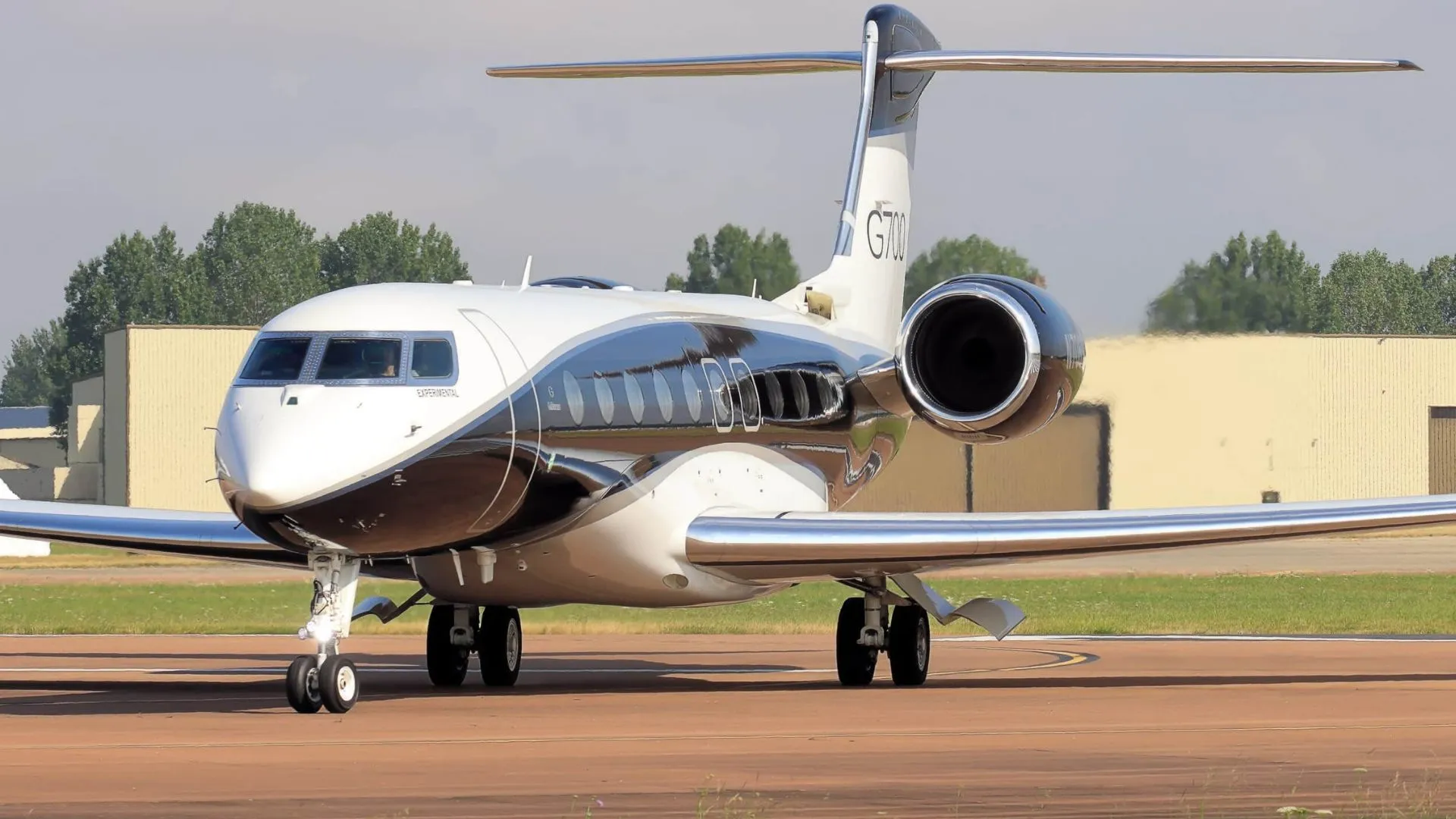
The Gulfstream G700 received its FAA type certificate in March 2022 and began customer deliveries in early 2023. The aircraft was designed with a single objective: surpass the Bombardier Global 7500 in every measurable cabin and performance metric. At 7,750 NM range and Mach 0.85 long-range cruise, the G700 matches the Global 7500's reach. Where it separates itself is the cabin: 56 feet 11 inches long, 8 feet 2 inches wide, and 6 feet 3 inches tall, making it the tallest, widest, and longest cabin in purpose-built business aviation.

The G700 is powered by two Rolls-Royce Pearl 700 engines, each producing 18,250 lbs of thrust. The Pearl 700 is a clean-sheet turbofan developed specifically for the G700 and G800, derived from Rolls-Royce's BR700 family but with a new core, improved compressor, and advanced materials that increase efficiency by 5% over the previous generation. The engines produce lower noise and emissions than the Rolls-Royce BR710 units on the G550 and BR725 on the G650, while delivering significantly more thrust.

Performance Specifications

The G700 is a larger aircraft than the G650ER in every dimension. Its maximum takeoff weight of 107,600 lbs (48,800 kg) exceeds the G650ER by 8,000 lbs, and its cabin is 10 feet longer. This size increase comes with a fuel burn penalty: the G700 burns approximately 420-450 gallons per hour at long-range cruise versus the G650ER's 380-420 GPH. At $7.00 per gallon, the G700 costs roughly $280-$350 more per flight hour in fuel than the G650ER.

The G700's most impressive performance figure is its high-speed range: at Mach 0.90, the aircraft still achieves 6,400 NM. This means an operator can fly New York to Dubai at near-maximum cruise speed without sacrificing the ability to complete the mission nonstop. At Mach 0.85, the G700 covers New York to Tokyo (6,740 NM) with NBAA IFR reserves. No other purpose-built business jet combines this speed and range envelope.

The Cabin: Five Living Areas in 57 Feet

The G700 cabin accommodates up to five distinct living areas and can be configured for 13-19 passengers depending on seating density. The standard floorplan includes a forward club section (4 seats), a conference/dining group (4-6 seats), a lounge with entertainment credenza, a private stateroom with a berthing divan, and an aft lavatory with shower. Gulfstream offers 11 standard floorplan configurations and unlimited custom options.

Cabin altitude at FL410 is 2,916 feet, and at FL430 it drops to 3,810 feet. These are among the lowest cabin altitudes in business aviation, reducing passenger fatigue on flights exceeding 10 hours. The cabin pressurization system maintains sea-level pressure up to FL295. Gulfstream's 100% fresh-air circulation system cycles the entire cabin volume every 2-3 minutes with no recirculated air, a meaningful improvement over the G650's already-excellent environmental system.

7,750 NM
Maximum Range
Mach 0.925
Max Speed
5 Zones
Cabin Living Areas
$78M
List Price

Need a Charter Quote?

Contact our team for a personalized quote.

Get a Quote

The Symmetry Flight Deck: PlaneView III

The G700 introduces Gulfstream's Symmetry Flight Deck, the most advanced cockpit in business aviation. The system features 10 touchscreen displays (eliminating most physical switches), active control sidesticks (a first in civil aviation, providing tactile feedback to both pilots simultaneously), and Honeywell Primus Epic-based avionics with enhanced synthetic vision, head-up displays with enhanced vision, and predictive landing performance.

The active control sidesticks deserve emphasis. Unlike passive sidesticks on Airbus commercial aircraft (where one pilot cannot feel what the other is doing), the G700's sticks are electronically coupled: inputs from the flying pilot are mechanically replicated on the monitoring pilot's stick. This prevents the dual-input scenarios that have contributed to accidents in passive-sidestick aircraft. Combined with fly-by-wire flight controls, the G700 offers handling precision that pilots describe as significantly smoother than the G650's conventional yoke-and-cable system.

  • 10 touchscreen displays replace 90+ physical switches and knobs
  • Active control sidesticks: industry first in civil aviation
  • Dual head-up displays with enhanced vision system (EVS) standard
  • Predictive landing performance system for contaminated runways
  • FANS/CPDLC datalink for oceanic and remote airspace
  • Combined vision system (synthetic + enhanced) overlaid on HUD
  • Reduced pilot workload enables more attention to passenger experience

Market Position and Pricing

The G700 lists at approximately $78 million, positioning it between the G650ER ($71.5 million, still in production) and the theoretical ceiling of purpose-built business jets. The Bombardier Global 7500 lists at $75 million, making the G700 approximately $3 million more expensive. Early pre-owned G700 transactions (2023-2024 delivery aircraft) have occurred at $72-$78 million, reflecting strong demand and limited supply during the production ramp.

Charter rates for the G700 range from $15,000 to $18,000 per flight hour, approximately 10-15% above G650ER rates. The premium reflects the newer aircraft, larger cabin, and lower availability (fewer G700s in the charter fleet as of mid-2026). For corporate flight departments acquiring the G700, total annual operating costs at 400 flight hours are estimated at $4.2-$4.8 million, including crew, maintenance, insurance, hangar, and management.

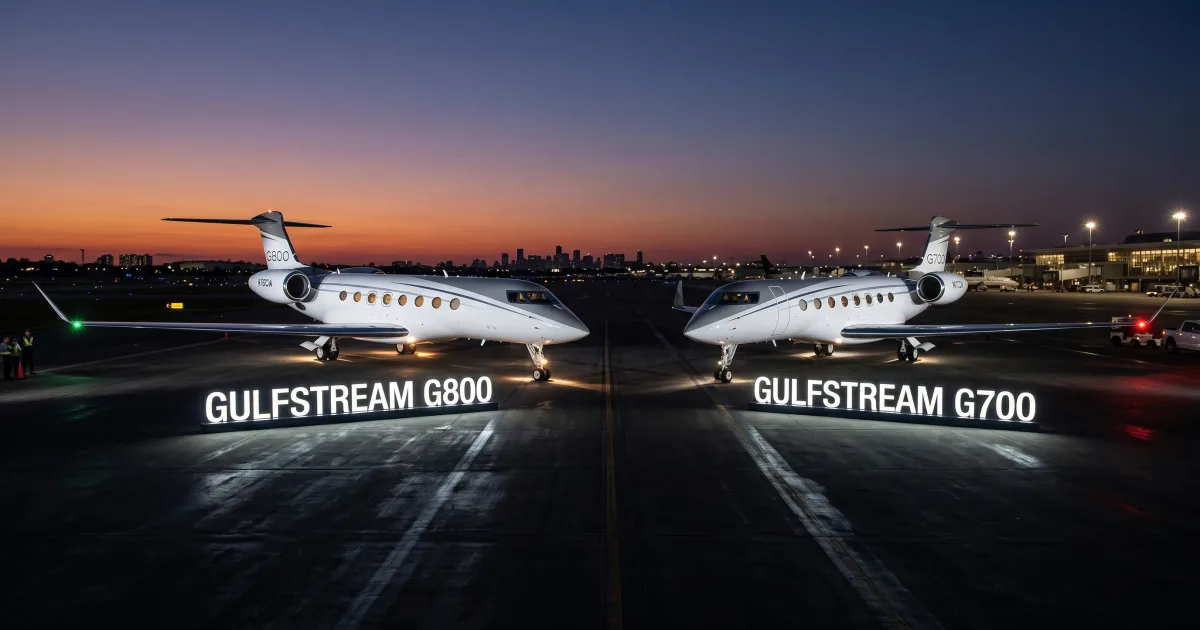
The G700 and G800 share the same airframe, engines, and cockpit. The G800 sacrifices approximately 5 feet of cabin length to carry additional fuel, extending range to 8,000 NM, the longest range of any purpose-built business jet. For operators who need New York to Singapore nonstop, the G800 is the only current option. For all other missions, the G700's longer cabin is the better trade.

Brian Galvan

Written By

Brian Galvan

Founder, The Jet Finder ยท Private Aviation Operations & Technology

Former Director of Technology at FlyUSA (Inc. 5000 fastest-growing private jet company). Decade of hands-on experience across Part 135 operations, charter sales, fleet management, and aviation data systems.

LinkedInRead Full Profile →
Common Questions

Frequently Asked Questions


8 questions about chartering this aircraft

The G700 cabin is wider (8 ft 2 in vs 8 ft 0 in), taller (6 ft 3 in vs 6 ft 2 in), and longer (56 ft 11 in vs 54 ft 7 in). These differences are small individually (2 inches wider, 1 inch taller, 28 inches longer) but compound into a noticeably more spacious environment, particularly in the conference and stateroom zones. The Global 7500 counters with its own strengths: a dedicated crew rest area, the patented Nuage seat design, and slightly lower cabin noise. Both cabins represent the peak of business aviation interior design.

The G700's 250 NM range advantage over the G650ER opens a few specific city pairs that are marginal for the G650ER: New York to Mumbai (7,800 NM, achievable by the G700 in favorable winds), Los Angeles to Dubai (7,250 NM, comfortable for the G700 but tight for the G650ER with headwinds), and Singapore to London (6,750 NM, easily within G700 capability). In practice, both aircraft cover 95% of the same city pairs. The G700's real advantage is carrying a full cabin load on ultra-long sectors without payload/range trade-offs.

Active control sidesticks are electronically coupled flight controls where inputs from one pilot's stick are mechanically replicated on the other pilot's stick in real time. Traditional passive sidesticks (as used on Airbus commercial aircraft) operate independently; one pilot cannot feel what the other pilot is commanding. This independence has contributed to accidents where both pilots unknowingly made conflicting inputs. The G700's active sticks eliminate this risk by providing haptic feedback that both pilots feel simultaneously. The G700 is the first civilian aircraft to implement this technology.

At FL410 (41,000 feet), the G700 cabin pressurizes to 2,916 feet. At FL430, cabin altitude rises to 3,810 feet. At FL450, approximately 4,850 feet. Lower cabin altitude means higher oxygen saturation, reduced fatigue, and less dehydration on long flights. A passenger on a 14-hour G700 flight at FL410 (2,916 ft cabin) will arrive measurably less fatigued than on an aircraft maintaining 6,000-8,000 ft cabin altitude. The difference is particularly noticeable on east-west flights crossing 8+ time zones.

As of mid-2026, Gulfstream has delivered approximately 80-100 G700 aircraft since customer deliveries began in 2023. The production rate is ramping toward 36-40 units per year. The current backlog is approximately 24-30 months for new orders. Early delivery positions have commanded premiums on the secondary market as buyers unwilling to wait 2+ years purchase delivery slots from position holders. Gulfstream's Savannah, Georgia facility is producing G700, G800, G650ER, G500, and G600 simultaneously.

The G700 burns approximately 420-450 gallons per hour at long-range cruise versus the G650ER's 380-420 GPH. At $7.00 per gallon, the G700 costs $2,940-$3,150 per hour in fuel versus the G650ER's $2,660-$2,940. The difference is $200-$350 per flight hour, or $80,000-$140,000 per year at 400 annual hours. This premium is the price of the G700's additional 10 feet of cabin, higher maximum takeoff weight, and 250 NM range extension. For operators who use the G700's full cabin, the economics are straightforward.

The G700's balanced field length at maximum takeoff weight is approximately 6,250 feet at sea level, standard day conditions. At reduced weights (lighter fuel load for shorter missions or fewer passengers), takeoff distance decreases to 5,400-5,800 feet. Landing distance is approximately 2,500 feet. The G700 can operate from most business aviation airports with 6,000+ foot runways. However, it cannot access short runways like Aspen (8,006 ft, but 7,820 ft altitude density altitude challenges), Teterboro (7,000 ft, acceptable), or airports under 5,500 feet without weight restrictions.

The Pearl 700 produces 18,250 lbs of thrust, compared to the BR725's 16,900 lbs (G650) and the BR710's 15,385 lbs (G550). Beyond raw thrust, the Pearl 700 features a new compressor core, advanced single-crystal turbine blades, and improved combustor design that delivers 5% better specific fuel consumption than the BR725. The engine produces less noise at all power settings and lower NOx emissions. Pearl 700 maintenance intervals are longer than the BR725, reducing per-engine overhaul costs on a time-between-overhaul basis. Rolls-Royce's CorporateCare program covers the Pearl 700 at approximately $280-$350 per engine per hour.

Continue Reading

Related Articles


Your Next Mission

Ready to Fly?


Whether you need a charter quote or want to explore aircraft options, our team is here.

Contact Us