What Fractional Ownership Actually Means
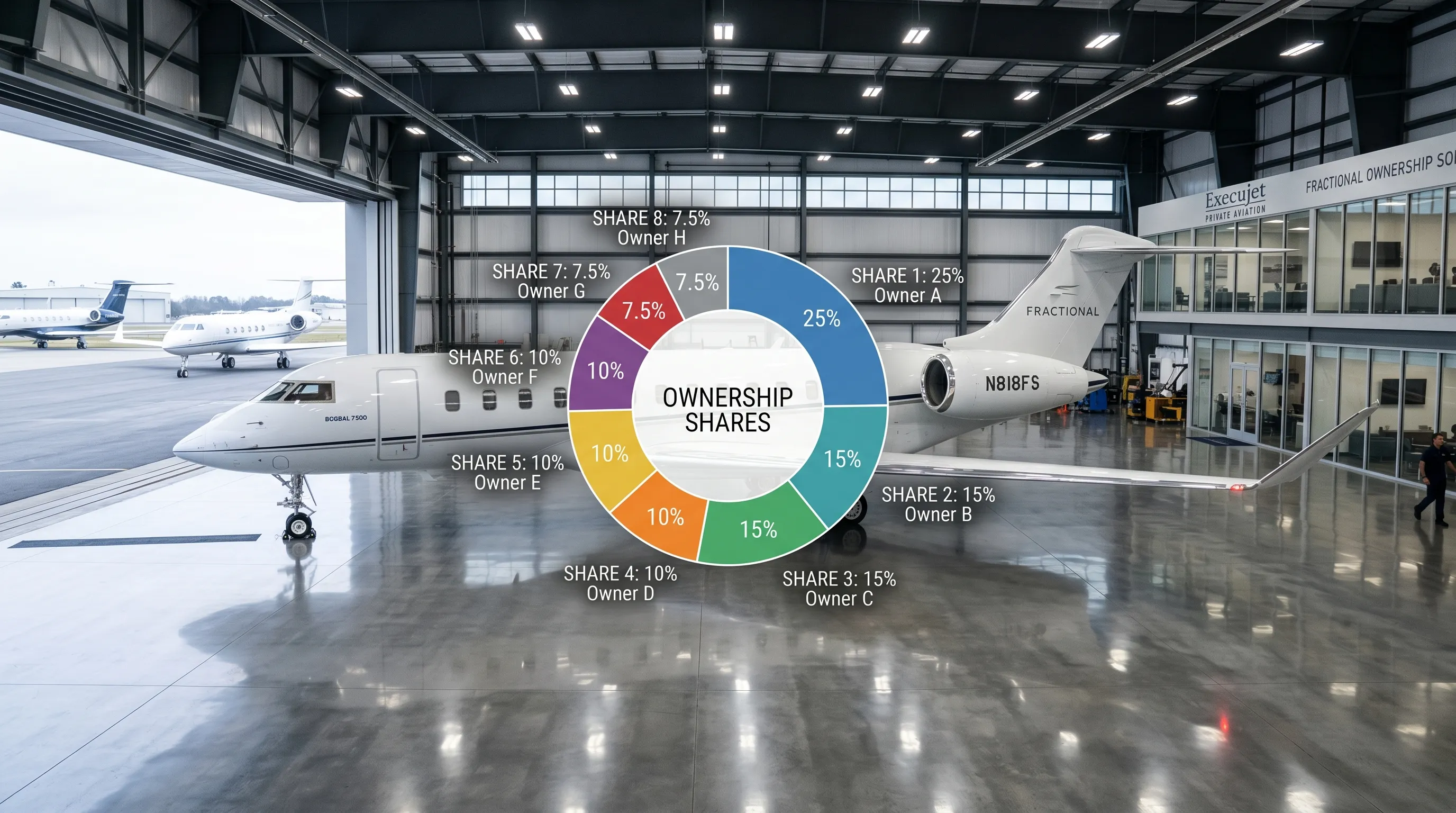
Fractional ownership is a deeded interest in a specific aircraft. You purchase a share, typically 1/16 or 1/8, and receive a proportional number of guaranteed flight hours per year. A 1/16 share provides 50 occupied hours. A 1/8 share provides 100 hours. You are on the aircraft's title. You share the depreciation. You pay monthly management fees that cover crew, hangar, maintenance, insurance, and scheduling.
The concept differs fundamentally from jet cards and charter. A jet card provides access to a fleet without ownership. Charter is pay-per-trip. Fractional ownership makes you a part-owner of a physical aircraft with the rights, tax implications, and capital requirements that entails. The three dominant U.S. programs are NetJets, Flexjet, and PlaneSense. Each structures ownership, pricing, and fleet access differently.
NetJets: The Market Leader
NetJets, a Berkshire Hathaway subsidiary, operates the largest fractional fleet in the world with approximately 900 aircraft. Share options range from 1/16 to whole-aircraft management. The fleet spans Phenom 300s, Citation Latitudes, Citation Longitudes, Challenger 350s, and Global 7500s among other types. NetJets guarantees aircraft availability with as little as 10 hours notice for domestic flights.
Pricing Structure
A 1/16 share (50 hours/year) in a NetJets Challenger 350 requires an acquisition cost of approximately $1.3 million. Monthly management fees run $18,000 to $22,000 regardless of whether you fly. Occupied hourly fees, charged per flight hour, range from $5,500 to $7,500 depending on aircraft type. These hourly fees cover fuel, landing fees, and variable costs. Annual all-in cost for 50 hours on a Challenger 350 share: approximately $530,000 to $620,000.
NetJets' occupied-hour pricing is not negotiable. The acquisition cost sometimes includes fleet credits or introductory pricing. But the monthly management fee and hourly rate are fixed for the contract term, typically five years.
Flexjet: The Premium Challenger
Flexjet operates approximately 250 aircraft with a fleet concentrated on Bombardier and Embraer models: Praetor 500, Challenger 350, and Global 7500. Flexjet differentiates through its LXi membership tier, which bundles concierge services, guaranteed Wi-Fi, and newer-vintage aircraft (typically under 5 years old). Share sizes mirror NetJets: 1/16 minimum.
Pricing Comparison
Flexjet 1/16 shares in a Challenger 350 carry acquisition costs of approximately $1.2 million, slightly below NetJets. Monthly management fees run $17,000 to $20,000. Occupied hourly fees are $5,200 to $6,800. The all-in annual cost for 50 hours: approximately $490,000 to $570,000. Flexjet is typically 5-10% less expensive than NetJets for comparable aircraft types.
Flexjet's smaller fleet means less schedule flexibility on short notice. Guaranteed availability requires 16 hours domestic notice versus NetJets' 10 hours. For owners who plan trips 48+ hours in advance, this difference is irrelevant. For those who fly on 12-hour notice regularly, it matters.
Need a Charter Quote?
Contact our team for a personalized quote.
Get a Quote →PlaneSense: The Turboprop Alternative
PlaneSense operates a fleet of approximately 40 Pilatus PC-12s and PC-24s. The program targets owners flying 50 to 200 hours annually on shorter routes (under 1,000 NM). A 1/16 share in a PC-12 requires approximately $250,000 in acquisition cost with monthly management fees around $8,000 to $10,000. Annual all-in cost for 50 hours: approximately $160,000 to $200,000.
$1.2M+
Entry Capital (Midsize)
3 Major Programs
U.S. Market
PlaneSense cannot compete on speed or range with NetJets or Flexjet. The PC-12 cruises at 285 knots versus 430+ for a Citation XLS. But for owners flying New England to mid-Atlantic routes, accessing short runways, or prioritizing cost efficiency over speed, PlaneSense offers a compelling entry point. The PC-24, added to the fleet in 2019, bridges the gap with jet-speed performance and the PC-12's short-field capability.
The Hidden Costs Nobody Advertises
Fractional programs publish acquisition costs, monthly fees, and occupied hourly rates. They do not emphasize the costs that erode the value proposition for lower-utilization owners.
Share Depreciation
Your share depreciates like any aircraft asset. A $1.3 million Challenger 350 share purchased in 2024 may be worth $900,000 to $1.1 million at contract end in 2029, depending on aircraft age, total time, and market conditions. NetJets guarantees a buyback at fair market value. Flexjet offers similar terms. But fair market value is not acquisition cost. Budget for 20-30% depreciation over a five-year contract.
Peak-Day Surcharges
Some programs impose peak-day surcharges on high-demand travel dates: Thanksgiving Eve, Christmas week, Super Bowl, major holidays. Surcharges range from 15% to 50% above standard occupied hourly rates. These surcharges are disclosed in contract fine print but rarely discussed during the sales process.
International Fees
International travel adds permit fees, customs handling charges, and international fuel surcharges. A fractional trip from Teterboro to London on a NetJets Global 7500 share can carry $8,000 to $15,000 in international surcharges above the standard occupied hourly rate. Caribbean trips add $2,000 to $5,000. These fees are per-trip, not per-hour.
When Fractional Ownership Makes Sense
Fractional ownership works best for individuals or companies flying 100 to 250 hours annually on predictable routes. Below 100 hours, a jet card or ad-hoc charter almost always costs less. Above 250 hours, whole-aircraft ownership with a management company becomes more economical. The sweet spot is the owner who needs guaranteed availability without the operational burden of managing a full aircraft.
The tax advantages of fractional ownership are real. As a deeded owner, you may qualify for bonus depreciation under Section 168(k), MACRS depreciation, and state sales tax exemptions depending on registration jurisdiction. Consult an aviation tax specialist. The depreciation benefit alone can offset 10-20% of the first-year cost, which shifts the break-even analysis compared to jet cards.
If your routing is unpredictable, your travel dates fluctuate, or you fly fewer than 75 hours per year, fractional ownership is likely not the right structure. A 25-hour jet card on a comparable aircraft type will cost $150,000 to $200,000 annually with no capital commitment and no monthly management fee. The math only favors fractional at higher utilization.