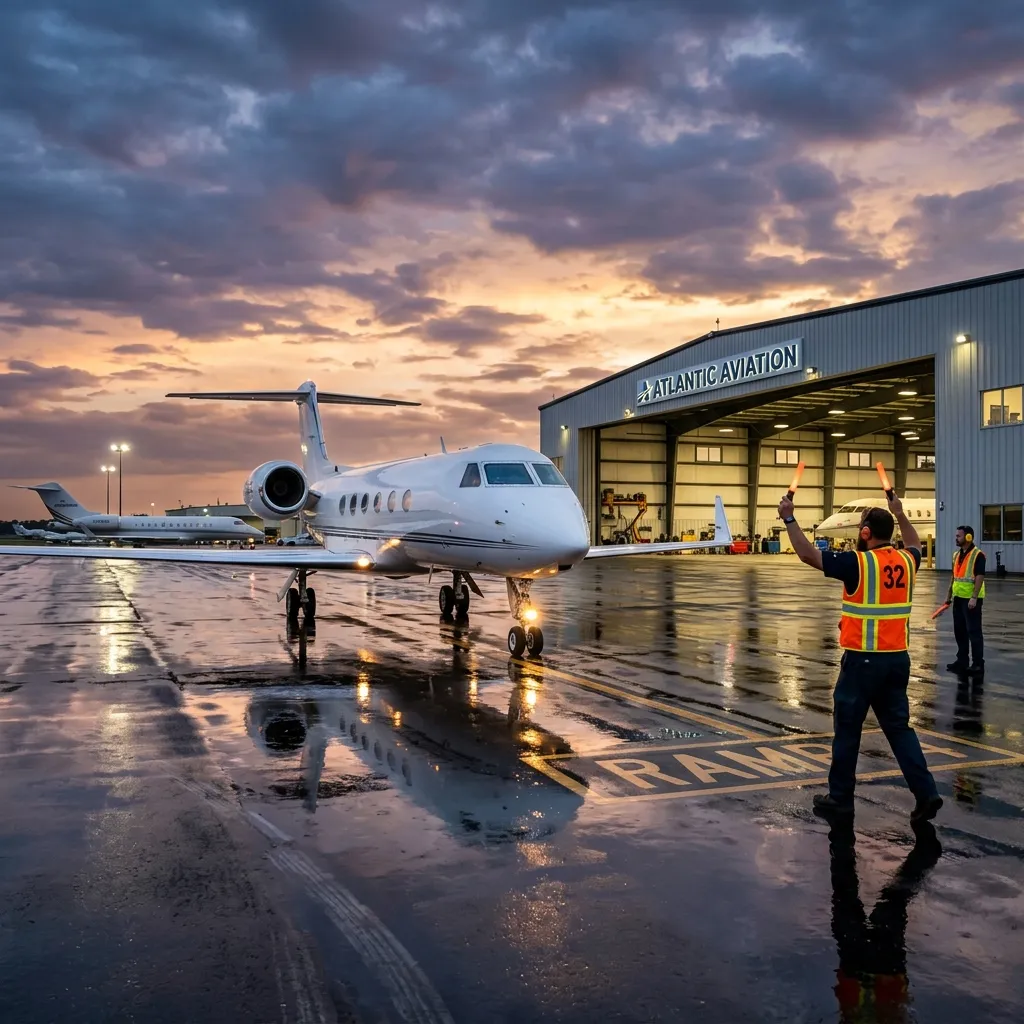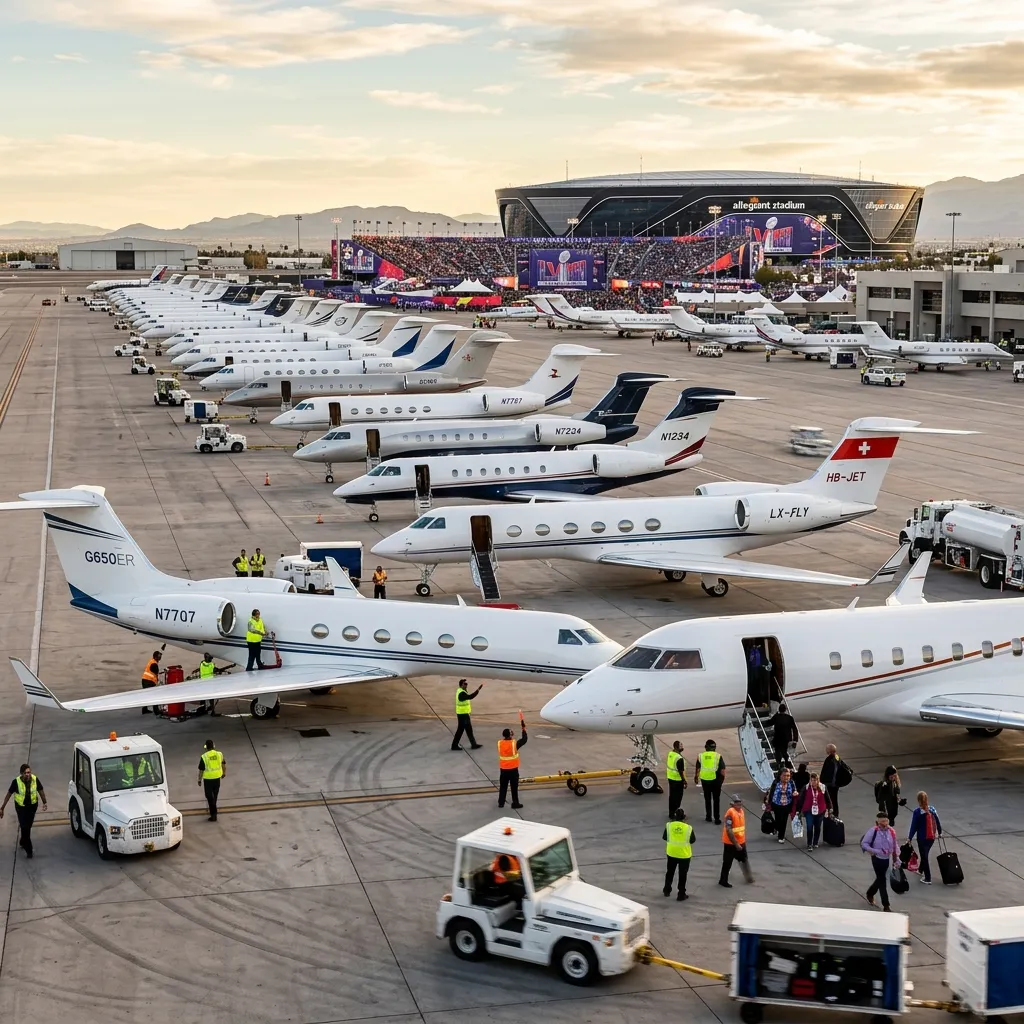
Private jets lined up on an airport ramp during a Formula 1 race weekend with the circuit visible in the background

Formula 1 by Private Jet: Airport Strategy for Austin, Miami, and Las Vegas Race Weekends

undefined

In This Article

F1 Weekends Are Private Aviation's Biggest Demand Surge Austin Grand Prix: Circuit of the Americas Miami Grand Prix: Miami International Autodrome Las Vegas Grand Prix: The Strip Circuit Booking Strategy and Cost Expectations Frequently Asked Questions

F1 Weekends Are Private Aviation's Biggest Demand Surge

Formula 1 race weekends generate the most concentrated private aviation demand events in the United States. The three American Grand Prix venues (Austin, Miami, and Las Vegas) each produce a 300-400% surge in private jet movements over the Thursday-through-Monday race window. Ramp space at nearby airports sells out weeks in advance. FBO fees spike 50-200% during peak hours. Charter rates for positioning legs into race cities can reach 3-4x normal pricing. For clients arriving by private jet, the experience starts with airport selection and ground logistics, not the paddock.

The U.S. F1 calendar has expanded aggressively since 2021: Austin (Circuit of the Americas, October), Miami (Miami International Autodrome, May), and Las Vegas (Las Vegas Strip Circuit, November). Each venue presents distinct private aviation challenges. Austin has limited GA infrastructure for a mid-size metro. Miami distributes traffic across a mature multi-airport system. Las Vegas funnels surge demand into airports already operating near capacity due to casino and convention traffic.

Austin Grand Prix: Circuit of the Americas

Austin-Bergstrom International (AUS) is the primary private aviation entry point for the USGP. The Atlantic Aviation and Signature Flight Support FBOs handle race weekend traffic, but ramp space is finite. By Thursday of race week, transient parking is at capacity and late arrivals may be redirected to Georgetown (GTU) or San Marcos (HYI). Reserve ramp space 4-6 weeks in advance. Landing fees during F1 weekend at AUS are standard, but FBO handling fees and overnight parking rates increase significantly.

COTA is located 15 miles southeast of Austin-Bergstrom. The drive is 15-25 minutes under normal conditions but can stretch to 45-60 minutes during race ingress (Friday-Sunday, 8-10 AM). Helicopter transfers from AUS to COTA are available through operators like Hill Country Helicopters, with landing at the circuit's designated helipad. Helicopter pricing runs $3,000-$6,000 per flight (4-6 passengers), but eliminates the traffic variable entirely.

Georgetown Municipal (GTU) is the overflow airport for Austin race weekends. Its 5,000-foot runway accommodates light jets (Phenom 300, CJ4, Citation XLS) but not super-midsize or heavy jets. Georgetown is 35-45 minutes from COTA under normal conditions. During race weekend, northbound traffic from Georgetown to COTA adds 15-20 minutes. For heavy jet operators, San Marcos Regional (HYI) offers 5,600 feet and is closer to COTA but has limited FBO services.

Miami Grand Prix: Miami International Autodrome

Miami's private aviation infrastructure is built for surge demand. Opa-locka Executive (OPF) is the closest general aviation airport to the Miami International Autodrome (Hard Rock Stadium complex in Miami Gardens), with an 8,002-foot runway and multiple FBOs. During race weekend, OPF handles 200-300 additional private jet movements above normal traffic. Fort Lauderdale Executive (FXE) absorbs overflow with its established FBO network and handles the Broward County attendee segment.

The Miami Grand Prix's location at Hard Rock Stadium means ground transport from any airport involves navigating I-95, the Palmetto Expressway, or surface streets through Miami Gardens. Race-day traffic from OPF to the stadium runs 30-45 minutes; from FXE, add 15-20 minutes. Helicopter transfers to the stadium helipad are the most efficient option for time-sensitive arrivals: 8-12 minutes from OPF, 15 minutes from FXE, at $4,000-$7,000 per flight.

Need a Charter Quote?

Contact our team for a personalized quote.

Get a Quote

Las Vegas Grand Prix: The Strip Circuit

The Las Vegas Grand Prix presents the most challenging private aviation logistics of the three U.S. races. Las Vegas already operates at high private jet volumes due to casino, entertainment, and convention traffic. Adding an F1 race on top of baseline demand overwhelms Henderson Executive (HND) and North Las Vegas (VGT). During the 2023 inaugural race weekend, Henderson logged over 600 private jet arrivals in 72 hours, straining ramp space and ground handling capacity.

Henderson Executive (HND) is the preferred airport for race weekend: closest to the Strip, 6,501-foot runway, and multiple FBOs. But HND's ramp fills 2-3 weeks before the race. North Las Vegas (VGT) handles overflow but its 5,004-foot runway limits operations to light and some midsize jets. McCarran/Harry Reid International (LAS) accepts private jets through Signature Flight Support, but landing and handling fees ($1,000-$3,000+) and airline congestion make it a last resort. Early booking (60-90 days ahead) is essential for Henderson ramp reservations.

The Las Vegas Strip Circuit runs through the heart of the Strip, closing major streets Thursday through Sunday. This road closure affects ground transport from every airport. Henderson to the Strip, normally 15-25 minutes, can stretch to 45-60 minutes during race-weekend street closures. North Las Vegas to the Strip may require routing through the I-215 beltway, adding 15-20 minutes. Pre-arrange ground transport with a driver who knows the closure map. The Wynn, Bellagio, and Venetian have private arrival lounges for guests arriving by helicopter or car service.

Booking Strategy and Cost Expectations

The total cost of private jet access to an F1 weekend is substantial: $30,000-$100,000 for round-trip charter (depending on aircraft type and origin city), $500-$2,000 in FBO fees, $3,000-$7,000 for helicopter transfers (if used), and ground transport. For clients already attending F1 with paddock access ($5,000-$15,000), hospitality suites ($10,000-$50,000+), and hotel accommodations ($1,500-$5,000/night at race-adjacent properties), the private aviation component is a significant but proportional expense.

Brian Galvan

Written By

Brian Galvan

Founder, The Jet Finder ยท Private Aviation Operations & Technology

Former Director of Technology at FlyUSA (Inc. 5000 fastest-growing private jet company). Decade of hands-on experience across Part 135 operations, charter sales, fleet management, and aviation data systems.

LinkedInRead Full Profile →
Common Questions

Frequently Asked Questions


8 questions about chartering this aircraft

Aircraft availability for race weekends begins tightening 60-90 days before the event. At 30 days out, pricing for positioning legs has already increased 50-100%. At 14 days, aircraft availability narrows significantly and clients may be offered aircraft types they did not prefer. Charter operators report that F1 weekends are among the earliest-booking events in their annual calendar, alongside the Super Bowl, Masters golf, and Cannes Film Festival. Securing your preferred aircraft and schedule requires committing 2-3 months ahead.

McCarran/Harry Reid International (LAS) through Signature Flight Support is the alternative for heavy and ultra-long-range jets. LAS can accommodate G650, Global 7500, and BBJ aircraft that Henderson and North Las Vegas cannot efficiently park. Landing fees at LAS are higher ($1,000-$3,000) and airline congestion adds taxi time, but the 13,000-foot runway and professional handling make it viable. Some operators position heavy jets at Jean Sport Aviation (0L7, 30 miles south) for parking, then shuttle passengers to the Strip by car.

Yes, but availability and infrastructure vary. Austin: Hill Country Helicopters and charter operators offer AUS-to-COTA transfers using the circuit's helipad. Limited capacity (4-6 helicopters per hour). Miami: Established helicopter charter market (Ocean Helicopters, HeliNY seasonal) with transfers from OPF and FXE to Hard Rock Stadium helipad. Capacity is higher due to existing infrastructure. Las Vegas: Maverick Helicopters and charter operators offer transfers, but Strip airspace is complex and helicopter operations face restrictions during race sessions due to event TFRs (Temporary Flight Restrictions).

Yes, if you reserve ramp or hangar space in advance. Multi-day parking at AUS during race weekend costs $200-$500 per night depending on aircraft size and whether ramp or hangar parking is available. Hangar space sells out first. Ramp parking exposes the aircraft to Austin's October weather (typically mild, but thunderstorms are possible). Reserve through your FBO (Atlantic or Signature) 4-6 weeks ahead. An alternative is parking the aircraft at Georgetown (GTU) or San Marcos (HYI) at lower nightly rates and repositioning for your Monday departure.

Empty legs are advertised through charter broker platforms (PrivateFly, Avinode-connected brokers, Victor), operator direct listings (NetJets, Flexjet, XO), and specialized apps (FlyEmpty, Airly). For F1 weekends, empty legs departing Austin, Miami, and Las Vegas become available Sunday afternoon through Monday evening as operators reposition aircraft back to home bases. Pricing is 40-60% below standard one-way rates. The catch: empty legs have fixed origin, destination, and departure time with minimal flexibility. You must match the operator's repositioning schedule.

Street closures around the Strip reroute traffic from Las Vegas Boulevard to I-15, Koval Lane, and Industrial Road. Henderson to the Strip via Eastern Avenue and Tropicana remains partially open but congested. GPS routing apps during race weekend may suggest circuitous routes that add 20-30 minutes. Pre-arrange a driver familiar with the closure pattern. The Wynn and Encore (north Strip) are accessible from I-15 without crossing the circuit. The Bellagio and Aria (mid-Strip) require navigating around the circuit perimeter, adding 10-15 minutes versus normal routing.

Three strategies reduce F1 charter cost. First, fly in Thursday and depart Monday to avoid Friday-Sunday peak pricing and departure queues. Second, book a light jet for short routes (under 1,000 NM) instead of a heavy; the price difference is $15,000 versus $45,000 one-way. Third, explore empty-leg repositioning flights into the race city: operators position aircraft for their clients' departures and may sell the inbound leg at 40-60% discount. Coordinating with 3-4 brokers simultaneously increases the probability of finding favorable positioning.

Several charter operators and brokers offer multi-race packages that bundle charter access across 2-3 U.S. Grand Prix weekends at a 10-20% discount versus individual bookings. NetJets and Flexjet do not offer formal F1 packages but their contract holders benefit from locked-in hourly rates that do not surge during events. Independent brokers like PrivateFly and Monarch Air Group have created F1 season packages that include charter, FBO coordination, and ground transport for clients attending multiple races. These packages require commitment 3-4 months before the first race.

Continue Reading

Related Articles


Your Next Mission

Ready to Fly?


Whether you need a charter quote or want to explore aircraft options, our team is here.

Contact Us