Three Airports, Three Different Experiences
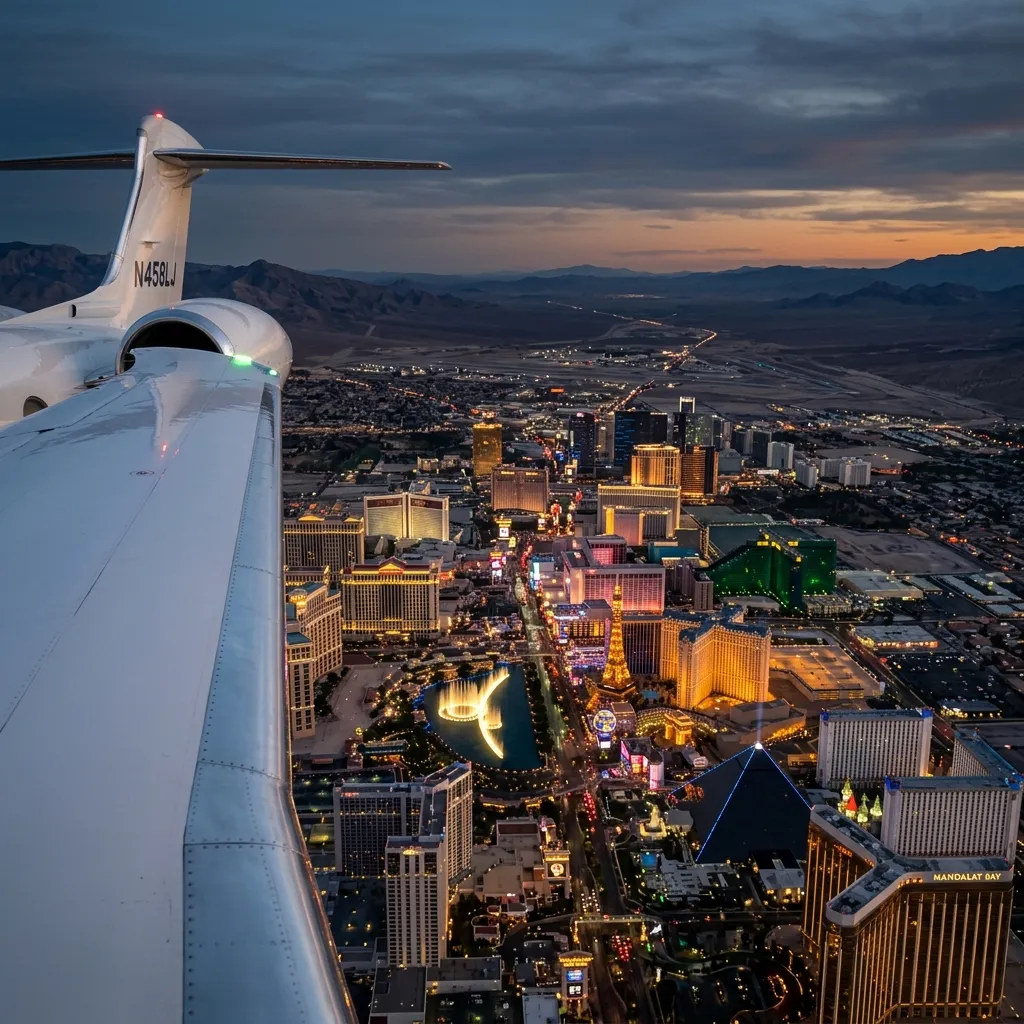
Las Vegas handles over 60,000 private jet operations per year, distributed across three airports within 20 miles of the Strip. Henderson Executive Airport (HND) processes roughly 85% of that traffic through a 6,501-foot runway and two competing FBOs. Your choice of airport affects everything from ground transfer time to ramp fees and noise curfew restrictions.
Henderson Executive (HND) sits 12 miles south of the Strip and handles roughly 85% of Las Vegas private jet traffic. The airport has a 6,501-foot runway that accommodates everything up to heavy jets with weight restrictions, two full-service FBOs, and a 15-minute drive to most Strip hotels. North Las Vegas (VGT) lies 8 miles north of downtown with a 5,004-foot runway better suited to light and midsize jets. Harry Reid International (LAS) offers FBO service on the south side of the commercial airport, providing the shortest ground transfer to the south Strip but at significantly higher fees.
Henderson Executive Airport: The Default Choice
Henderson's appeal is straightforward: it has the longest general aviation runway near the Strip, the most FBO competition (keeping prices reasonable), and approach procedures that keep jets away from McCarran's complex Class B airspace. Signature Flight Support and Henderson Executive Aviation operate full-service FBOs with lounges, conference rooms, and customs clearance capability.
Runway 17R/35L at 6,501 feet handles Gulfstream G550s, Challenger 350s, and most heavy jets without payload restrictions at standard temperatures. On summer days when density altitude exceeds 5,000 feet, heavy jets at maximum takeoff weight may require performance analysis. Light jets and midsize aircraft operate without restriction year-round.
Summer Heat Operations
Las Vegas temperatures routinely exceed 110°F between June and September. At those temperatures, runway performance degrades measurably. A Challenger 604 that departs Henderson at maximum weight on a 115°F day needs nearly 6,200 feet of the 6,501 available. Operators schedule departures before 10 AM or after 7 PM during peak summer to maintain performance margins. Passengers should expect adjusted departure times during July and August.
Henderson sits at 2,492 feet MSL, modest by western airport standards but high enough to affect takeoff performance calculations during summer. Density altitude on a 115F day reaches approximately 6,000 feet. Pilots planning heavy jet departures from Henderson during June through September run performance calculations using the worst-case temperature for the departure window and add conservative margins. The result is occasional payload restrictions: fuel trades for passengers, or passengers trade for baggage. Light jets and turboprops operate without meaningful restriction at any temperature Henderson experiences.
FBO Selection and Costs at Henderson
Signature Flight Support operates the larger facility at HND with a 12,000 square foot terminal, passenger lounge, crew rest area, and covered vehicle parking. Ramp fees start at $150 for light jets and scale to $500 for large cabin aircraft, waived with minimum fuel purchase. Fuel prices at Henderson track 10-15% above Gulf Coast wholesale, with current Jet-A pricing around $6.20-$7.00 per gallon depending on volume.
Henderson Executive Aviation runs a competitive operation with a slightly smaller terminal but aggressive fuel pricing to capture market share. Many charter operators prefer this FBO for cost reasons, passing the savings through to clients. Ground transportation coordination is comparable at both facilities, with pre-arranged vehicles meeting passengers at the aircraft.
During CES, SEMA, and March Madness, Henderson's ramp fills to capacity. Slot reservations go from optional to mandatory. Book FBO arrival slots at least 72 hours in advance for any major convention or sporting event.
Peak Events and Pricing Surcharges
Las Vegas hosts the most demanding private aviation events in North America. CES in January generates an estimated 3,000 private jet movements in four days. The Super Bowl (when hosted in Vegas) floods all three airports. The Formula 1 Las Vegas Grand Prix in November has created a new peak that rivals CES for aircraft volume. During these windows, charter pricing to Las Vegas increases 40-75% above standard rates.
Outside event windows, Las Vegas charter pricing is competitive. The city's position as a destination rather than a hub means operators frequently have aircraft repositioning to or through Vegas, creating empty leg opportunities. One-way flights from Los Angeles to Las Vegas on a light jet regularly appear as empty legs in the $3,500-$5,000 range.
The Formula 1 Las Vegas Grand Prix, added to the calendar in 2023, has created a new November peak that operators compare to CES in volume and pricing intensity. The race weekend generates an estimated 1,800-2,200 private jet movements, concentrated between Thursday and Sunday night. Unlike CES, which distributes arrivals across multiple days, F1 arrival demand spikes sharply on Thursday afternoon and Friday morning. Departure demand compresses into a six-hour window after the race on Saturday evening, creating ramp congestion that challenges even Henderson experienced line crews.