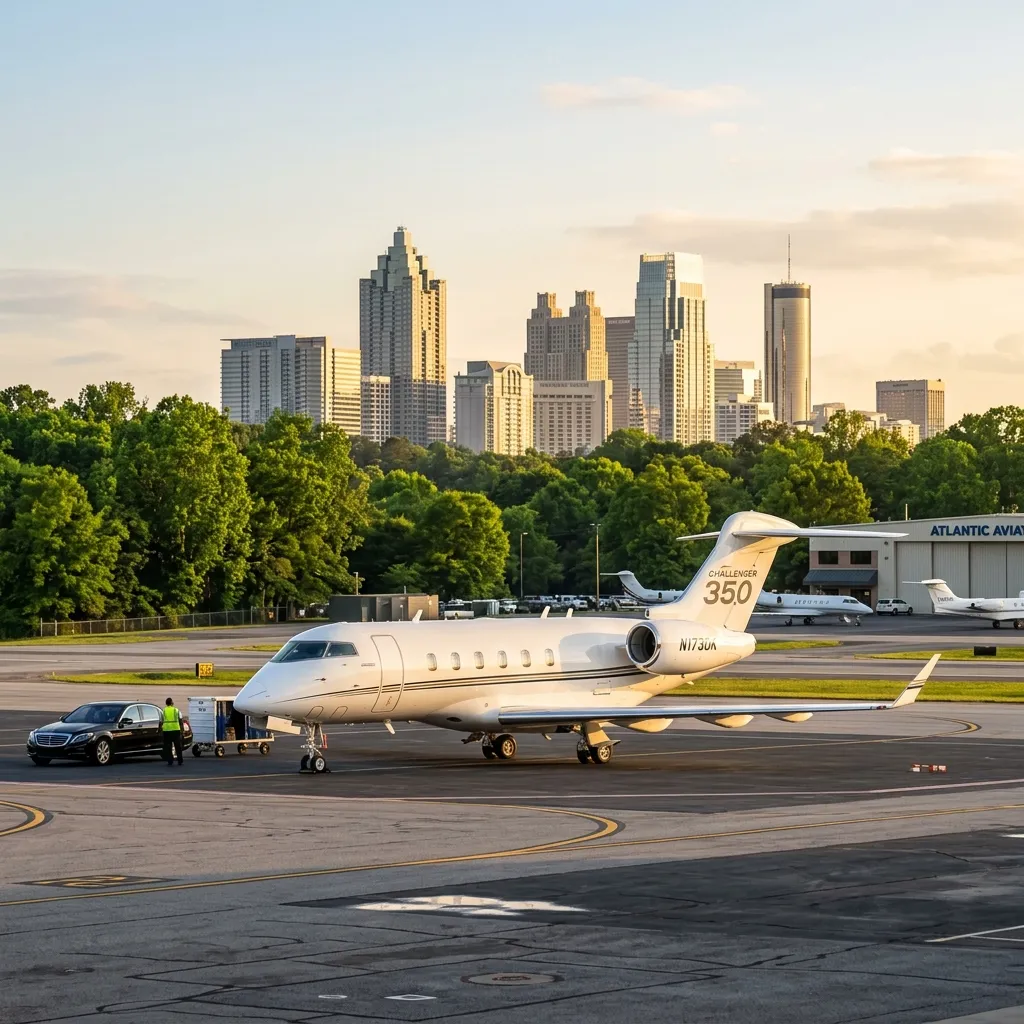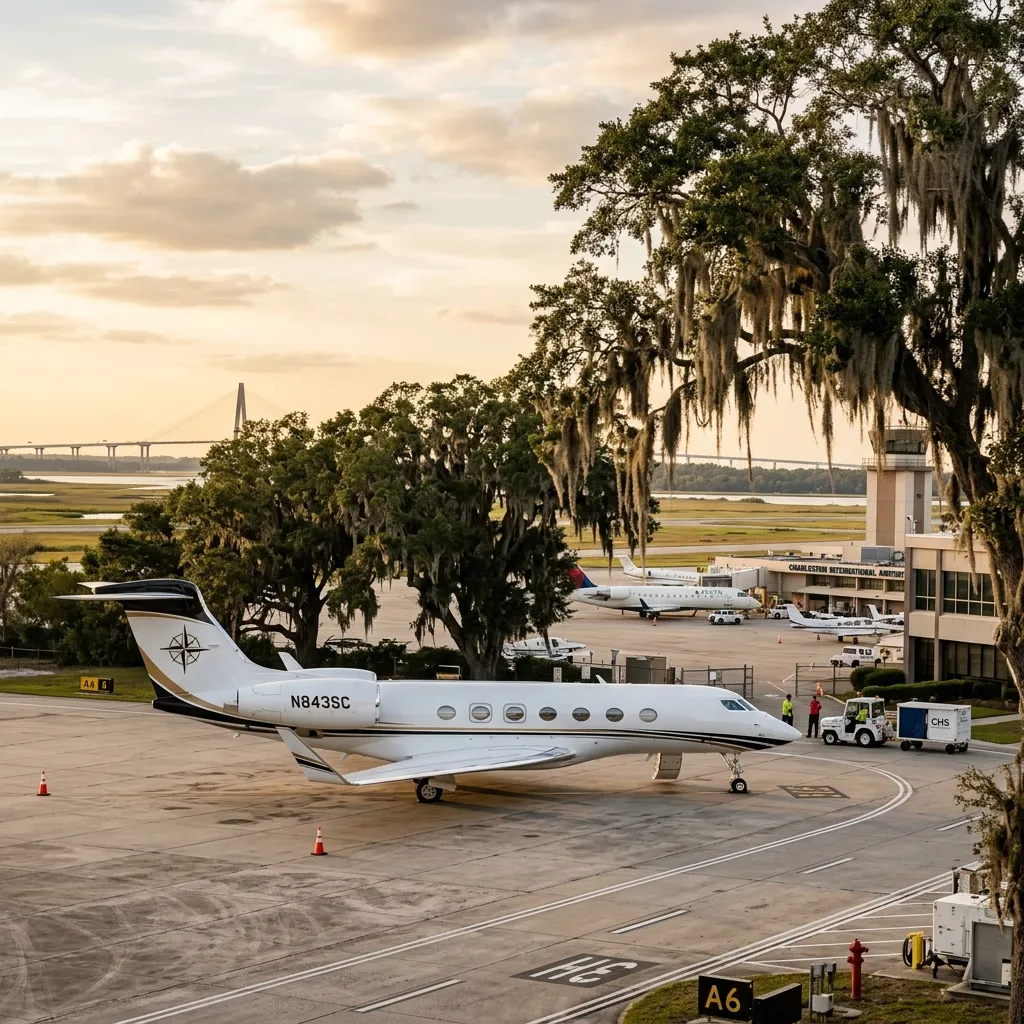
Business jet on the ramp at Charleston International Airport with moss-draped live oaks and historic architecture visible beyond the field

Flying Private to Charleston: CHS, Mount Pleasant, and Lowcountry Airport Strategy

undefined

In This Article

Charleston: The Lowcountry's Private Aviation Gateway Airport Options Wedding and Event Season Seasonal Weather and Hurricane Considerations Frequently Asked Questions

Charleston: The Lowcountry's Private Aviation Gateway

Charleston has emerged as one of the fastest-growing private aviation markets in the Southeast, driven by corporate relocations (Volvo, Mercedes-Benz Vans, Boeing 787 Dreamliner final assembly), a booming luxury real estate market, and its status as the top U.S. travel destination per Condé Nast Traveler for 11 consecutive years. Charleston International Airport/Air Force Base (CHS) handles the vast majority of private jet traffic, with a 9,001-foot runway that accommodates every business jet in production.

Private jet traffic at CHS has increased 35% since 2019. The growth reflects both leisure demand (destination weddings, resort travel to Kiawah Island and Isle of Palms) and corporate demand (Boeing, Volvo, Blackbaud, and a growing tech startup ecosystem). Atlantic Aviation operates the primary FBO at CHS, providing full services 15 minutes from the historic district's King Street and the French Quarter.

Airport Options

Charleston International (CHS) is the primary private jet airport for the Lowcountry region. The 9,001-foot runway handles all aircraft types, CBP is available for Caribbean and international arrivals, and Atlantic Aviation's FBO terminal provides a modern passenger experience. CHS shares its runway system with the 437th Airlift Wing (Air Force C-17 operations) and Boeing's 787 Dreamliner assembly facility, but military and commercial traffic do not significantly delay private jet operations.

Mount Pleasant Regional (LRO) serves light jets and turboprops east of the Cooper River. Its 3,700-foot runway limits operations to Citation M2, Phenom 100, and similar light aircraft. LRO's value is proximity to Mount Pleasant, Sullivan's Island, and Isle of Palms: passengers heading to east-of-Cooper destinations save 15-20 minutes versus CHS. Charleston Executive Airport (JZI) on Johns Island provides the closest access to downtown and Kiawah Island with a 3,800-foot runway suitable for light jets.

Hilton Head Island Airport (HHH) is 90 miles south of Charleston with a 4,300-foot runway. For clients splitting time between Charleston and Hilton Head, a 20-minute reposition flight (CHS to HHH) is more efficient than the 2-hour drive via US-17. Hilton Head's runway restricts operations to light and midsize jets. Beaufort County Airport (BFT) near Beaufort/Bluffton provides a 7,100-foot runway for heavier aircraft, 30 minutes from Hilton Head.

Need a Charter Quote?

Contact our team for a personalized quote.

Get a Quote

Wedding and Event Season

Charleston is one of the top destination wedding markets in the country, and wedding-related charter generates a meaningful share of private jet traffic. Peak wedding season (March-May and September-November) drives weekend demand spikes, particularly Friday arrivals and Sunday departures. Venues at Boone Hall Plantation, Middleton Place, and Kiawah Island Club attract wedding parties that arrive by private jet from New York, Chicago, and Dallas.

The Spoleto Festival USA (May-June, 17 days) brings performing arts patrons from across the country and generates charter demand concentrated on opening and closing weekends. The Southeastern Wildlife Exposition (February) and Charleston Wine + Food Festival (March) drive secondary surges. For all events, CHS ramp space is generally adequate: Charleston's ramp congestion is significantly less severe than comparable-size markets because Atlantic Aviation manages a large ramp area relative to demand.

Seasonal Weather and Hurricane Considerations

Charleston's subtropical climate produces warm, humid conditions year-round with hurricane exposure from June through November. Hurricane season is the most operationally significant weather factor: Charleston sustained direct hits from Hurricane Hugo (1989, Category 4) and significant impacts from Hurricane Matthew (2016) and Hurricane Ian (2022). Aircraft based at CHS should maintain hurricane evacuation plans to inland airports (Columbia, Charlotte, Atlanta).

Summer heat (June-September, 90-95°F with 80-90% humidity) affects aircraft performance modestly at CHS's 9,001-foot runway, where even the heaviest business jets have ample margin. Afternoon thunderstorms are common during summer months and can cause 1-3 hour delays. Winter weather rarely impacts operations: Charleston averages less than 1 inch of snow per year and freezing precipitation events occur every 3-5 years.

Brian Galvan

Written By

Brian Galvan

Founder, The Jet Finder · Private Aviation Operations & Technology

Former Director of Technology at FlyUSA (Inc. 5000 fastest-growing private jet company). Decade of hands-on experience across Part 135 operations, charter sales, fleet management, and aviation data systems.

LinkedInRead Full Profile →
Common Questions

Frequently Asked Questions


8 questions about chartering this aircraft

The 437th Airlift Wing operates C-17 Globemaster III aircraft from CHS. Military operations have priority when active, which can create 5-15 minute delays during C-17 departure sequences. The military flies primarily during weekday business hours. Weekend military activity is minimal, which aligns well with Charleston's leisure-heavy charter demand pattern. Atlantic Aviation FBO coordinates with the military tower to minimize civilian delays. Most private jet operators report that military traffic at CHS is a minor scheduling consideration, not a significant operational constraint.

Charleston Executive (JZI) on Johns Island is the closest airport to Kiawah at 20-25 minutes via Bohicket Road, but its 3,800-foot runway limits operations to light jets. CHS to Kiawah Island is 35-45 minutes via I-26 East and Highway 17. For passengers arriving in midsize or larger jets, CHS is the only option. The 35-45 minute drive is scenic, crossing the Ashley River and passing through historic plantation country along Highway 17 South. Pre-arranged car services are recommended for Kiawah transfers.

Boeing's 787 Dreamliner assembly facility is on the north side of the airport, separate from the Atlantic Aviation FBO on the south side. Boeing uses the main runway for test flights and delivery flights, which can create 10-15 minute delays during Dreamliner departures (large aircraft require extended runway occupancy). Boeing flights average 2-3 per week, so the probability of conflict on any given day is low. The industrial presence has no impact on FBO quality or ground services.

Yes. Charleston's luxury real estate market ($2M+ properties on Kiawah, Sullivan's Island, downtown) generates consistent house-hunting charter demand. Buyers from New York, Chicago, Boston, and south Florida charter for long-weekend property tours, typically Friday arrival through Sunday departure. Real estate agents in the $5M+ segment coordinate directly with Atlantic Aviation FBO to arrange ground transport to multiple property showings. The pattern is consistent year-round with peaks during spring (March-May) when Charleston's garden season enhances property appeal.

Begin monitoring tropical systems when a named storm enters the western Atlantic or Gulf of Mexico with a potential Carolina track. Evacuate when the National Hurricane Center's forecast cone includes Charleston at 72 hours. CHS will close 12-24 hours before projected landfall of a Category 1+ hurricane. Common evacuation destinations include Columbia (CAE, 95 miles), Charlotte (CLT, 195 miles), and Atlanta (PDK, 300 miles). Post-storm, CHS may remain closed for 24-72 hours due to flooding, debris clearance, and damage assessment.

For light aircraft (Phenom 100, Citation M2, King Air 350), LRO is the most time-efficient option for east-of-Cooper destinations. Sullivan's Island is 10-15 minutes from LRO versus 25-30 minutes from CHS. Isle of Palms is similarly closer. LRO has no FBO services (self-service fuel only) and no ground transport arrangements, so passengers should pre-arrange car service or rental. For midsize and larger jets, CHS remains the only option with appropriate runway length.

Charleston and Savannah are 108 miles apart (2-hour drive via I-95). They are not interchangeable for most itineraries. SAV serves Hilton Head Island (45 min), Bluffton (30 min), and the Georgia coast. CHS serves Charleston proper, Kiawah (40 min), and the South Carolina Lowcountry. For clients visiting both Charleston and Savannah/Hilton Head, a 25-minute reposition flight (CHS to SAV or HHH) is more efficient than driving. Savannah's Sheltair FBO is comparable to Charleston's Atlantic Aviation in service quality.

The Charleston Wine + Food Festival (first week of March) generates a moderate private aviation surge, primarily from New York, Dallas, and south Florida. The festival's attendee demographic skews toward HNW food and wine enthusiasts who prefer private aviation. CHS ramp space can accommodate the surge without overflow. However, Friday arrival and Sunday departure slots concentrate demand during those windows. Book charter 2-3 weeks ahead for festival weekend. The festival coincides with Charleston's spring bloom season, which enhances the destination appeal and drives some additional leisure charter demand.

Continue Reading

Related Articles


Your Next Mission

Ready to Fly?


Whether you need a charter quote or want to explore aircraft options, our team is here.

Contact Us