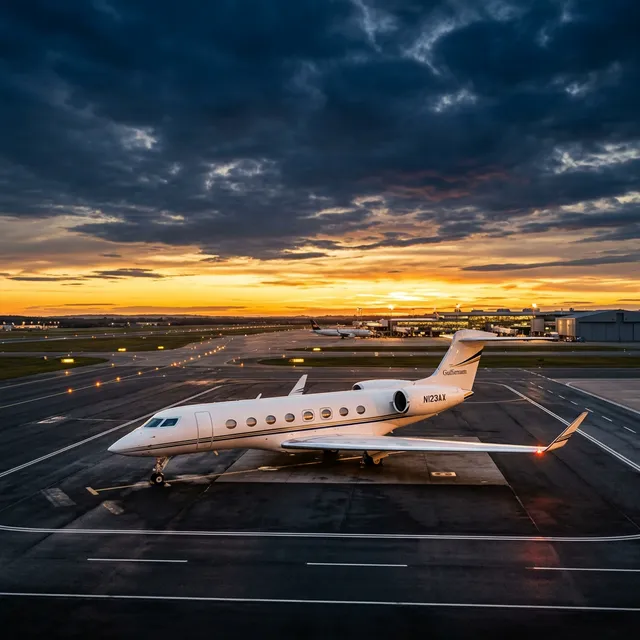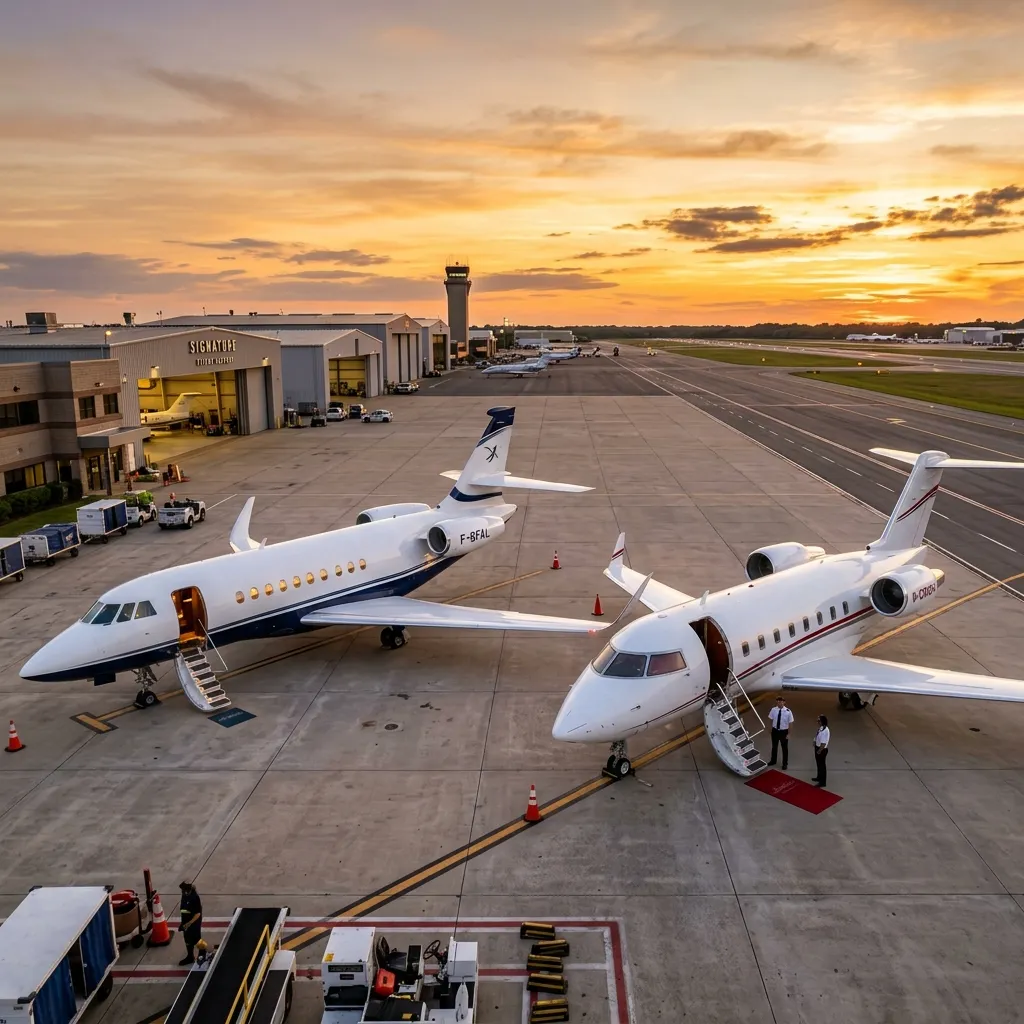
Dassault Falcon 2000LXS and Bombardier Challenger 604 business jets side by side on a ramp

Falcon 2000LXS vs Challenger 604: Two Wide-Body Heavies, Two Different Philosophies

undefined

In This Article

Two Approaches to the Heavy Jet Mission Performance Comparison Cabin: Width Versus Efficiency Operating Economics and Pre-Owned Values Choosing Between Them Frequently Asked Questions

Two Approaches to the Heavy Jet Mission

The Dassault Falcon 2000LXS and Bombardier Challenger 604 both deliver approximately 4,000 NM range with large cabins, but they reach that capability through fundamentally different design philosophies. The Falcon 2000LXS descends from Dassault's fighter jet heritage: lower drag, shorter field performance, and higher cruise altitude. The Challenger 604 descends from the widest fuselage cross-section in its class: more cabin volume, more passenger comfort, and a proven engine-airframe combination with four decades of service history.

The Falcon 2000LXS (2014-present) is the current production variant of the Falcon 2000 family, featuring PW308C engines and the Honeywell EASy III flight deck. The Challenger 604 (1996-2007) is no longer in production but remains available in significant numbers on the pre-owned market, with approximately 350 aircraft still in active service. This comparison pits a current-production Dassault against a proven, value-priced Bombardier.

Performance Comparison

The Falcon 2000LXS holds meaningful advantages in every performance metric except range, where both aircraft deliver 4,000 NM. The Falcon cruises 22 knots faster, climbs 6,000 feet higher (FL470 vs FL410), and departs from runways 660 feet shorter. The shorter takeoff distance is the Falcon's signature capability: airports like Aspen (ASE), London City (LCY), and La Mole-Saint Tropez (LTT) that restrict or exclude the Challenger 604 are accessible in the Falcon 2000LXS.

The Falcon 2000LXS burns approximately 40 fewer gallons per hour than the Challenger 604. At $7/gallon and 400 annual flight hours, that fuel efficiency saves $112,000 per year. Over a 5-year ownership period, fuel savings alone total $560,000, enough to offset a significant portion of the Falcon's higher acquisition premium.

Cabin: Width Versus Efficiency

The Challenger 604's 8.2-foot cabin width is its defining advantage. That 6-inch margin over the Falcon transforms the seating configuration: the 604 offers true wide-body club seating where four adults sit facing each other with a center aisle wide enough for comfortable movement. The Falcon 2000LXS cabin at 7.7 feet is generous by any standard, wider than every super-midsize jet on the market, but the 604's extra width is noticeable to passengers who have experienced both.

The Falcon compensates with more baggage volume (131 cu ft vs 115 cu ft) and Dassault's signature cabin fit and finish. Falcon interiors are designed and built at Dassault's Le Bourget completion center, with a reputation for material quality and craftsmanship that has earned loyal following among repeat buyers. The Challenger 604's longer cabin (28.3 ft vs 26.2 ft) provides more space for three-zone configurations with a forward galley, mid-cabin club, and aft divan.

Need a Charter Quote?

Contact our team for a personalized quote.

Get a Quote

Operating Economics and Pre-Owned Values

The acquisition cost gap is the defining variable. A pre-owned Challenger 604 trades at $3.5-$6 million, roughly one-third the cost of a pre-owned Falcon 2000LXS ($12-$18 million). That $8-$12 million gap buys a lot of fuel: at $280/hour fuel savings, the Falcon needs 28,000-43,000 flight hours to break even on acquisition alone. No owner flies that much. The Challenger 604 is the value play for buyers who prioritize cabin width and low acquisition cost. The Falcon 2000LXS is the performance play for buyers who value runway flexibility, fuel efficiency, and current-generation avionics.

Choosing Between Them

The Falcon 2000LXS suits operators who need access to short or challenging runways, fly 300+ hours annually (where fuel savings compound), want current-production aircraft support and warranty coverage, and value Dassault's flight characteristics and avionics integration. European operators, in particular, favor the Falcon 2000 family for its London City Airport certification and Mediterranean short-field access.

The Challenger 604 suits buyers with a $4-$6 million budget who prioritize cabin width above all other variables, fly primarily domestic routes where FL410 ceiling and 459-knot speed are adequate, and accept the tradeoffs of a 15-25 year-old airframe (higher maintenance risk, dated avionics unless upgraded). The 604 excels as a group-charter workhorse, corporate shuttle, and medical evacuation platform where cabin volume is the primary requirement.

For buyers in between, the Challenger 605 (2007-2014) and Challenger 650 (2015-present) offer the same 8.2-foot cabin width with updated avionics at $8-$13 million and $14-$19 million respectively. These split the difference between the 604's value pricing and the Falcon 2000LXS's modern capabilities.

Brian Galvan

Written By

Brian Galvan

Founder, The Jet Finder ยท Private Aviation Operations & Technology

Former Director of Technology at FlyUSA (Inc. 5000 fastest-growing private jet company). Decade of hands-on experience across Part 135 operations, charter sales, fleet management, and aviation data systems.

LinkedInRead Full Profile →
Common Questions

Frequently Asked Questions


8 questions about chartering this aircraft

The Falcon 2000LXS. Its lower fuel burn (210 GPH vs 250 GPH) means more range per gallon of fuel loaded. With 8 passengers and bags (approximately 2,000 lbs payload), the Falcon 2000LXS maintains closer to its published 4,000 NM range than the Challenger 604, which drops to approximately 3,400-3,600 NM at the same payload. The Falcon's aerodynamic efficiency (lower drag coefficient from its fighter-derived wing design) produces a measurably flatter payload-range curve.

London City Airport (LCY, 4,948 ft) is the marquee example: the Falcon 2000 family is certified for LCY steep-approach operations, while the Challenger 604 is not. Other airports that favor the Falcon include La Mole-Saint Tropez (LTT, 4,593 ft), Lugano (LUG, 4,921 ft), and Samedan/St. Moritz (SMV, 5,600 ft but at 5,600 ft elevation). In the U.S., airports like Steamboat Springs (HDN, 4,452 ft at 6,882 ft elevation) are marginal for the CL604 but within the Falcon's envelope.

On domestic flights under 3 hours, the altitude difference has minimal practical impact. Both aircraft fly above most weather and commercial traffic at FL350-FL410. The Falcon's FL470 advantage matters on longer flights (4+ hours) where higher altitude improves fuel efficiency, and on busy air traffic days when ATC assigns altitudes based on availability. The 6,000-foot altitude advantage also means less turbulence exposure at higher altitudes, which is noticeable on transcontinental or transatlantic legs.

The PW308C benefits from Pratt & Whitney Canada's global service network, with authorized facilities across North America, Europe, Asia, and the Middle East. While the CF34's installed base (7,000+ engines) exceeds the PW308C (approximately 800 engines across all Falcon 2000 variants), P&WC's support infrastructure is robust. The PW308C is covered under P&WC's Eagle Service Plan (ESP) at $160-$220 per engine flight hour, comparable to GE's OnPoint coverage for the CF34. Parts availability and AOG response times are equivalent between the two engine programs.

Dassault's completion center at Le Bourget-Dugny has a reputation for fit, finish, and material selection that consistently ranks among the best in business aviation. The interior quality difference between a new Falcon and a new Bombardier has narrowed in recent years as Bombardier invested in its completion facilities. On pre-owned aircraft, the comparison is airframe-age dependent: a 2015 Falcon 2000LXS interior will show less wear than a 2002 CL604 interior regardless of manufacturer quality, simply due to age. Interior refurbishment ($800K-$1.5M for either type) equalizes cabin quality between the two.

Insurance premiums for both aircraft fall in the heavy jet category, typically $30,000-$60,000 annually for hull and liability coverage. The Challenger 604, being an older airframe with lower hull values ($3.5-$6M), carries lower hull insurance premiums (hull premiums are a percentage of insured value, typically 0.5-1.5%). Liability premiums are similar for both types. A $5M CL604 might cost $25,000-$35,000 annually in total premiums, while a $15M Falcon 2000LXS might cost $45,000-$65,000. The lower insurance cost is another economic advantage for the CL604.

Air ambulance configurations require a stretcher (72-76 inches long), medical equipment racks (monitors, ventilators, IV pumps), and working space for 2-3 medical attendants. The CL604's 8.2-foot width accommodates a stretcher along one sidewall with a 30-inch working aisle for medical personnel, plus equipment mounted on the opposite sidewall. The Falcon 2000's 7.7-foot width is 6 inches narrower, reducing the working aisle to approximately 24 inches, which restricts the medical team's ability to perform CPR and other interventions during flight. Multiple air ambulance operators (AirMed, AeroCare, Reva) chose the CL604 specifically for this width advantage.

The Falcon 2000LXS shares the same wing design philosophy as the three-engine Falcons: a leading-edge slat system that provides outstanding low-speed handling and short-field performance. Pilots who transition from the Falcon 900 to the 2000LXS report similar handling characteristics, including the responsive roll rate and predictable stall behavior that define Dassault aircraft. The 2000LXS uses digital flight controls (not full fly-by-wire, but digitally enhanced) that provide natural feedback. Challenger 604 pilots report solid, stable handling with heavier control forces typical of Bombardier's conventional hydraulic flight control systems.

Continue Reading

Related Articles


Your Next Mission

Ready to Fly?


Whether you need a charter quote or want to explore aircraft options, our team is here.

Contact Us