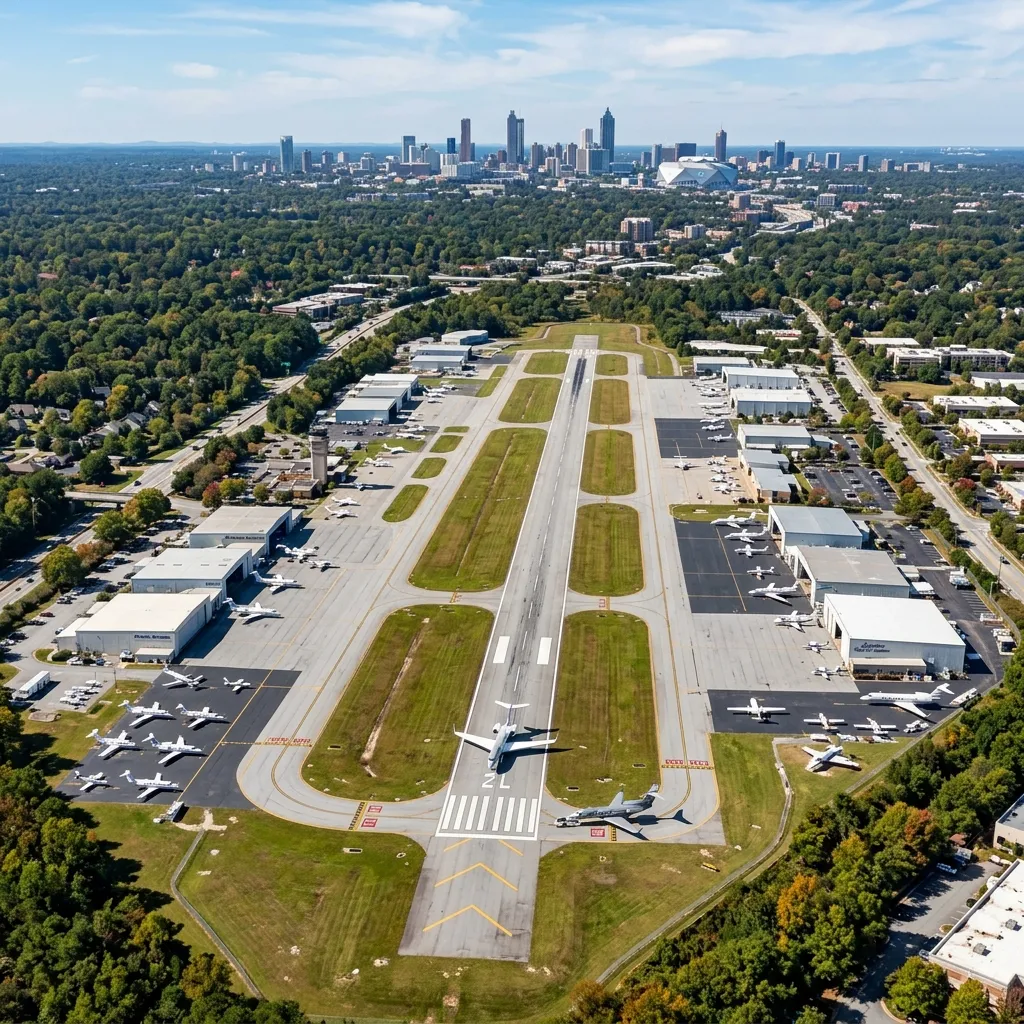
DeKalb-Peachtree Airport PDK with Atlanta skyline in the distance

DeKalb-Peachtree Airport: 310,000 Operations and Atlanta's Busiest GA Field

310,000 annual operations, three FBOs, and a 15-minute drive to Buckhead. PDK is how Atlanta's business community flies.

In This Article

PDK by the Numbers: 310,000 Operations Per Year FBO Options: Three Choices, Different Strengths Ground Transportation and Area Access Common Routes and Charter Pricing from PDK Noise Abatement and Operating Restrictions PDK vs Fulton County (FTY) vs Hartsfield-Jackson (ATL) Frequently Asked Questions

PDK by the Numbers: 310,000 Operations Per Year

DeKalb-Peachtree Airport (KPDK) recorded over 310,000 annual operations in 2025, placing it second among general aviation airports in the United States behind only Van Nuys (KVNY) in Los Angeles. The airport sits 8 miles northeast of downtown Atlanta in the Chamblee-Dunwoody area, directly accessible from I-285 and GA-400. For destinations in Buckhead, Midtown, or the Perimeter business corridor, PDK is materially closer than Hartsfield-Jackson (ATL).

Two parallel runways serve the field. Runway 3R/21L measures 6,001 feet, adequate for most business jets up to super-midsize category at typical operating weights. Runway 3L/21R measures 3,967 feet, primarily used by piston and light turboprop traffic. The 6,001-foot primary runway accommodates Citation Latitudes, Challenger 350s, and most Gulfstream models up to the G280 without payload restrictions.

Heavy jets like the Gulfstream G650, Global 6500, or Falcon 8X are runway-limited at PDK. Operators of these types typically use Fulton County Airport (FTY) on the west side of Atlanta, which offers a 5,796-foot runway, or Cobb County McCollum Field for lighter traffic. For heavy iron, PDK is not the right field.

FBO Options: Three Choices, Different Strengths

Signature Flight Support operates the largest FBO at PDK with a recently renovated terminal on the east side. The facility includes a passenger lounge, pilot rest area, conference rooms, covered parking, and GPU/lavatory service. Signature handles the majority of charter and transient business jet traffic at PDK.

Epps Aviation has operated at PDK since 1965 and owns the longest continuous FBO presence on the field. The operation includes a full-service maintenance shop, avionics installation facility, and aircraft management. Epps is the preferred FBO for locally based aircraft owners who value the integrated management-maintenance relationship.

Atlantic Aviation occupies a modern facility on the west ramp. Their fuel pricing is often the most competitive on the field, making them a frequent choice for operators focused on direct operating costs. Atlantic also provides deicing services during Atlanta's occasional winter weather events.

  • Signature Flight Support: largest terminal, highest traffic volume, full-service amenities, 24/7 operations
  • Epps Aviation: legacy operator since 1965, integrated maintenance and management, locally owned
  • Atlantic Aviation: competitive fuel pricing, newer facility, deicing capability
  • Average Jet-A price at PDK: $6.40-$7.20/gal (varies by FBO and fuel volume)
  • Customs: No CBP on field. International arrivals must clear at ATL first, then reposition to PDK

Ground Transportation and Area Access

Buckhead (financial district, hotels, restaurants): 15-20 minutes via GA-400 South. Midtown (arts district, technology corridor): 20-25 minutes via I-85 South. Downtown Atlanta (conventions, Mercedes-Benz Stadium): 25-30 minutes. Hartsfield-Jackson ATL for commercial connections: 35-45 minutes via I-285 West.

Car Service and Ride-Share

All three FBOs coordinate car service upon request. Black car to Buckhead runs $85-$120. SUV to downtown Atlanta runs $120-$175. Uber and Lyft operate freely at PDK with no restrictions on ride-share pickup from FBO terminals. During Atlanta's notorious rush hour (4-7 PM), add 30-50% to all drive time estimates.

Atlanta traffic is the single biggest variable in the PDK experience. The airport itself is efficient, uncongested, and well-run. The drive to your destination can double in length between 3 PM and 7 PM. Plan ground transportation around Atlanta's traffic patterns, not your flight schedule.

Need a Charter Quote?

Contact our team for a personalized quote.

Get a Quote

Common Routes and Charter Pricing from PDK

The PDK-to-Teterboro corridor is the highest-volume route from the field, driven by corporate shuttle traffic between Atlanta and New York. Empty leg availability on this route is common, particularly on Monday mornings (southbound) and Friday afternoons (northbound). The Atlanta-to-South Florida corridor is the second busiest, peaking during winter months.

Noise Abatement and Operating Restrictions

PDK operates under a voluntary noise abatement program. Preferred noise abatement departure procedures route traffic north over less populated areas. A voluntary curfew discourages operations between 10 PM and 7 AM, though it is not enforced by regulation.

The airport's location in a densely populated suburban area has generated ongoing tension with surrounding communities. DeKalb County has periodically explored runway length restrictions and operational caps. As of 2026, no regulatory caps on operations or runway length have been implemented, but operators should be aware that the political environment around PDK's growth is more contentious than at most metropolitan reliever airports.

Stage 2 aircraft are prohibited at PDK. All modern business jets meet Stage 3 or Stage 4 noise standards and are not affected by this restriction. Helicopter operations are permitted but subject to specific noise abatement routing.

PDK vs Fulton County (FTY) vs Hartsfield-Jackson (ATL)

PDK is the default choice for business aviation arriving from the north, east, or south side of Atlanta. Fulton County Airport (KFTY) serves the west side and handles heavier aircraft that exceed PDK's runway capability. ATL is rarely the right choice for private aviation due to airline traffic congestion, higher ramp fees, and longer taxi times.

For destinations in Buckhead, Midtown, Alpharetta, or the GA-400 corridor, PDK saves 20-40 minutes of ground time compared to ATL. For destinations on the west side of Atlanta (Cobb County, Marietta, Six Flags area), FTY is closer. For international arrivals requiring customs, ATL is necessary because PDK does not have CBP facilities.

310K+
Annual Operations
6,001 ft
Longest Runway
3 FBOs
On Field
15 min
To Buckhead
Brian Galvan

Written By

Brian Galvan

Founder, The Jet Finder ยท Private Aviation Operations & Technology

Former Director of Technology at FlyUSA (Inc. 5000 fastest-growing private jet company). Decade of hands-on experience across Part 135 operations, charter sales, fleet management, and aviation data systems.

LinkedInRead Full Profile →
Common Questions

Frequently Asked Questions


8 questions about flying private to DeKalb-Peachtree Airport

Technically possible on the 6,001-foot Runway 3R/21L, but operationally marginal. Both aircraft require 5,500-6,000 feet for takeoff at reduced weights and in favorable conditions. Most operators of heavy jets avoid PDK and use Fulton County Airport (FTY) or reposition from ATL after customs clearance. Light and midsize jets operate at PDK without restriction.

No. PDK does not have CBP facilities on the field. International arrivals must clear customs at Hartsfield-Jackson (ATL) first, then reposition the short flight to PDK. This adds approximately 45-90 minutes to the arrival process depending on CBP processing time and ATL taxi congestion.

Atlantic Aviation typically offers the most competitive Jet-A pricing at PDK, running $0.20-$0.40 per gallon below Signature and Epps on posted rates. However, contract fuel programs through Avfuel or World Fuel Services can close or eliminate that gap at any FBO. Operators fueling 200+ gallons should request contract pricing from all three before committing.

Approximately 25-30 minutes by car via I-85 South, or 35-45 minutes during rush hour. For large events at Mercedes-Benz Stadium (Super Bowl, SEC Championship, MLS matches), ground transportation times can double. Consider departing PDK well before event end times, or arrange a staging area near the venue to avoid the post-event traffic surge.

No hard curfew exists. PDK has a voluntary noise abatement program that discourages operations between 10 PM and 7 AM. The FBOs remain staffed for after-hours arrivals with advance notice. Late arrivals are not prohibited by regulation, but operators are expected to follow preferred noise abatement departure and arrival procedures during quiet hours.

Epps Aviation operates a full-service maintenance facility with A&P mechanics, avionics technicians, and AOG (Aircraft on Ground) response capability. They service most Citation, Hawker, and Learjet models in-house. For Gulfstream-specific maintenance, the Gulfstream service center in Savannah is a 45-minute flight. Bombardier has authorized service at multiple Atlanta-area facilities.

Masters week (typically early April) significantly increases private jet traffic in the Atlanta-Augusta corridor. PDK ramp space fills quickly, and FBOs require advance reservations. Many operators reposition to Augusta Regional (AGS) or Daniel Field (DNL) for direct access to the tournament. PDK serves as an overflow option when Augusta-area airports reach capacity.

Yes. Helicopter operations are permitted at PDK subject to noise abatement routing. There is no dedicated helipad; helicopters use the runway system. Epps Aviation and Signature both handle helicopter fuel and ground services. Helicopter charter from PDK to downtown Atlanta helipads takes approximately 8-10 minutes.

Continue Reading

Related Articles


Your Next Mission

Ready to Fly?


Whether you need a charter quote or want to explore aircraft options, our team is here.

Contact Us