The Numbers: APA by the Data
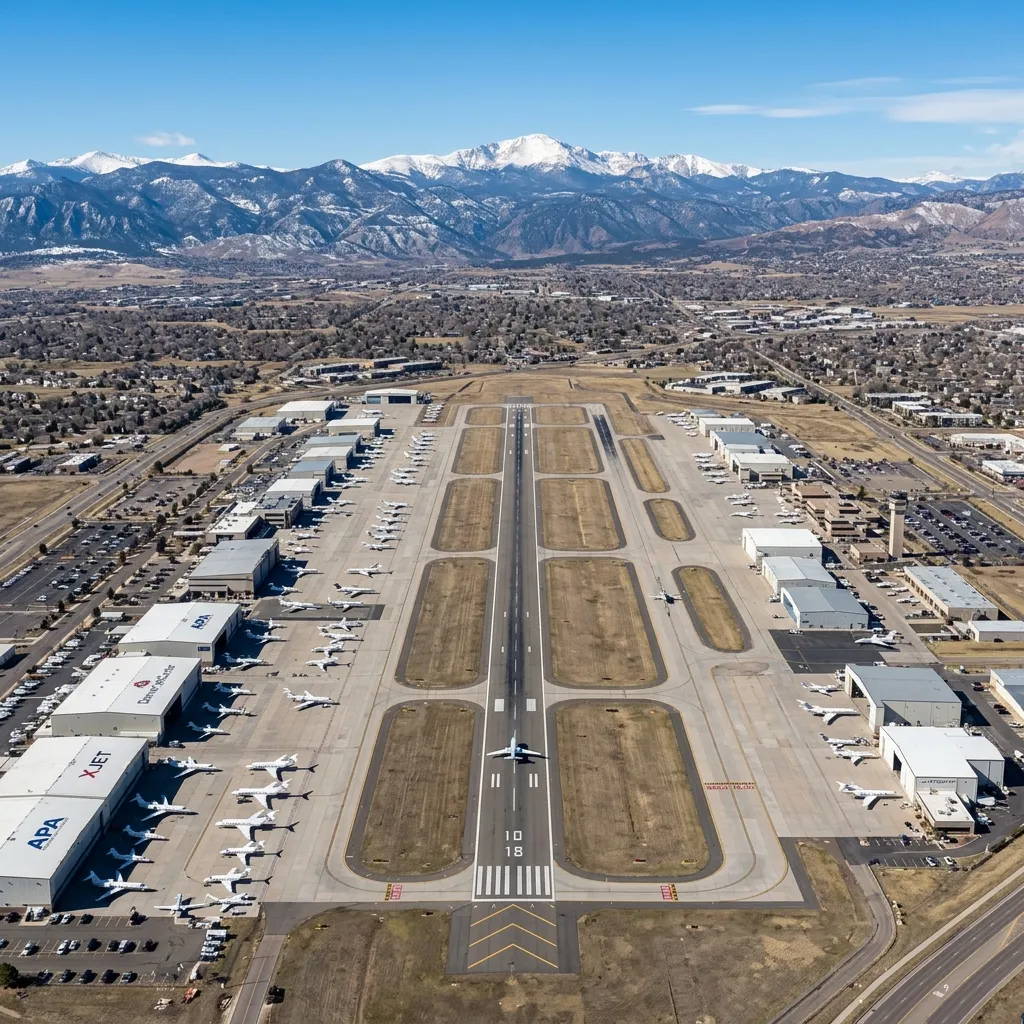
Centennial Airport (APA) sits 13 miles south of downtown Denver in Arapahoe County, Colorado. The airport has three runways: 17L/35R at 10,001 feet, 17R/35L at 7,001 feet, and 10/28 at 4,800 feet (primarily for light aircraft). The primary runway's 10,001-foot length accommodates every business jet in production, including the Global 7500 and Gulfstream G700 at maximum takeoff weight.
APA handles approximately 300 to 350 daily aircraft movements, making it the third-busiest general aviation airport in the United States behind Teterboro and Van Nuys. The airport has no commercial airline service and no TSA screening, providing the speed and privacy advantages that define private aviation.
The airport elevation of 5,885 feet is the defining operational characteristic. Every performance calculation (takeoff distance, climb rate, landing distance) is degraded by the high elevation. On a 95°F summer day, the density altitude at APA can exceed 9,000 feet, which reduces engine thrust and wing lift by 15 to 20% compared to sea-level performance. The 10,001-foot primary runway exists specifically to accommodate this performance penalty.
The Four FBOs
Centennial has four FBO operations: TAC Air, Signature Flight Support, Modern Aviation, and Denver Jet Center. The competition is intense, with each FBO targeting different segments of the market.
Denver Jet Center is the only independently owned FBO at Centennial. It occupies the southeast corner of the airport and is preferred by pilots who want a non-chain experience. TAC Air operates the largest facility with the most hangar space and ramp capacity. Signature handles the majority of international traffic and large-cabin jet operations.
Fuel pricing at APA is competitive due to the four-way FBO rivalry. Jet-A averages $6.50 to $7.50 per gallon at Centennial, compared to $7.50 to $9.00 at competing Rocky Mountain airports like Eagle County (EGE) and Aspen (ASE). The fuel price advantage drives operators to fuel up at APA rather than at mountain destination airports.
Density Altitude: The Invisible Variable
At 5,885 feet elevation, Centennial Airport operates in a permanent state of reduced aircraft performance compared to sea-level airports. The standard atmosphere temperature at 5,885 feet is approximately 3°C (38°F). When the actual temperature exceeds this value, which it does for 8 months of the year, the effective altitude of the airport increases.
On a typical July afternoon in Denver (temperature 95°F), the density altitude at APA reaches approximately 9,200 feet. A Phenom 300 that takes off in 3,400 feet at sea level needs approximately 5,500 feet at that density altitude. A Challenger 350 that needs 4,800 feet at sea level may need 7,500+ feet at APA on a hot day. The 10,001-foot primary runway provides adequate margin for all business jets, but the 7,001-foot secondary runway becomes limiting for larger aircraft.
Winter operations reverse the equation. On a January morning at 20°F, the density altitude at APA drops to approximately 4,500 feet, and aircraft performance is closer to sea-level published numbers. The best takeoff performance at Centennial occurs on cold winter mornings. The worst occurs on hot summer afternoons.
Need a Charter Quote?
Contact our team for a personalized quote.
Get a Quote →The Denver Metro Aviation Landscape
Denver International Airport (DEN) handles private jet traffic through Signature Flight Support's FBO on the south side of the field. DEN has longer runways (up to 16,000 feet) and ILS approaches to Cat IIIb minimums, but the airport's location (25 miles northeast of downtown) and security requirements make it less convenient than APA for most private aviation users.
Rocky Mountain Metropolitan Airport (BJC) in Broomfield handles overflow from Centennial and serves the northwest Denver metro. BJC has a 9,000-foot runway and three FBOs. Jefferson County Airport (JeffCo) is no longer operational for jets. Front Range Airport (FTG) east of Denver handles primarily training and light GA traffic.
For charter passengers arriving from out of state, Centennial is the default Denver-area airport. The 13-mile drive to downtown Denver takes 20 to 30 minutes. The drive to the Denver Tech Center and Greenwood Village is 5 minutes. The drive to Colorado Springs is 60 minutes south on I-25. APA's location in the southern suburbs makes it the most convenient option for the business centers that generate most of Denver's private jet demand.
Mountain Connections: APA as a Staging Point
Centennial serves as the staging airport for flights to Colorado's mountain destinations. Eagle County (EGE, serving Vail and Beaver Creek), Aspen (ASE), Steamboat Springs (HDN), Telluride (TEX), and Gunnison (GUC) are all within 150 to 200 nm of APA. Charter passengers who cannot access mountain airports due to weather, curfews, or aircraft performance limitations use APA as an alternate with ground transportation to the mountains.
The drive from Centennial to Vail is approximately 2 hours via I-70 through the Eisenhower Tunnel. To Aspen, 3.5 hours via I-70 and Highway 82. To Steamboat Springs, 3 hours via I-70 and Highway 40. During ski season (December through March), the I-70 mountain corridor experiences severe weekend congestion that can double these drive times.
Helicopter transfers from APA to Vail or Aspen are available through Colorado-based operators at $5,000 to $10,000 per trip (up to 6 passengers). The flight time is 35 to 45 minutes, eliminating the I-70 drive entirely. For passengers whose mountain airport is fogged in or wind-limited, the helicopter transfer from APA is the fastest alternative.
Centennial's role in Colorado aviation is not just as a destination. It is the backup plan for every mountain airport in the state.
Operating Patterns and Peak Periods
APA traffic follows a pronounced seasonal pattern. Peak volumes occur during ski season (December through March) when inbound charter traffic from Texas, California, and the East Coast surges. Secondary peaks occur during summer outdoor recreation season (June through August) and during Denver's convention calendar (Great American Beer Festival in October, National Western Stock Show in January).
The busiest single-day traffic events at APA are Denver Broncos home games. Sunday afternoon departures after a 2 PM kickoff create a concentrated 4-hour departure rush from 5 PM to 9 PM. FBO ramp space fills by noon. Operators who do not pre-position aircraft and fuel in advance experience delays.
Centennial has no mandatory nighttime curfew. Voluntary noise abatement procedures request that aircraft use runway 17L/35R for nighttime operations (the runway furthest from residential areas) and follow specific departure headings to minimize noise impact. Compliance is generally high because the Denver area's residential development has not encroached as close to APA as it has around airports like Santa Monica or Teterboro.