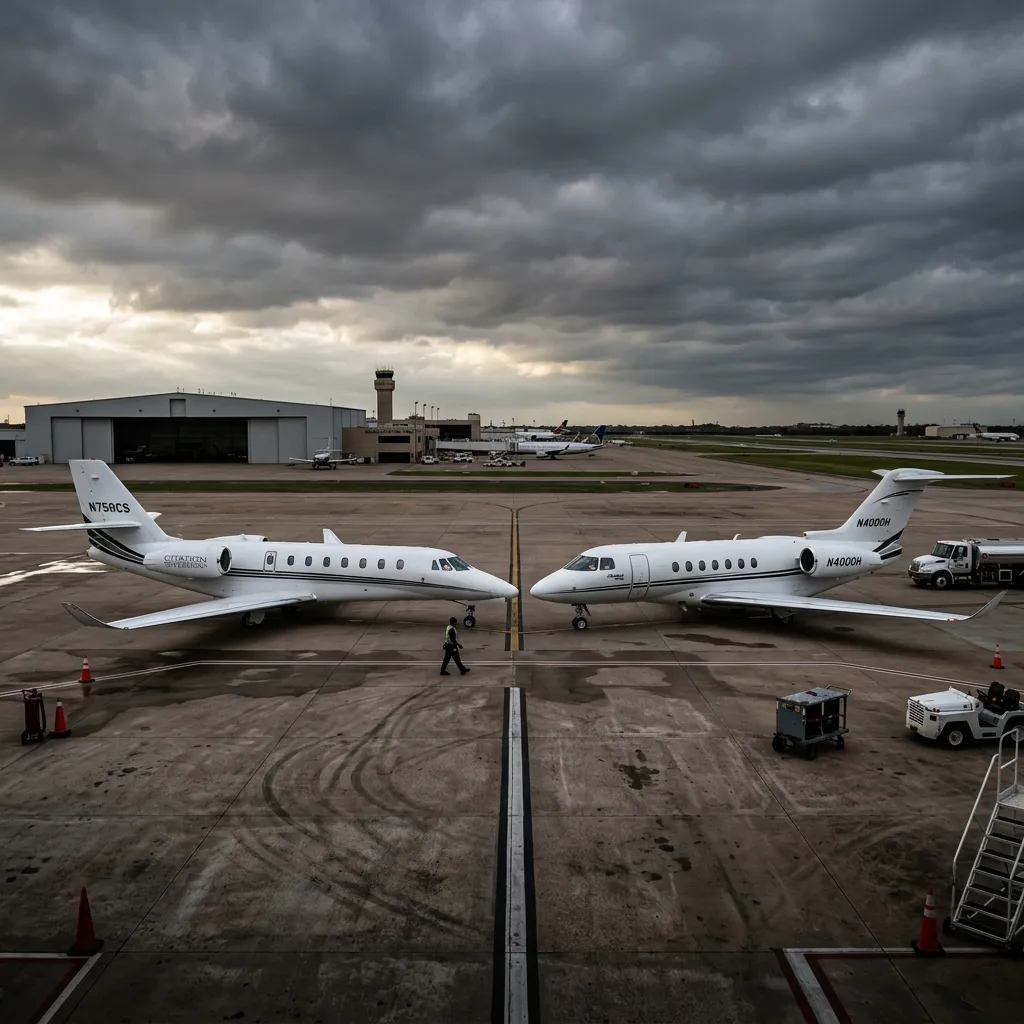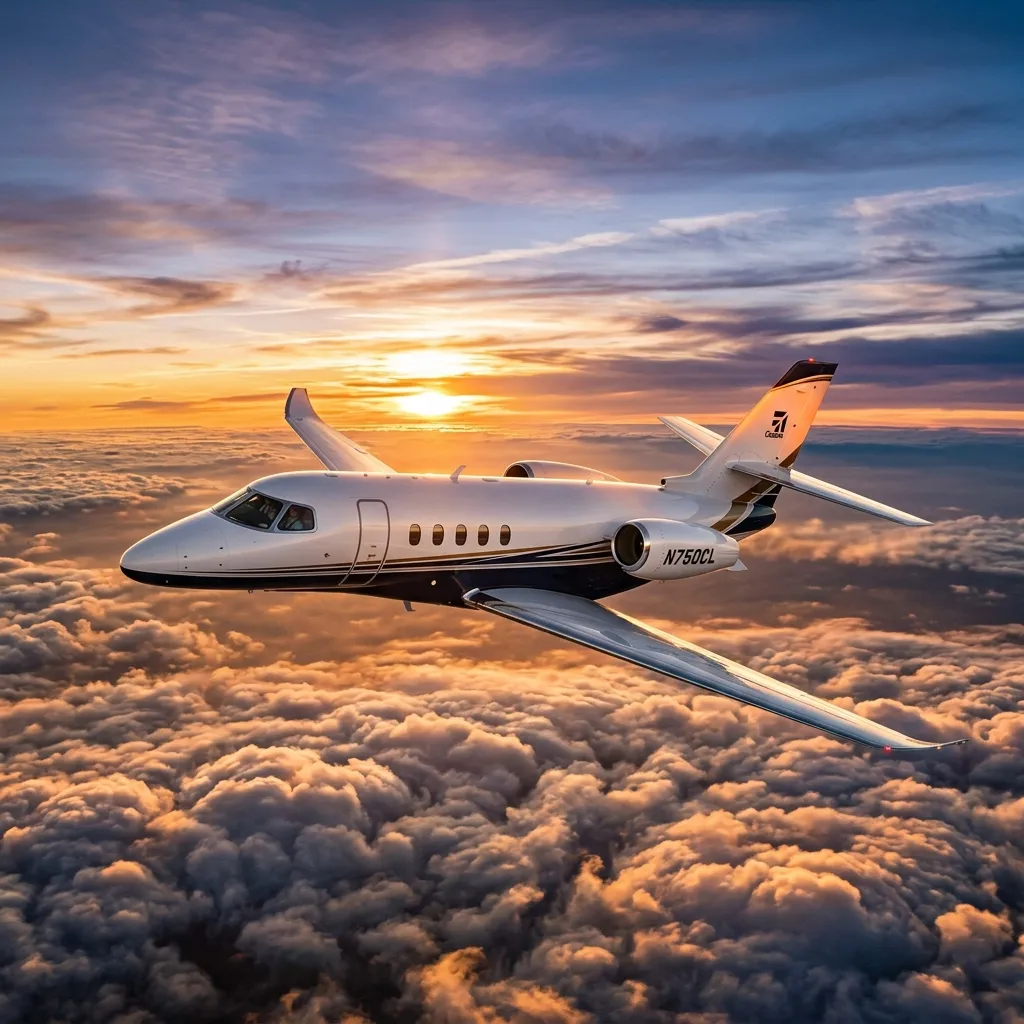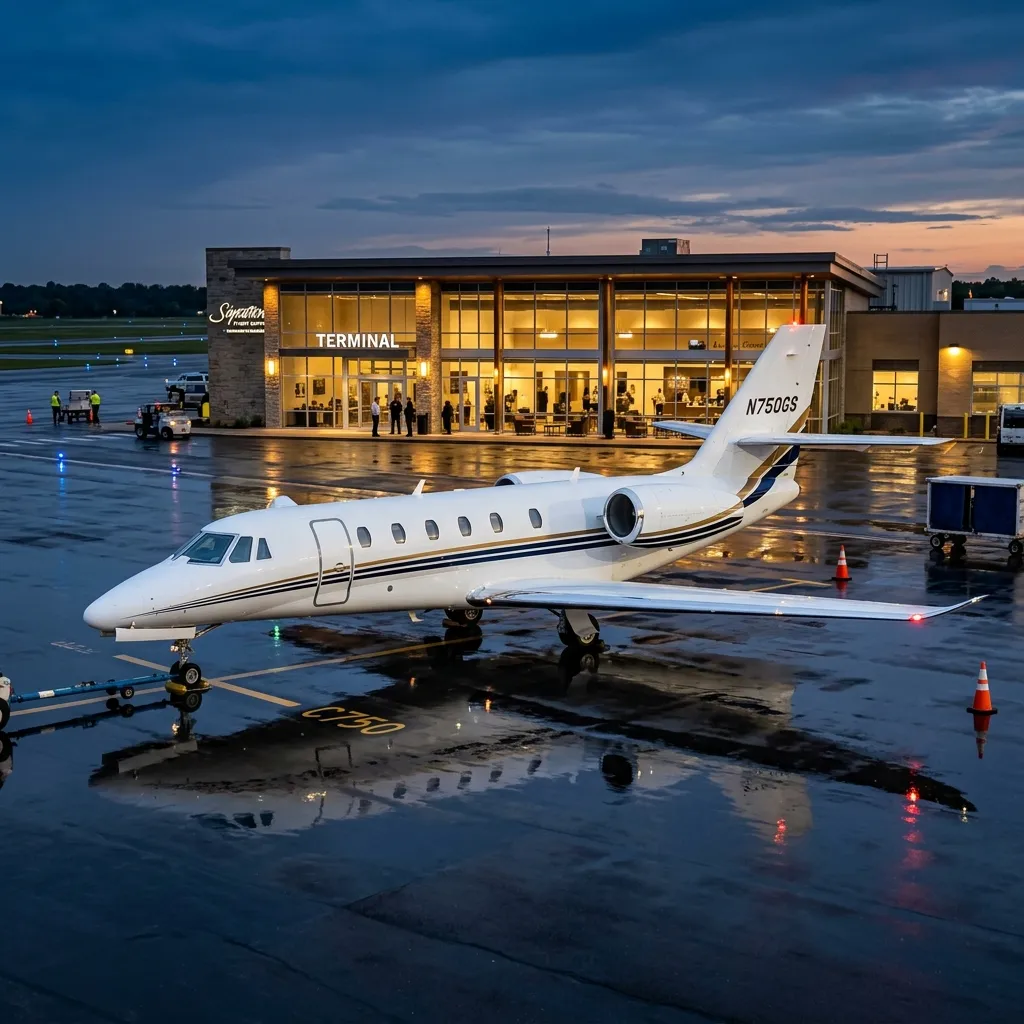
Cessna Citation Sovereign super-midsize jet parked on a private terminal ramp at dusk

The Citation Sovereign: 2,847 NM of Range That Nobody Talks About

undefined

In This Article

Cessna Built a Transcontinental Jet and Forgot to Market It Performance: Where the Sovereign Earns Its Name The Cabin: Wider Than a Hawker, Narrower Than a Challenger The Sovereign+ Variant: What Changed Operating Economics: What Owners and Operators Pay Why the Market Undervalues the Sovereign Frequently Asked Questions

Cessna Built a Transcontinental Jet and Forgot to Market It

The Citation Sovereign entered service in 2004 with a specification sheet that should have dominated the super-midsize category. A 2,847 NM range that connects New York to London nonstop under favorable conditions. A 47,000-foot ceiling that puts it above airline traffic and most weather. Twelve seats in a cabin that measures 25.3 feet long. And a 3,630-foot takeoff roll that opens smaller regional airports to an aircraft class normally restricted to 5,000-foot-plus runways. Approximately 460 Sovereigns sit on the FAA registry in 2026. That number has held steady for five years.

Cessna (now Textron Aviation) never gave the Sovereign the marketing push it deserved. The aircraft launched into a market already crowded by the Hawker 800XP and Learjet 60, then found itself flanked by the Citation Latitude below and the Challenger 350 above. Cessna's own sales team often steered buyers toward the flashier Latitude, which offered a wider cabin but 1,000 fewer nautical miles of range. The result: a secondary market filled with capable, underpriced Sovereigns trading between $2.5 and $5 million.

Performance: Where the Sovereign Earns Its Name

Two Pratt & Whitney Canada PW306C engines produce 5,770 pounds of thrust each, pushing the Sovereign to a maximum cruise speed of 458 knots (Mach 0.80). Long-range cruise at 430 knots delivers the full 2,847 NM range with NBAA IFR reserves. That range figure covers Los Angeles to Teterboro, Miami to Seattle, or Teterboro to Shannon, Ireland in the right conditions.

The 3,630-foot takeoff distance is the Sovereign's hidden advantage. At sea level on a standard day, the aircraft lifts off in less runway than a Citation CJ4 (3,410 ft) requires. For an aircraft in the super-midsize class, this is unusual. The Challenger 350 needs 4,835 feet. The Latitude needs 3,580 feet at lighter weights but stretches past 4,000 at max takeoff weight. The Sovereign operates comfortably out of airports like Aspen (7,006 ft at 7,820 ft elevation), Eagle County (8,150 ft at 6,535 ft), and Teterboro (7,000 ft) where larger super-mids face restrictions.

The Cabin: Wider Than a Hawker, Narrower Than a Challenger

The Sovereign's cabin measures 25.3 feet long, 5.5 feet wide, and 5.7 feet high. Most passengers over 5'8" can stand upright. The width falls between the Hawker 800XP (5.75 ft) and the Challenger 350 (6.2 ft). In double-club configuration, the Sovereign seats 8 passengers comfortably. Maximum density is 12 seats, but at that count, the cabin becomes a commuter arrangement.

2,847 NM
Max Range
458 kts
Max Cruise
FL470
Service Ceiling
3,630 ft
Takeoff Distance

The 135-cubic-foot baggage compartment is external and pressurized. That number beats every aircraft in the super-midsize class and most heavy jets. Two full-size golf bags, four rolling suitcases, and ski equipment fit without negotiation. For clients whose trips involve oversized baggage (hunting equipment, film gear, trade show materials), the Sovereign's cargo volume eliminates the usual weight-and-balance conversation.

Interior Configuration and Refurbishment

Most charter Sovereigns carry a forward four-place club, an aft three-place divan or four-place club, and an enclosed lavatory in the rear. The galley is a forward sidebar unit with microwave, coffee maker, and cold storage. Original 2004-era interiors feature beige leather and wood veneer; many have been through at least one refurbishment. A full interior refresh (seats, sidewalls, carpet, lighting) runs $250,000 to $400,000. The Sovereign+ variant (2013-2019) ships with updated materials and optional LED mood lighting.

Need a Charter Quote?

Contact our team for a personalized quote.

Get a Quote

The Sovereign+ Variant: What Changed

Textron introduced the Citation Sovereign+ in 2013 as a mid-life upgrade, not a clean-sheet redesign. The primary changes: winglets (adding 350-400 NM of range), Garmin G5000 avionics replacing the Collins Pro Line 21, and autothrottle capability. The PW306D engines on the Sovereign+ produce the same 5,770 lbs of thrust but achieve slightly better specific fuel consumption through improved turbine metallurgy.

  • Winglets: Add approximately 350-400 NM of range, reducing drag by 4-6%
  • Garmin G5000: Touchscreen avionics replacing the Collins Pro Line 21 CRT displays
  • Autothrottle: Reduces pilot workload on approach and improves fuel economy
  • Range improvement: 3,200 NM (Sovereign+) vs 2,847 NM (original Sovereign)
  • Production ended in 2019 when Textron consolidated the line around the Latitude and Longitude

The Sovereign+ is one of the better values in the pre-owned super-midsize market. A 2015 Sovereign+ with 2,500 hours trades between $5.5 and $7 million. A comparable-age Challenger 350 trades at $12-14 million. For operators who prioritize range over cabin width, the Sovereign+ delivers 90% of the Challenger experience at 45% of the acquisition cost.

Operating Economics: What Owners and Operators Pay

The Sovereign burns approximately 215 gallons per hour at normal cruise power. At $6.50 per gallon, that is $1,398 in fuel per hour. Total direct operating cost (fuel, maintenance reserves, crew) runs $2,600 to $3,200 per flight hour for an owner-operator. Charter rates fall between $3,200 and $4,500 per hour depending on the operator and market.

The PW306C engine has a TBO of 6,000 hours with a hot section inspection at 3,000 hours. Overhaul cost runs $450,000 to $550,000 per engine. Pratt & Whitney offers the Eagle Service Plan (ESP), a pay-per-hour program that spreads overhaul cost into a predictable hourly rate ($180-$220 per engine per hour). Most professionally managed Sovereigns are enrolled in ESP.

Why the Market Undervalues the Sovereign

The Sovereign's resale problem is perception, not capability. Three factors depress values. First, the cabin width: at 5.5 feet, the Sovereign falls 0.7 feet short of the Challenger 350's 6.2-foot cabin. In a market where buyers compare interior photos on broker websites, that 8 inches of width creates a measurable impression gap. Second, Textron discontinued the line in 2019, signaling that the manufacturer has moved on to the Latitude and Longitude platforms. Third, the Sovereign lacks the brand cachet of Bombardier or Gulfstream.

For charter clients and operators, these perception issues are irrelevant. The aircraft flies the same missions as a Challenger 350 (minus 350 NM of range), costs $6-8 million less to acquire, and operates from shorter runways. If the client's trip profile is domestic transcontinental or Caribbean, the Sovereign handles it. The 5.5-foot cabin width is not uncomfortable; it is narrower. These are different things.

Ask any Part 135 director of maintenance which super-midsize jet gives the fewest headaches, and the Sovereign will be on the short list. Cessna built the airframe with redundancy in systems architecture, well-documented maintenance manuals, and a parts supply chain that benefits from being the world's largest business jet manufacturer.

Brian Galvan

Written By

Brian Galvan

Founder, The Jet Finder ยท Private Aviation Operations & Technology

Former Director of Technology at FlyUSA (Inc. 5000 fastest-growing private jet company). Decade of hands-on experience across Part 135 operations, charter sales, fleet management, and aviation data systems.

LinkedInRead Full Profile →
Common Questions

Frequently Asked Questions


8 questions about chartering this aircraft

Approximately 460 Citation Sovereign and Sovereign+ aircraft appear on the FAA registry as of early 2026. This count has been stable for five years, indicating that the fleet is not shrinking through retirements or exports. The global fleet (including non-U.S. registrations) is estimated at 530-560 airframes.

With 4-6 passengers and NBAA IFR reserves, the original Sovereign (2,847 NM) handles Teterboro to Van Nuys (2,150 NM) and Boston to Los Angeles (2,240 NM) nonstop. The Sovereign+ (3,200 NM) adds enough margin for Miami to Seattle (2,400 NM) with headwind allowance. Westbound transcontinental trips against the jet stream are the limiting case; at maximum passenger loads, the original Sovereign may require a fuel stop in Denver or Albuquerque on winter westbound crossings.

The original Sovereign (2004-2012) uses the Rockwell Collins Pro Line 21 avionics suite with CRT displays. The Sovereign+ (2013-2019) upgraded to the Garmin G5000 touchscreen suite with synthetic vision, WAAS/LPV approaches, and integrated autothrottle. Several aftermarket STCs exist to upgrade original Sovereigns with partial glass cockpit solutions, though a full G5000 retrofit is not available for the original airframe.

Original Sovereigns (2004-2012) trade between $2.5 and $5 million depending on year, total time, engine program enrollment, and interior condition. Sovereign+ models (2013-2019) command $5.5 to $8 million. Aircraft on Pratt & Whitney ESP engine programs and with ProParts airframe programs trade at premiums of $300,000-$600,000 over equivalent aircraft without hourly programs. A 2008 Sovereign with 4,000 hours and a fresh interior refurbishment typically lists around $3.5 million.

The Sovereign measures 5.5 feet wide by 5.7 feet tall at the widest/tallest cross-section point. The Citation Latitude widens to 6.4 feet but shortens to 5.8 feet tall. The Citation Longitude measures 6.0 feet wide by 6.0 feet tall. In practical terms, the Sovereign's 5.5-foot width accommodates two facing club seats with a narrow aisle between them. Passengers sitting in window seats feel shoulder proximity to the sidewall. The Latitude's extra 10.8 inches of width creates a noticeably more spacious feel in the same seating configuration.

At Aspen-Pitkin County (ASE, elevation 7,820 ft), the Sovereign's takeoff distance extends to approximately 5,200-5,800 feet depending on temperature and weight. Aspen's 7,006-foot runway accommodates this with margin. At Telluride (TEX, elevation 9,070 ft), the performance penalty is greater, and the Sovereign may face weight restrictions on hot days. Pilots must run specific performance calculations for each high-altitude departure using the AFM charts and current conditions.

The Sovereign follows a progressive inspection schedule with Phase 1-4 inspections at 200-hour intervals and a major 48-month inspection. Phase inspections cost $15,000-$25,000 each. The 48-month inspection runs $80,000-$120,000 including landing gear service. PW306C engines require hot section inspection at 3,000 hours ($180,000-$220,000 per engine) and overhaul at 6,000 hours ($450,000-$550,000 per engine). Total annual maintenance budget at 400 hours per year is $200,000-$280,000.

Textron consolidated its super-midsize and midsize product line around the Citation Latitude (introduced 2015) and Citation Longitude (introduced 2019). The Latitude offered a wider cabin (6.4 ft vs 5.5 ft) at a lower price point, while the Longitude delivered Sovereign+-class range (3,500 NM) in a larger airframe. Sales of the Sovereign+ had slowed to under 20 deliveries per year by 2018. Rather than invest in further upgrades to a 2004-era airframe, Textron redirected engineering resources to the Longitude program.

Continue Reading

Related Articles


Your Next Mission

Ready to Fly?


Whether you need a charter quote or want to explore aircraft options, our team is here.

Contact Us