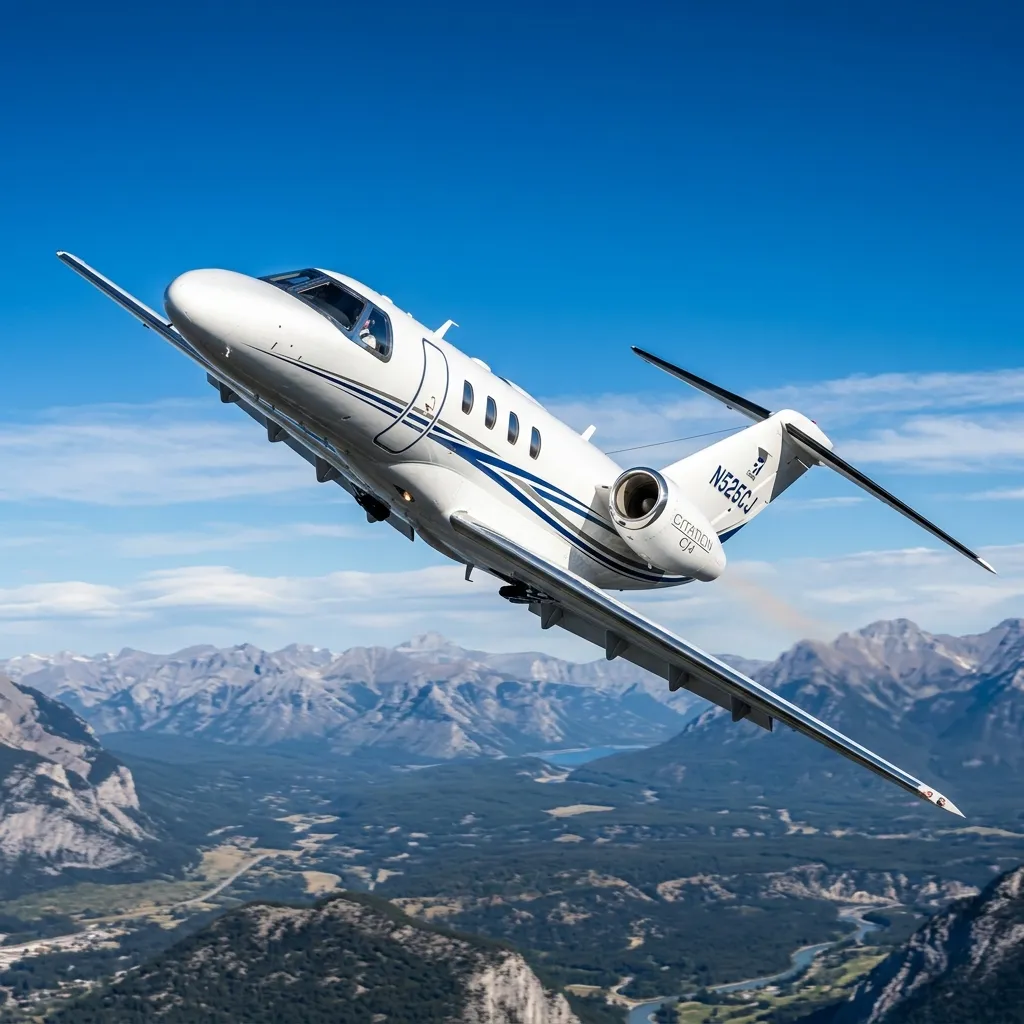
Cessna Citation CJ4 business jet climbing through clear skies showing its distinctive winglet design

The Citation CJ4: The Most Capable Single-Pilot Light Jet in Service

undefined

In This Article

The CJ4's Position in the Market Performance Analysis: Light Jet Specs, Midsize Capability Cabin and Interior Configuration Single-Pilot Operations: Capability and Reality Acquisition and Operating Economics Frequently Asked Questions

The CJ4's Position in the Market

The Citation CJ4 entered service in 2010 as the largest and most capable member of Cessna's CJ (CitationJet) family. Where the CJ3 serves as a 7-seat light jet for regional trips and the CJ2 covers short-haul missions, the CJ4 pushes into territory traditionally occupied by midsize jets. Its 2,165 NM range covers coast-to-coast U.S. routing nonstop. Its 451-knot max cruise speed matches or exceeds several midsize jets. And its FAA single-pilot certification means an owner with the right training can fly this aircraft without hiring a second pilot.

As of early 2026, Textron Aviation has delivered approximately 340 CJ4 and CJ4 Gen2 aircraft. The Gen2 upgrade (introduced 2022) added Garmin G3000 touchscreen avionics, autothrottle, and enhanced flight envelope protection. The CJ4 competes in the $4-$6 million pre-owned market against the Phenom 300E ($6-$9M), Learjet 75 ($4-$6M discontinued), and the Citation XLS ($3-$5M). Its distinguishing characteristic remains single-pilot approval for an aircraft of this performance class, a feature no competitor matches.

Performance Analysis: Light Jet Specs, Midsize Capability

The CJ4 and Phenom 300E are close in speed and altitude capability. The CJ4's range advantage of 155 NM is meaningful on transcontinental routes: it provides a wider margin for headwinds and alternate airports. The CJ4's takeoff distance of 3,410 feet is short enough for most general aviation airports, though the Phenom 300E edges it by 272 feet. Where the CJ4 separates definitively is single-pilot certification. The Phenom 300E requires a second pilot (SIC) for all operations, a regulatory distinction that adds $80,000-$120,000 annually in crew costs for owner-operators.

The Williams FJ44-4A engines on the CJ4 produce 3,621 lbs of thrust each, the most powerful variant in the FJ44 family. Williams International designed the FJ44 specifically for the Citation CJ line. The engine's 4,000-hour TBO (time between overhaul) and reputation for reliability have contributed to low operating costs. A hot section inspection runs approximately $55,000-$75,000 per engine; a full overhaul runs $200,000-$250,000. These are among the lowest engine maintenance costs in the light-to-midsize jet segment.

Cabin and Interior Configuration

The CJ4's cabin is 3 inches narrower and 1 inch shorter than the Phenom 300E's. These differences are perceptible but not transformative. The CJ4 typically configures with a 7-seat layout (club four plus three forward-facing seats), though 9- and 10-seat high-density layouts exist for shuttle operations. The interior finishing on the Gen2 models includes Cessna's latest cabin management system with USB charging, LED lighting, and wireless device connectivity.

The CJ4's 77 cubic feet of baggage space is adequate for 4-6 passengers with standard luggage. Golf bags and ski equipment require planning: 4 golf bags consume approximately 50 cubic feet, leaving limited room for personal bags. The externally accessible baggage compartment is a Cessna tradition that allows loading and unloading without entering the cabin, a convenience feature for crews managing tight turnarounds.

Need a Charter Quote?

Contact our team for a personalized quote.

Get a Quote

Single-Pilot Operations: Capability and Reality

The CJ4's FAA single-pilot certification (14 CFR Part 23) means a qualified pilot can legally operate the aircraft alone. The Williams FJ44-4A engines, Rockwell Collins Pro Line 21 avionics (or Garmin G3000 on Gen2), and autopilot system are designed to manage workload for a single pilot. Collins Pro Line 21 provides fully coupled approaches to ILS Cat I minimums with autothrottle engagement on Gen2 models. The aircraft effectively flies itself on a programmed approach, reducing workload during the highest-task-density phase of flight.

In practice, approximately 60-65% of CJ4 owner-operators fly single-pilot. The remainder add a second pilot for insurance reasons, passenger comfort, or personal preference. Insurance underwriters typically require 500-1,000 hours of total turbine time and 100-200 hours in type before approving single-pilot coverage. Premiums for single-pilot CJ4 operations run 15-25% higher than dual-pilot premiums on the same hull value, reflecting the actuarial reality that single-pilot operations have a higher statistical risk profile.

The CJ4 type rating takes approximately 14-18 days at FlightSafety International (Wichita or Dallas). The training program includes single-pilot emergency procedures, workload management drills, and CRM (Crew Resource Management) modules adapted for single-pilot operations. Pilots transitioning from the CJ3 typically complete a shorter differences course of 5-7 days. The CJ4 Gen2's Garmin G3000 avionics require a separate avionics familiarization module.

Acquisition and Operating Economics

The CJ4's single-pilot capability creates a meaningful economic advantage. Eliminating the second pilot removes $80,000-$120,000 in annual salary, benefits, and recurrent training costs. For an owner flying 200-300 hours per year, this savings represents 15-25% of total annual operating cost. Pre-owned CJ4s from 2012-2018 trade between $4.0 and $5.5 million, placing them in the price range of older midsize jets (Citation XLS, Hawker 800XP) but with newer technology and lower operating costs.

The Gen2 upgrade commands a 40-60% premium over equivalent-age original CJ4s, reflecting the Garmin G3000 avionics suite, autothrottle, and enhanced safety features. For buyers deciding between a 2016 CJ4 at $5 million and a 2023 CJ4 Gen2 at $8.5 million, the $3.5 million difference buys significantly improved avionics, lower pilot workload, and better resale retention. The original Pro Line 21 avionics are functional but dated, and retrofit paths to Garmin are limited and expensive.

Brian Galvan

Written By

Brian Galvan

Founder, The Jet Finder ยท Private Aviation Operations & Technology

Former Director of Technology at FlyUSA (Inc. 5000 fastest-growing private jet company). Decade of hands-on experience across Part 135 operations, charter sales, fleet management, and aviation data systems.

LinkedInRead Full Profile →
Common Questions

Frequently Asked Questions


8 questions about chartering this aircraft

The 10-seat configuration uses every available position including side-facing seats and a belted lavatory seat. It is used for short shuttle flights (under 90 minutes) and is not comfortable for longer trips. The typical 7-seat configuration (club four plus three forward-facing) provides adequate space for flights up to 3 hours. For 4 passengers on a coast-to-coast flight, the cabin is entirely comfortable. Above 6 passengers, the CJ4 feels crowded on any flight exceeding 2 hours.

Insurance requirements vary by underwriter, but typical minimums are 2,500-3,500 total flight hours, 500-1,000 hours of turbine time, and 100-200 hours in the CJ4 type. Pilots transitioning from lighter Citations (CJ2, CJ3) or turboprops (King Air, PC-12) typically meet the turbine time requirement. The CJ4 type rating itself requires 14-18 days of ground school and simulator training. Some underwriters require 25-50 hours of dual instruction in the actual aircraft before approving single-pilot insurance.

New York (TEB) to Los Angeles (VNY) is approximately 2,150 NM. The CJ4's 2,165 NM NBAA IFR range covers this route with minimal reserve margin under ideal conditions. With headwinds (common on westbound legs), a fuel stop in Kansas, Oklahoma, or New Mexico becomes necessary. Eastbound returns typically benefit from tailwinds. For reliable nonstop coast-to-coast capability in both directions, the CJ4 requires 4 passengers or fewer and favorable winds. Full-cabin (7+ passengers) coast-to-coast flights routinely require a fuel stop.

A full overhaul on the FJ44-4A runs $200,000-$250,000 per engine at Williams International's authorized service centers. Hot section inspections at the 2,000-hour midpoint cost $55,000-$75,000 per engine. Williams offers the TAP (Total Assurance Program) engine maintenance program at approximately $190-$220 per engine flight hour, which covers all scheduled and unscheduled engine maintenance including overhaul. TAP enrollment is common among charter operators and recommended for owner-operators planning to fly 200+ hours annually.

For pilots, the G3000 is a transformative upgrade. Touchscreen controllers, synthetic vision, autothrottle, and datalink weather integration reduce single-pilot workload by an estimated 20-30% compared to the Pro Line 21. The autothrottle alone eliminates one of the highest-workload tasks during approach and landing. For passengers, the upgrade is invisible. Resale data suggests Gen2 models retain value 8-12% better than original CJ4s over the first 5 years, which partially offsets the acquisition premium.

Aspen (7,820-foot runway at 7,820 feet elevation) is within the CJ4's capability with weight restrictions. Telluride (6,870-foot runway at 9,070 feet elevation) is more challenging: the combination of short runway and high density altitude limits the CJ4 to reduced passenger loads and may require performance calculations that restrict operations during hot summer months. Eagle County (EGE) at 6,547 feet with an 8,000-foot runway is the more common CJ4 destination for Vail-area access.

Approximately 55-60% of the CJ4 fleet operates under Part 91 (private, owner-flown or corporate) and 40-45% under Part 135 charter certificates. The single-pilot certification skews the fleet toward owner-operators who fly themselves, a demographic that prefers Part 91. Charter operators using CJ4s almost always fly dual-pilot regardless of the type certificate, both for safety margins and because charter clients expect two pilots. The Gen2 variant has attracted more charter operators due to its enhanced avionics and autothrottle.

The CJ4 is certified for flight into known icing conditions (FIKI). It uses a combination of bleed air anti-icing for the engine inlets and wing leading edges, and electric de-icing boots or heated surfaces for other protected areas. The aircraft performs well in moderate icing but, like all light jets, is more susceptible to ice accumulation rates than larger aircraft with more powerful bleed air systems. Pilots operating single-pilot in icing conditions face elevated workload managing ice protection systems while maintaining instrument flight.

Continue Reading

Related Articles


Your Next Mission

Ready to Fly?


Whether you need a charter quote or want to explore aircraft options, our team is here.

Contact Us