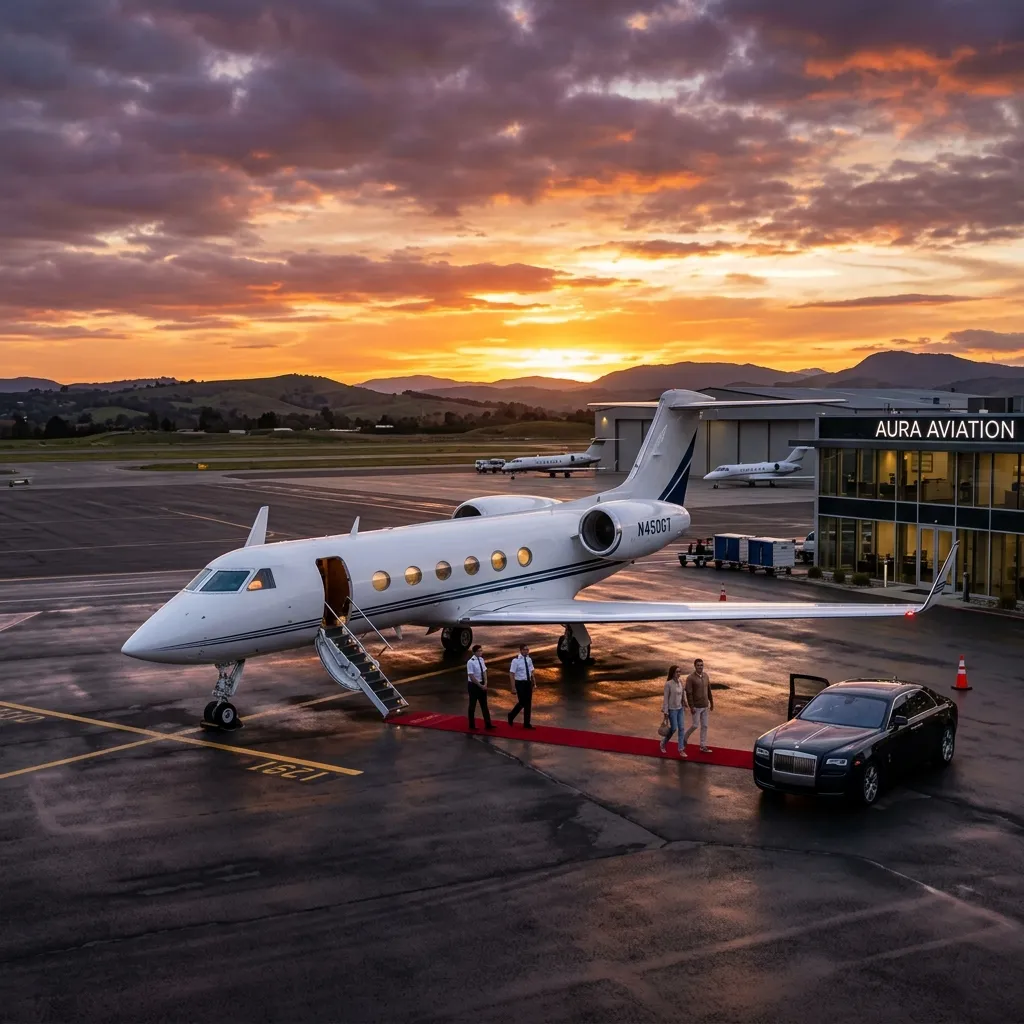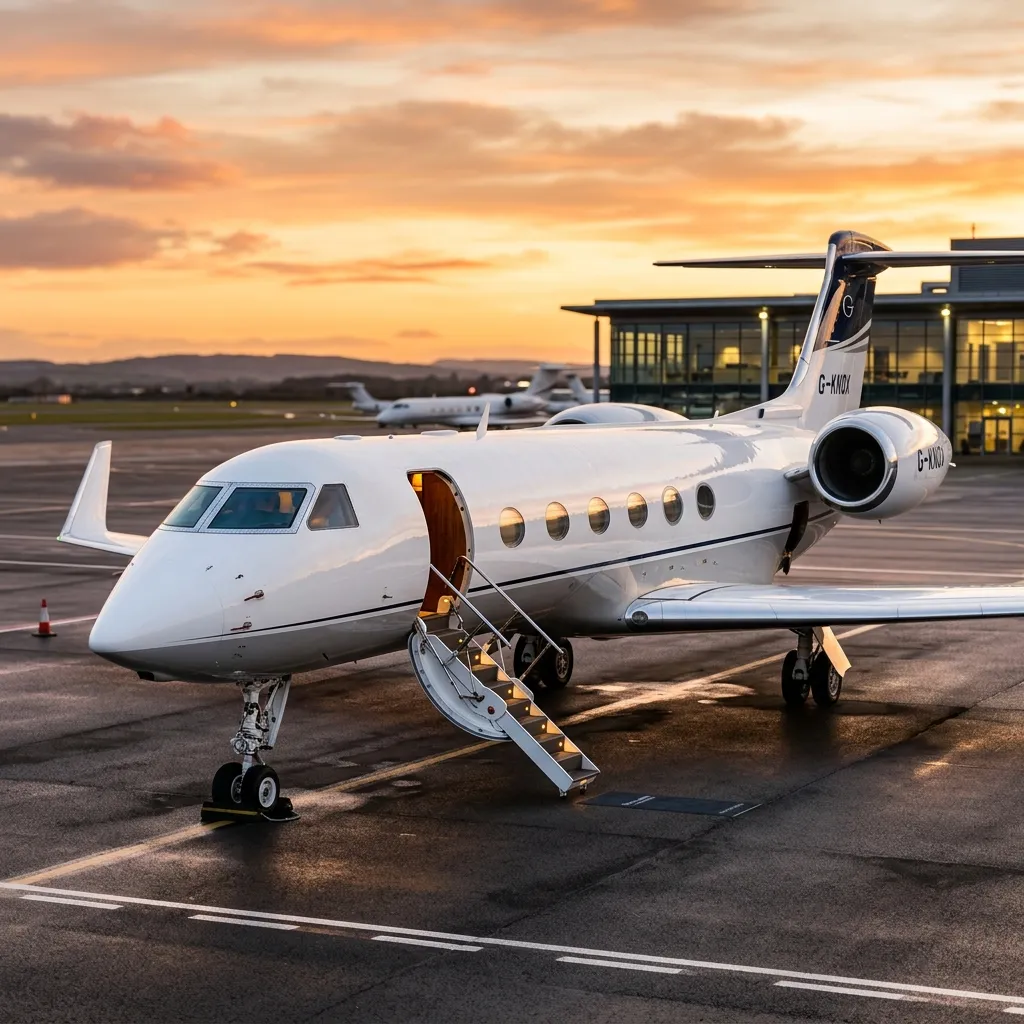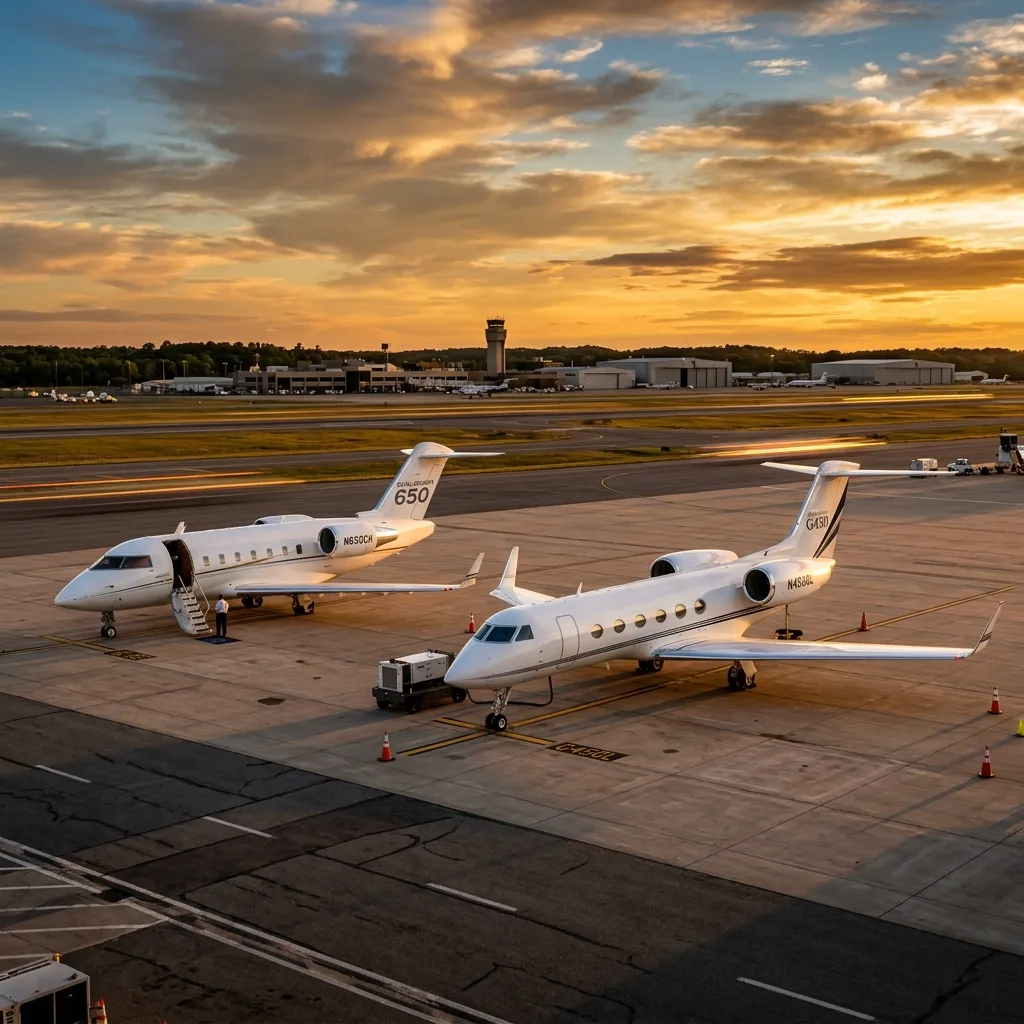
Bombardier Challenger 650 and Gulfstream G450 heavy jets side by side on ramp

Challenger 650 vs Gulfstream G450: Which Heavy Jet Delivers More for the Money

Both aircraft occupy the same price bracket on the used market. Both seat 12-14 passengers in walk-around cabins. Both fly coast-to-coast without thinking about fuel. The difference is in what each manufacturer decided to optimize, and which philosophy matches your mission.

In This Article

Two Jets, Same Mission, Different Answers Cabin Comparison: Width Wins Comfort Range and Performance: The G450 Advantage Charter Cost: Trip-Level Economics Ownership and Resale: Market Position in 2026 The Verdict: Match the Jet to the Mission Frequently Asked Questions

Two Jets, Same Mission, Different Answers

The Challenger 650 charters between $6,500 and $8,500 per flight hour. The Gulfstream G450 runs $7,000 to $9,200. That $500 to $700 hourly gap buys the G450 an extra 350 nm of range and Gulfstream's PlaneView cockpit. Whether those advantages justify the premium depends entirely on how you use the aircraft.

Bombardier built the Challenger 600 series as a wide, comfortable cabin first and an airplane second. The fuselage cross-section dates to the original Canadair LearStar 600 from 1976, refined through the 601, 604, and 605 into today's 650. Gulfstream designed the G450 as the follow-on to the GIV-SP, prioritizing range and systems sophistication. Each aircraft reflects its manufacturer's DNA: Bombardier sells the cabin, Gulfstream sells the mission.

Cabin Comparison: Width Wins Comfort

The Challenger 650 cabin is 8.2 feet wide. That is nearly a foot wider than the G450 and wider than most hotel room bathrooms. Three passengers sit abreast comfortably, which is unusual in business aviation. The G450 counters with 17 more feet of cabin length, translating to more seating zones. On a 12-passenger configuration, the G450 spreads people out. The 650 keeps them closer together in a wider space.

Operators who fly both say the same thing: passengers remember the 650's width and the G450's length. Ask six people who flew both which cabin they preferred, and you will get a 3-3 split. The tiebreaker is always the specific trip: coast-to-coast with 8 executives choosing the G450 for separation, poker run with 10 friends choosing the 650 for the wider card table.

The G450's forward galley is substantially larger, supporting full hot catering service on flights over 3 hours. The Challenger 650 galley is functional but compact; cold catering and beverage service are standard, with hot options requiring advance coordination. Both aircraft have fully enclosed lavatories. The G450 offers a second lavatory option on some configurations, which matters on 6+ hour missions with a full cabin.

Range and Performance: The G450 Advantage

$6,500-$8,500
CL650 Hourly Rate
$7,000-$9,200
G450 Hourly Rate
4,000 nm
CL650 Range
4,350 nm
G450 Range

The G450 flies 350 nm farther on a full fuel load. That is the difference between making TEB to London Luton nonstop eastbound or stopping in Goose Bay. Domestically, both jets cover every U.S. city pair without issue. The range gap only matters on transatlantic or transcontinental missions where the extra fuel allows nonstop operation under adverse wind conditions.

Speed favors the G450 marginally. Maximum Mach number of 0.88 versus the 650's 0.85 translates to about 15-20 knots faster at cruise, saving 8 to 12 minutes on a 4-hour leg. Meaningful on a tight schedule, negligible on a leisure trip. Both aircraft cruise at FL 450 or above, keeping them above commercial traffic and most weather.

Short-Field Access

The Challenger 650 needs approximately 5,610 feet of runway at sea level. The G450 requires about 5,560 feet. Functionally identical. Neither aircraft operates into Aspen or Telluride. Both handle Eagle County, Teterboro, Scottsdale, and most major metro business airports. If short-field access is the priority, neither of these jets is the answer; step down to a Challenger 350 or Citation Latitude.

Charter a Heavy Jet

Challenger 650, G450, or something else entirely. Tell us the mission and we will match the aircraft.

Get a Quote

Charter Cost: Trip-Level Economics

The Challenger 650 saves $1,000 to $3,500 per trip depending on leg length. On a transcontinental round trip, that gap widens to $5,000 to $7,000. Over a year of quarterly coast-to-coast travel, the 650 saves roughly $20,000 to $28,000. That is the price of the G450's extra range, speed, and Gulfstream brand cachet. For domestic-only missions, the 650 delivers equivalent capability for less money.

Ownership and Resale: Market Position in 2026

Used Challenger 650s (2015-2023 vintage) trade between $16 million and $24 million depending on total time, engine status, and interior condition. G450s (2004-2018) range from $8 million for high-time early models to $19 million for late-production, low-time examples. The G450 production run ended in 2018 when the G500 took over. The 650 remains in production as of 2026, which gives it a parts and support advantage.

Depreciation favors the Challenger 650 over the next decade. Active production means factory support, newer avionics baselines, and a deeper maintenance network. The G450, while fully supported by Gulfstream today, will gradually shift to a legacy fleet. Buyers planning to hold for 10+ years should weigh the G450's lower acquisition price against the 650's stronger long-term support outlook.

The Verdict: Match the Jet to the Mission

Charter the Challenger 650 When

  • Domestic missions dominate your travel. The 4,000 nm range covers every U.S. city pair.
  • Cabin width matters more than cabin length. The 8.2-foot fuselage is unmatched in this segment.
  • Budget discipline matters. $1,000 to $3,500 less per trip adds up over multiple legs.
  • You want a currently-produced aircraft with factory-fresh parts availability.

Charter the Gulfstream G450 When

  • Transatlantic or transpacific routing is part of the mission profile.
  • You need a longer cabin to separate work zones from rest areas on 6+ hour flights.
  • Speed is a scheduling constraint. The extra 15-20 knots may matter on tight turnarounds.
  • The Gulfstream nameplate matters to your principals or board members.

Neither jet is wrong. The 650 is the practical choice for domestic operators who want heavy-jet cabin volume at a competitive hourly rate. The G450 is the range-first choice for international missions and operators who value systems sophistication over cabin width. If range and speed are secondary to comfort and cost, the Challenger wins on the spreadsheet. If the mission demands it, the G450 earns its premium.

Brian Galvan

Written By

Brian Galvan

Founder, The Jet Finder ยท Private Aviation Operations & Technology

Former Director of Technology at FlyUSA (Inc. 5000 fastest-growing private jet company). Decade of hands-on experience across Part 135 operations, charter sales, fleet management, and aviation data systems.

LinkedInRead Full Profile →
Common Questions

Frequently Asked Questions


7 questions about Challenger 650 vs Gulfstream G450

The Challenger 650's CF34-3B engines cost approximately $850,000-$1.1M per engine for a full overhaul. The G450's Rolls-Royce Tay 611-8C engines run $1.0-$1.4M per engine. Combined with lower airframe maintenance reserves, the 650 typically saves $400-$600 per flight hour in total maintenance costs compared to the G450.

Yes. Both the Challenger 650 and G450 meet TEB Stage 3 noise requirements and operate without curfew limitations. Runway 6/24 at 7,000 feet accommodates both aircraft comfortably. Both are common sights on the TEB ramp, particularly during peak business travel and holiday periods.

The G450. Its longer cabin (45.1 ft vs 28.4 ft) allows berthing configurations where seats fold into fully flat sleeping surfaces. Some G450 configurations include a dedicated divan or credenza sleeper. The 650's wider cabin means individual seats have more shoulder room, but the shorter cabin limits sleeping arrangements to fewer positions.

Approximately 40-50 Challenger 650s and 60-80 G450s operate under Part 135 charter certificates in the United States. The G450 has a larger charter fleet due to its longer production run and lower used-market acquisition cost, making it more attractive for operator fleet additions.

The Challenger 650 ships with Rockwell Collins Pro Line 21 Advanced, which is a modern and capable system. The G450 uses Gulfstream's PlaneView flight deck based on Honeywell Primus Epic, which Gulfstream co-developed specifically for its large-cabin fleet. Both are excellent. Pilots transitioning between the two generally consider PlaneView more integrated, while Pro Line 21 is more intuitive for pilots coming from smaller Bombardier or Cessna aircraft.

On major corridors like TEB-LAX, OPF-MDW, and ADS-PBI, brokers can usually source both a Challenger 650 and a G450 within 24-48 hours. On thinner routes or during peak demand, availability narrows. Specifying either aircraft type is reasonable; demanding a specific tail number limits options significantly.

Projections suggest $8-10M by 2030, reflecting continued fleet aging past the 2018 production cutoff. Compare that to a 2020 Challenger 650 purchased at $22M, which should hold $16-18M through 2030 thanks to active factory production and stronger residual demand. The G450's lower entry price partially offsets the steeper depreciation curve.

Continue Reading

Related Articles


Your Next Mission

Ready to Fly?


Whether you need a charter quote or want to explore aircraft options, our team is here.

Contact Us