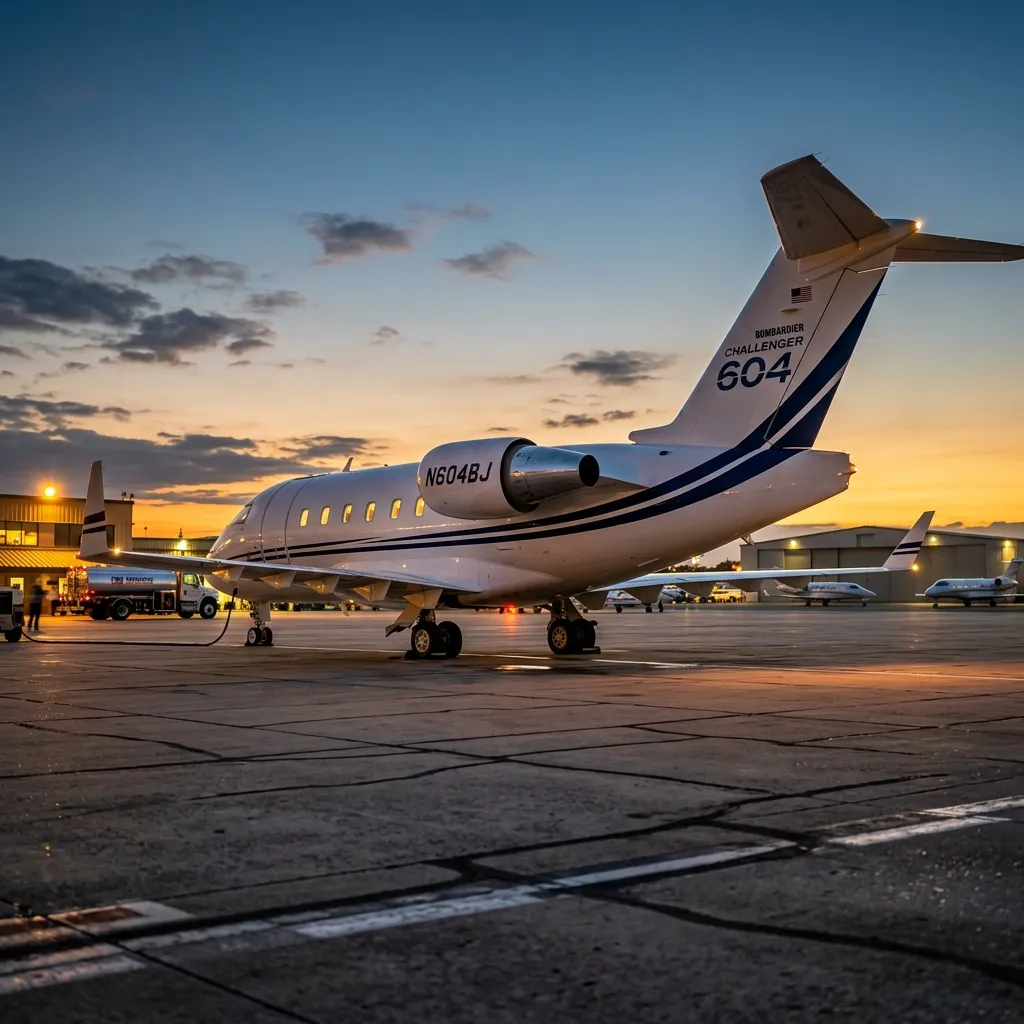
Bombardier Challenger 604 heavy jet on ramp at dusk

Bombardier Challenger 604: The Heavy Jet That Built the Charter Industry

The Challenger 604 entered service in 1996 and never really left. Nearly three decades later, it remains one of the most frequently chartered heavy jets in North America. The reason is straightforward: a wide cabin, transcontinental range, and acquisition costs that let operators offer heavy-jet pricing at rates that newer aircraft cannot match.

In This Article

Why the 604 Endures Cabin and Passenger Experience Performance Profile Operating Economics in 2026 Maintenance and Parts Ecosystem Frequently Asked Questions

Why the 604 Endures

Bombardier built approximately 370 Challenger 604s between 1996 and 2007. As of 2026, the vast majority remain in active service. Some have been retired or converted to special missions, but the fleet attrition rate is remarkably low for an aircraft of this age. The reason is economic: the 604's acquisition cost has dropped to $4 to $7 million on the pre-owned market, while its operational capability remains comparable to aircraft that cost three to four times as much when new.

Charter operators price heavy jet service based on hourly operating cost plus margin. The 604's fully depreciated hull value means the operator's capital cost is minimal compared to someone flying a $25 million Challenger 650 or a $35 million Gulfstream G550. This cost advantage flows directly to the charter passenger. A one-way heavy jet flight from New York to Miami on a 604 runs $18,000 to $24,000. The same trip on a newer Challenger 350 or 650 costs $22,000 to $30,000.

The 604's two General Electric CF34-3B engines produce 8,729 pounds of thrust each and are among the most mature and reliable powerplants in business aviation. Parts availability is excellent. Engine shops compete for CF34 overhaul work, keeping maintenance costs predictable. Hot section inspections and overhauls follow a well-established interval schedule with no surprises.

Cabin and Passenger Experience

The Challenger 604 cabin is 6 feet 1 inch wide, 6 feet 1 inch tall, and 28.4 feet long. This is the cabin dimension that earned the Challenger line its reputation: wide enough for passengers to stand and move freely, long enough for a genuine three-zone layout with forward club seating, mid-cabin conference grouping, and aft divan. Most charter configurations seat 9 to 12 passengers.

The flat floor throughout the cabin is a feature that passengers take for granted until they fly a narrow-body aircraft with a center aisle step. Challenger's wide-body fuselage design, inherited from the original Canadair 600 series, creates a cabin cross-section that is closer to a small airliner than a traditional business jet. The lavatory is fully enclosed and located aft, separated from the cabin by a privacy curtain or solid bulkhead depending on configuration.

Interior refurbishment is a major factor in the 604 charter experience. A recently refurbished 604 with new cabinetry, LED lighting, updated seat foam, and modern entertainment systems delivers a passenger experience that rivals aircraft built 15 years later. Operators who invest in interior upgrades can charge premium rates because the physical experience contradicts the aircraft's chronological age. A tired, original-interior 604 feels dated. A refurbished one does not.

Performance Profile

The 604's 4,000 nm range covers New York to London, Los Angeles to Honolulu, and any domestic U.S. routing nonstop. Transatlantic operations require weather-dependent routing and ETOPS-equivalent considerations for the twin-engine aircraft, but eastbound crossings with favorable winds are routine. The aircraft's fuel capacity of 19,400 pounds gives operators flexibility to carry full passenger loads on long-range missions without fuel-stop penalties.

The Rockwell Collins Pro Line 4 avionics suite was standard equipment. Many 604s have been upgraded to Pro Line 21 or Pro Line Fusion, which adds synthetic vision, ADS-B Out compliance, and modern display technology. Avionics upgrade status is a significant factor in both resale value and charter operator preference. A 604 with Pro Line 21 and ADS-B Out is operationally equivalent to much newer aircraft for airspace access purposes.

Charter a Challenger 604

Wide-body cabin. Transcontinental range. Heavy jet pricing that makes sense.

Get a Quote

Operating Economics in 2026

At approximately $4,350 per flight hour in variable cost, the 604 competes with super-midsize jets that have significantly smaller cabins. The Challenger 350, Citation Longitude, and Praetor 600 all operate in the $3,800 to $4,500 per hour range but offer cabins that are 8 to 12 inches narrower. For passengers who prioritize cabin width and stand-up height, the 604 delivers large-cabin comfort at midsize-plus pricing.

The primary economic risk for 604 operators is major inspection cost. The aircraft's C-check equivalent intervals require significant downtime and expense. A 604 that is approaching a major inspection cycle will reflect this in its charter pricing and availability. Operators manage this by maintaining rolling reserve funds for inspections and scheduling them during low-demand periods. Savvy charter buyers can negotiate better rates on 604s that are mid-cycle between major inspections when the operator's cost outlook is most favorable.

Maintenance and Parts Ecosystem

The CF34-3B engine that powers the 604 is one of the most prolific turbofan engines in aviation. Beyond its business jet application, the CF34 family powers the Bombardier CRJ regional airliner fleet, creating an enormous parts supply chain and overhaul infrastructure. Multiple independent shops compete for CF34 work, keeping overhaul pricing competitive. A hot section inspection runs approximately $350,000 to $450,000; a full overhaul runs $750,000 to $900,000 per engine.

Bombardier's support infrastructure for the Challenger line extends to every major business aviation market. Service centers in Wichita, Hartford, Tucson, and Dallas handle scheduled maintenance and AOG (aircraft on ground) situations. Independent MROs like Duncan Aviation, West Star Aviation, and Constant Aviation also maintain 604 authorizations. The depth of this service network means a grounded 604 can typically return to service within 48 to 72 hours for most unscheduled maintenance events.

Airframe structural inspections follow a progressive schedule mandated by Bombardier's maintenance planning document. The 604's aluminum construction has proven highly resistant to fatigue and corrosion. No fleet-wide structural ADs (Airworthiness Directives) have required major remediation. Individual aircraft are tracked by total flight hours, cycles, and calendar time. Most 604s operating in temperate climates with standard utilization rates have decades of structural life remaining.

Brian Galvan

Written By

Brian Galvan

Founder, The Jet Finder ยท Private Aviation Operations & Technology

Former Director of Technology at FlyUSA (Inc. 5000 fastest-growing private jet company). Decade of hands-on experience across Part 135 operations, charter sales, fleet management, and aviation data systems.

LinkedInRead Full Profile →
Common Questions

Frequently Asked Questions


6 questions about the Bombardier Challenger 604

Most Challenger 604s in active charter service are 18 to 28 years old, built between 1998 and 2007. Age alone does not determine airworthiness. Business jets are maintained to strict FAA standards regardless of age, and many 604s have undergone comprehensive refurbishment programs that include new interiors, updated avionics, and complete systems overhauls. Calendar age matters less than maintenance history and total airframe hours.

The Challenger 605 replaced the 604 in 2007, followed by the Challenger 650 in 2015. Each successor added incremental improvements: the 605 brought a Rockwell Collins Pro Line 21 glass cockpit and redesigned cabin windows. The 650 added further avionics upgrades, improved cabin design, and better fuel efficiency. The core airframe dimensions and CF34 engine platform remained essentially unchanged across all three variants.

From Teterboro or Westchester, the 604's 4,000 nm range covers London Luton (3,000 nm), Los Angeles (2,150 nm), Miami (950 nm), Cancun (1,350 nm), and anywhere in the continental U.S. or Caribbean nonstop. Westbound transatlantic crossings against headwinds may require an Iceland tech stop depending on winter jet stream positioning. The 604 handles virtually any domestic mission and most eastbound international routes without fuel stops.

Three factors contribute. First, the 6-foot-1-inch cabin width allows two passengers to sit side-by-side without shoulder contact, which is not possible in most super-midsize jets. Second, the flat floor design eliminates the step-down found in some competitors. Third, the 28.4-foot cabin length supports a genuine three-zone layout that super-mids cannot replicate. Passengers consistently rate the 604 cabin experience higher than midsize alternatives despite the aircraft's chronological age.

The most common upgrade path is from the original Pro Line 4 to Collins Pro Line 21 or Pro Line Fusion. This provides synthetic vision, ADS-B Out compliance, LPV approach capability, and modern display technology. FANS/CPDLC upgrades enable oceanic crossing compliance. A full avionics upgrade runs $1.5 to $3 million depending on scope, but significantly enhances the aircraft's operational capability and resale value.

Yes. Most charter-configured 604s seat 9 to 12 passengers in double club and divan layouts. The wide cabin accommodates this passenger count comfortably. For groups of 10 or more, the 604 is often the most cost-effective option because stepping up to a Gulfstream G-IV or G550 adds significant hourly cost while providing only marginally more space. Corporate groups and sports teams frequently charter 604s for this reason.

Continue Reading

Related Articles


Your Next Mission

Ready to Fly?


Whether you need a charter quote or want to explore aircraft options, our team is here.

Contact Us