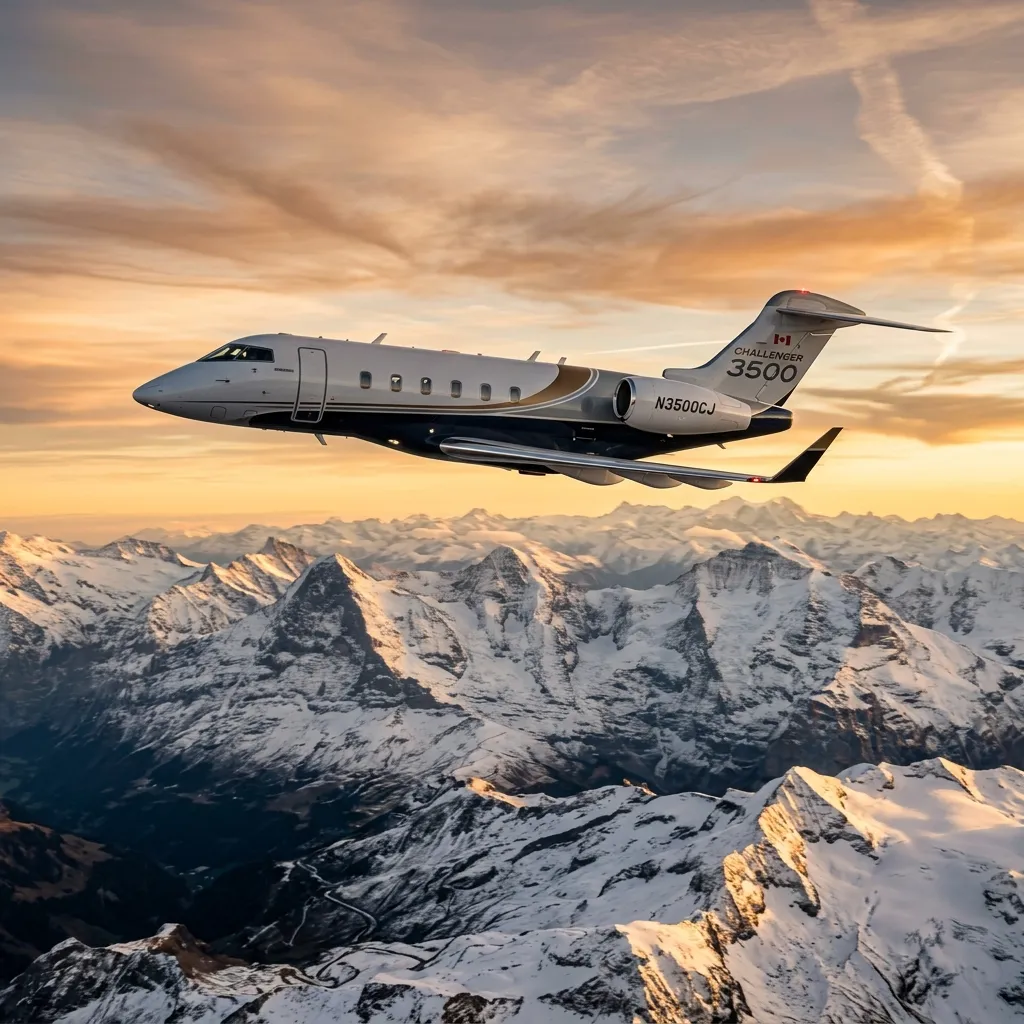
Challenger 3500 Charter Economics
Securing a Bombardier Challenger 3500 requires an investment of $6,500 to $8,500 per flight hour. On a classic transcontinental route like New York to Los Angeles (approximately 2,100 nautical miles, requiring roughly 5.5 hours of flight time depending on headwinds), clients should anticipate the one-way charter cost to range between $40,000 and $55,000 before mandatory taxes, segment fees, and FBO handling charges are applied. This positions the aircraft at the absolute apex of the super-midsize pricing spectrum.
These pricing figures represent the peak of the super-midsize market for a reason. When you charter a Challenger 3500, you are directly paying for modernized reliability, unparalleled cabin volume in its class, and state-of-the-art technological integrations. It is the direct evolution of the Challenger 350—which held the title of the best-selling super-midsize jet of the last decade—updated with lower cabin altitudes, zero-gravity seating, and voice-controlled cabin management systems. It provides full transcontinental capability without the heavier fuel burn, runway footprint, or elevated hourly rates of a heavy jet like the Gulfstream G450 or the Bombardier Global 5000.
Beyond the base hourly rate, chartering a Challenger 3500 involves variable costs that operators pass through to the client. Fuel surcharges are common in volatile energy markets. Additionally, because the aircraft is highly sought after for corporate roadshows and multi-leg itineraries, daily minimum flight hour requirements (typically 2.0 to 2.5 hours per day) will apply if the aircraft is held on the ground for extended periods.
The Cabin: Nuage Seats and Lower Altitudes
The Challenger 3500 cabin measures an impressive 25.2 feet in length, typically configured to accommodate eight or nine passengers in a highly functional double-club arrangement, or alternatively, a forward four-seat club followed by an aft three-place divan and two facing seats. Bombardier’s defining, headline-making upgrade for this specific model is the introduction of the Nuage seat—a proprietary ergonomic design previously exclusive to the flagship Global 7500. The seat features a deep recline architecture and a unique tilting headrest that drastically reduces lower back fatigue during cross-country flights.
The Nuage seat is not merely an aesthetic upgrade; it represents a fundamental shift in super-midsize cabin ergonomics, eliminating the physical toll of transcontinental travel.
Another critical, unseen enhancement is the dramatically lowered cabin altitude. Cruising at its maximum operating altitude of 41,000 feet, the Challenger 3500 maintains a cabin altitude of just 4,850 feet. By comparison, previous generations and older competitors typically maintain cabin altitudes closer to 7,200 feet. This lower pressure environment pushes significantly more oxygen into the bloodstream over the course of a five-hour flight, meaning passengers arrive at their destination feeling noticeably less fatigued, dehydrated, and jet-lagged.
Furthermore, the aircraft introduces the business aviation industry's first voice-controlled cabin environment. Passengers can seamlessly adjust ambient lighting, fine-tune the cabin temperature, and control the high-definition entertainment systems simply by speaking, entirely without touching a physical screen or bulkhead panel. It is an aesthetic and highly functional upgrade that firmly positions the 3500 as a thoroughly modern, premium charter option designed for the digital age.
The forward galley is similarly optimized for cross-country missions, equipped with a microwave, espresso machine, and ample cold storage to support multi-course catering for a full manifest of nine passengers. The aft lavatory is spacious and fully enclosed, featuring a large vanity and providing direct, inflight access to the 106-cubic-foot pressurized baggage compartment.
Baggage Capacity and Practicality
When chartering an aircraft for a week-long ski trip to Aspen or a golf retreat to Scotland, baggage capacity is a critical factor that is often overlooked until the day of departure. The Challenger 3500 features a generous 106-cubic-foot baggage compartment. Crucially, this compartment is fully pressurized, heated, and accessible in-flight through the aft lavatory.
This configuration allows passengers to safely store temperature-sensitive items, or retrieve a different jacket or laptop mid-flight without requesting assistance from the crew. The space is easily capable of holding multiple sets of golf clubs, heavy winter ski gear, and standard roll-on luggage for eight passengers simultaneously, eliminating the need to ship luggage ahead of time or compromise on what to pack.
Performance and Routing Capability
With an advertised 3,400-nautical-mile range, the Challenger 3500 easily and routinely handles coast-to-coast United States flights, even when flying westbound against notoriously strong winter jet streams. It is engineered specifically to connect major domestic and near-international financial centers without requiring a technical fuel stop.
- New York (TEB) to Los Angeles (VNY): 2,100 nm, approximately 5.5 hours. Effortless transcontinental performance.
- Miami (OPF) to Seattle (BFI): 2,400 nm, approximately 6 hours. Complete, nonstop coverage across the entire continental United States.
- London (FAB) to Dubai (DWC): 3,000 nm, approximately 6.5 hours. Easily executable under standard weather and payload conditions.
- Los Angeles (VNY) to Honolulu (HNL): 2,200 nm, approximately 5.5 hours. A popular over-water routing executed with ease.
Crucially, the Challenger 3500 meticulously maintains the exceptional short-field and high-altitude runway performance of its predecessor, the Challenger 350. It can safely access steep-approach, noise-restricted airports like London City (LCY), or challenging high-altitude, mountainous airports like Aspen-Pitkin County (ASE) and Eagle County Regional (EGE) in Colorado, while still carrying a meaningful payload. This operational versatility makes it arguably the most practical, go-anywhere jet in the super-midsize category.
Powered by twin Honeywell HTF7350 turbofans, the aircraft climbs rapidly directly to 43,000 feet, allowing it to quickly soar above commercial airline traffic and turbulent weather systems, ensuring a smoother ride for those in the cabin.