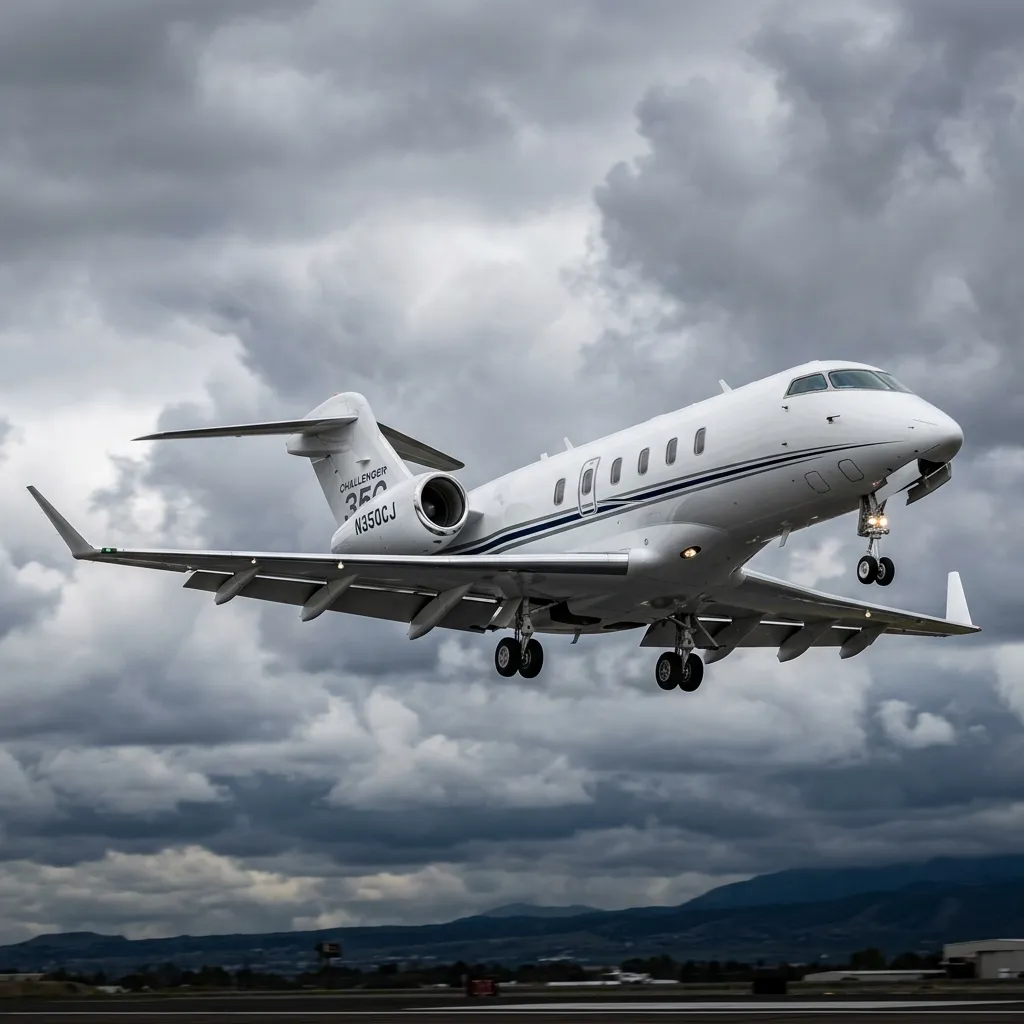
Bombardier Challenger 350 and Gulfstream G280 business jets parked side by side on an FBO ramp

Challenger 350 vs Gulfstream G280: Two Wide-Body Super-Midsize Jets, Two Design Philosophies

undefined

In This Article

The Two Aircraft That Define Super-Midsize Performance Head-to-Head Cabin Comparison: Width vs Length Charter Rates and Operating Economics Which One Fits Your Mission Frequently Asked Questions

The Two Aircraft That Define Super-Midsize

The Bombardier Challenger 350 and Gulfstream G280 are the two aircraft that have defined the super-midsize segment for over a decade. Between them, they account for approximately 70% of all super-midsize deliveries since 2014. The Challenger 350 leads in unit sales (700+ delivered versus roughly 250 G280s), but market share alone does not tell the story. These jets take fundamentally different approaches to the same mission: transcontinental range with a wide-body cabin.

The Challenger 350 carries its heritage from the Bombardier CL300 platform, emphasizing cabin width (7.2 feet), interior flexibility, and a broad service network. The G280 descends from the IAI Galaxy/Gulfstream G200 lineage, prioritizing altitude capability (FL450), fuel efficiency, and Gulfstream's cockpit standardization. Both aircraft cross the continent nonstop. The differences show up in how they do it and what the cabin experience feels like en route.

Performance Head-to-Head

The G280's performance advantage is clear on paper: 400 more nautical miles of range, lower fuel burn by approximately 20 gallons per hour, and the ability to cruise routinely at FL450 where winds are typically more favorable and traffic conflicts fewer. The G280 can reach London from the eastern seaboard in certain wind conditions, something the Challenger 350 cannot reliably accomplish. On fuel efficiency alone, the G280 saves approximately $900-$1,200 per flight hour at current fuel prices.

The G280's FL450 cruise capability is underappreciated. At FL450, the aircraft operates above most weather, virtually all commercial traffic, and in thinner air that reduces drag. Pilots report that the G280 at FL450 produces a noticeably smoother ride than the CL350 at FL410. For passengers sensitive to turbulence or for missions crossing weather systems, this altitude advantage is operationally meaningful.

Cabin Comparison: Width vs Length

The Challenger 350's cabin is wider by 3 inches and longer by 3.5 feet. This translates to a cabin that feels more spacious when seated and offers more room for conference-style seating arrangements. The extra length accommodates a more generous forward galley, which catering crews appreciate. The G280 counters with a larger baggage compartment (120 cubic feet versus 106) that is accessible in flight, and its cabin, while narrower, is still among the widest in the super-midsize class.

For charter clients carrying 4-6 passengers on coast-to-coast flights, the cabin differences are noticeable but not decisive. The Challenger feels more like a conference room; the G280 feels more like a Gulfstream (unsurprisingly). The G280's interior design language mirrors the G550 and G650, with oval windows, sculpted sidewalls, and signature Gulfstream lighting. Clients who have flown larger Gulfstreams will find the G280 cabin immediately familiar.

Need a Charter Quote?

Contact our team for a personalized quote.

Get a Quote

Charter Rates and Operating Economics

The G280's lower fuel burn produces measurable savings for owners and operators: $140 per flight hour at $7.00 per gallon, or $56,000 annually at 400 hours. For a charter operator flying 800 hours per year, the annual fuel savings approach $112,000. Charter rates for the G280 trend slightly lower than the Challenger 350, reflecting both the fuel savings and the G280's lower pre-owned acquisition cost.

Gulfstream discontinued the G280 in 2024 as the G400 development program advanced. This means all G280 purchases going forward are pre-owned. For buyers, this creates opportunity: low-time G280s (under 2,000 hours) trade at $13-$17 million, significantly below the Challenger 350's $16-$21 million range for equivalent vintage aircraft. The G280's residual value story will depend on whether the used market treats it as a discontinued model (depreciating) or a desirable asset with finite supply (stabilizing).

Which One Fits Your Mission

Choose the Challenger 350 when cabin size is the priority: larger groups (7-10 passengers), catering-intensive flights, or clients who prioritize interior space over altitude. The Challenger's wider cabin, longer floor plan, and more generous galley create a better environment for meetings, meals, and extended coast-to-coast flights with full passenger loads. The aircraft's massive installed base (700+ units) means parts, maintenance, and charter availability are abundant.

Choose the G280 when performance and efficiency drive the decision: longer-range missions, fuel-sensitive operations, high-altitude routing through weather, or buyers seeking a lower acquisition cost. The G280's FL450 cruise, lower fuel burn, and larger baggage compartment make it the better touring aircraft for 4-6 passengers covering multiple cities over several days. Its Gulfstream pedigree also appeals to clients who value the brand's cockpit standardization and pilot training ecosystem.

  • CL350 advantage: 3.5 feet longer cabin, wider by 3 inches, larger galley, bigger service network
  • G280 advantage: 400 NM more range, 20 GPH less fuel burn, FL450 cruise, lower pre-owned price
  • For 8+ passengers: Challenger 350 (more cabin space and catering capacity)
  • For transcontinental with 4-6 passengers: G280 (range, efficiency, ride quality at altitude)
  • For charter operators: CL350 dominates availability; G280 is a value play on operating cost
  • For buyers: G280 pre-owned at $13-$17M vs CL350 at $16-$21M for similar vintage
Brian Galvan

Written By

Brian Galvan

Founder, The Jet Finder ยท Private Aviation Operations & Technology

Former Director of Technology at FlyUSA (Inc. 5000 fastest-growing private jet company). Decade of hands-on experience across Part 135 operations, charter sales, fleet management, and aviation data systems.

LinkedInRead Full Profile →
Common Questions

Frequently Asked Questions


8 questions about chartering this aircraft

Gulfstream discontinued the G280 to make room for the G400, a clean-sheet super-midsize design expected to enter service around 2027-2028. The G280 was originally designed by Israel Aerospace Industries (IAI) and manufactured in Tel Aviv, with Gulfstream completing the interiors and avionics in the U.S. This split manufacturing arrangement was operationally complex and lower-margin than Gulfstream's fully domestic production. The G400 will be built entirely in Savannah, GA, with a new wing, PlaneView III cockpit, and improved cabin that should exceed both the G280 and CL350 in every metric.

Under standard conditions, no. The Challenger 350's NBAA IFR range with 4 passengers and NBAA reserves is approximately 3,200 NM. New York to London is roughly 3,450 NM. With strong tailwinds (40+ knots, common on eastbound North Atlantic tracks in winter), the CL350 can occasionally make it. The G280 at 3,600 NM can reach London from the northeast U.S. more reliably, though still weather-dependent. For guaranteed transatlantic capability, step up to the Challenger 650, G500, or heavier jets.

Direct maintenance costs are comparable: $350-$420 per flight hour for both aircraft. The Challenger 350 benefits from Bombardier's massive parts inventory and global service center network (30+ authorized facilities worldwide). The G280 benefits from Gulfstream's service reputation and pilot-reported dispatch reliability above 99%. Engine programs (Honeywell CorporateCare or JSSI) cost approximately $200-$250 per engine per hour for both the HTF7350 (CL350) and HTF7250G (G280). The CL350's larger installed base gives it a slight edge in parts availability.

Both aircraft fall in the 55-60 dB range at cruise, which is quieter than most midsize jets but louder than large-cabin jets like the G650 (52 dB) or Global 7500 (52 dB). The G280 has a slight edge in perceived cabin noise at its typical higher cruise altitude (FL430-450), where the engines operate at a more efficient power setting. The Challenger 350's cabin is wider, which allows sound-dampening insulation to be slightly thicker on the sidewalls. In practice, both cabins allow normal conversation at cruise without raising voices.

The Challenger 350 uses the Rockwell Collins Pro Line 21 Advanced avionics suite. The G280 uses the PlaneView 280 suite, based on Honeywell Primus Elite. Both are mature, certified avionics packages with synthetic vision, ADS-B Out, FANS/CPDLC datalink, and WAAS LPV approach capability. For charter clients, the avionics are invisible; both cockpits support identical operational capabilities. For owners and pilots, the avionics choice influences training costs: Gulfstream pilots can transition between G280/G500/G600/G650 with reduced training time due to cockpit commonality.

The standard CL350 charter configuration seats 8-9 passengers in a double-club arrangement: four forward-facing and four rear-facing seats around two tables, plus a belted lavatory seat. Some configurations include a three-place divan in place of the aft club seats, increasing total capacity to 10. The forward galley accommodates full catering service including hot meals. Most charter CL350s have Wi-Fi (Ka-band or Gogo Avance L5) and power outlets at every seat. The 7.2-foot cabin width allows two passengers to sit across from each other with full shoulder clearance.

The G280's 120 cubic foot baggage compartment is larger than the CL350's 106 cubic feet, and it is accessible in flight. Both compartments accommodate standard golf bags, ski bags, and large luggage sets. For a group of 6 with golf bags, the G280 handles the load more comfortably. The CL350 can accommodate 4-5 golf bags plus personal luggage. Neither aircraft has the baggage volume of a heavy jet (Global 6000: 195 cu ft), so groups of 8+ with bulky sporting equipment should consider stepping up in aircraft size.

Not immediately. The G400 is expected to enter service around 2027-2028 with a list price above $30 million. G280s currently trade at $13-$17 million for low-time examples, representing a significant price gap. The G280 will remain viable for buyers who want Gulfstream performance at a lower acquisition cost, similar to how the G450 and GIV-SP remain active in the pre-owned market years after the G500/G550 replacements arrived. The G280's residual value will likely stabilize rather than collapse, supported by its finite production run of approximately 250 aircraft and continued demand for super-midsize jets.

Continue Reading

Related Articles


Your Next Mission

Ready to Fly?


Whether you need a charter quote or want to explore aircraft options, our team is here.

Contact Us