Inventory Levels: Where the Market Stands
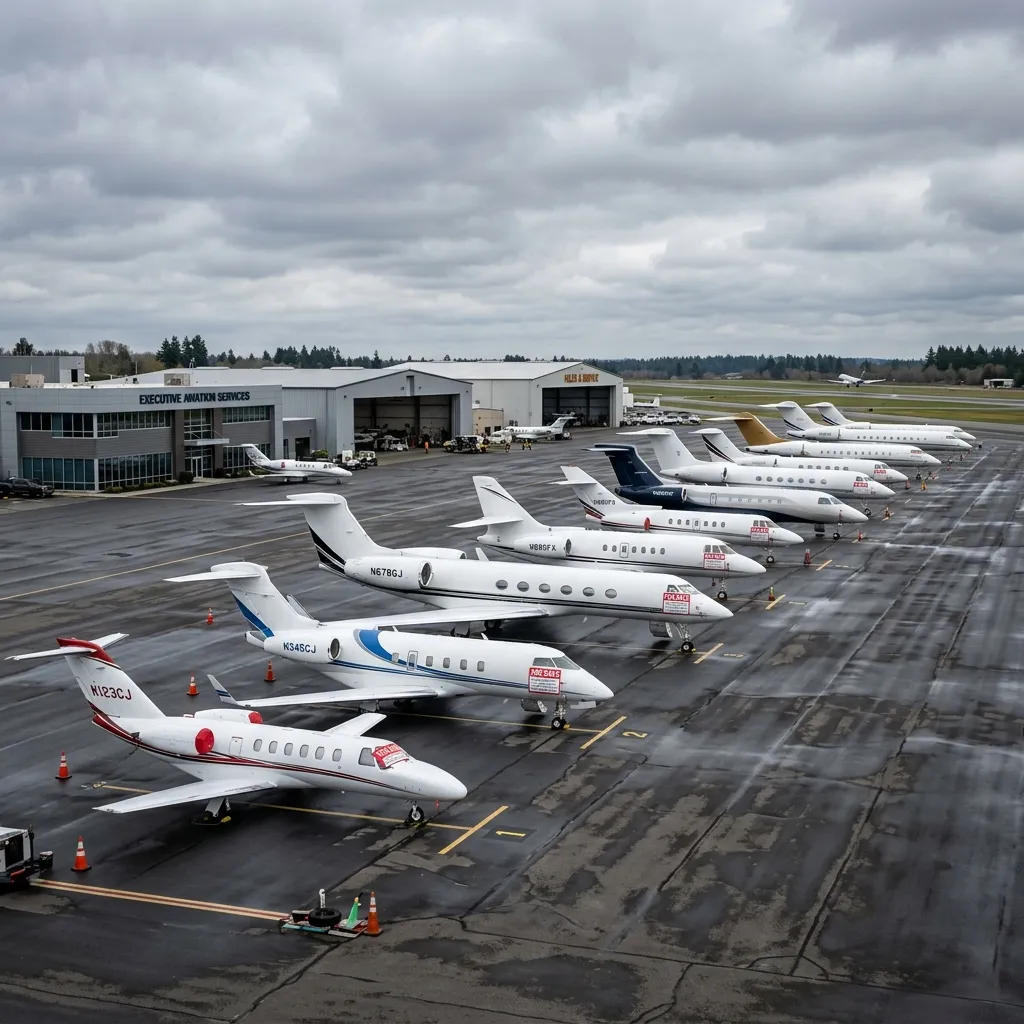
Approximately 2,340 business jets were listed for sale in Q2 2026, representing 11.2% of the active worldwide fleet of roughly 20,900 aircraft. This for-sale percentage is approaching the historical 10-year average of 12-14% that characterized the market before COVID-19 disrupted supply-demand dynamics. The pandemic created an unprecedented demand surge that drew down available inventory to 4.8% by early 2022, a level that gave sellers pricing power not seen since the mid-2000s boom.
The inventory rebuild has been gradual. From 4.8% in Q1 2022 to 7.1% in Q1 2023, 9.4% in Q1 2024, 10.3% in Q1 2025, and now 11.2% in Q2 2026. Each quarter adds roughly 0.3-0.5 percentage points as deferred trade-ins materialize, pandemic-era buyers sell after their initial ownership period, and new OEM deliveries push older aircraft into the secondary market.
Price Corrections by Category
Price corrections have been uneven across jet categories. Light jets have experienced the steepest percentage declines, with models like the Citation CJ3, Phenom 100, and Learjet 45 down 12-18% from 2022 peaks. These aircraft attracted first-time buyers during the pandemic who are now exiting ownership after encountering the full cost of maintenance, insurance, and hangar fees. The exit of speculative buyers is adding supply in the category that is most price-sensitive.
Midsize jets have corrected 8-12%. The Citation XLS and Hawker 800XP are broadly available, with transaction prices falling from pandemic highs. Super-midsize jets like the Challenger 350 have shown more resilience, with only 5-8% price softening. The Challenger 350's strong charter demand provides a floor: operators will absorb aircraft at prices that make charter economics work.
Ultra-long-range jets have been the most resistant to correction. G650ER values have declined only 3-5% from peaks, supported by limited production runs and the aircraft's role as a status marker. The Global 7500, with minimal pre-owned supply (fewer than 30 listed worldwide), has held essentially flat. New OEM pricing increases have raised the cost ceiling, supporting used values.
-8 to -15%
Price Change YoY
142 days
Avg Days on Market
Transaction Volume and Buyer Behavior
Transaction volume in 2025 totaled approximately 2,600 pre-owned business jet sales, down from the pandemic peak of 3,400 in 2021 but in line with pre-pandemic averages. The reduction in velocity reflects a market returning to normal negotiation timelines. During the 2021-2022 peak, aircraft sold within 30-45 days, often with multiple bidders. In 2026, average days on market has extended to 142, giving buyers the leverage to conduct proper pre-buy inspections, negotiate maintenance status adjustments, and evaluate multiple options before committing.
Buyer demographics are shifting. First-time buyers, who represented an estimated 25-30% of transactions during the pandemic, have dropped to approximately 15%. Corporate flight departments and established charter operators now account for a larger share of acquisitions. These experienced buyers conduct more thorough due diligence and negotiate more aggressively on price, contributing to longer transaction timelines.
The pandemic created buyers who had never priced an annual inspection or a hot-section overhaul. Many are now discovering that a $5 million acquisition is followed by $400,000-$800,000 in annual operating costs. That sticker shock is driving some of the inventory increase as first-time owners exit within their first 3-4 years.
Need a Charter Quote?
Contact our team for a personalized quote.
Get a Quote →Models to Watch in 2026
Best Value: Hawker 800XP ($1.8-$2.8M)
The Hawker 800XP represents the best value in midsize business aviation. Fully capable aircraft with 4,000+ hour airframes are available at $1.8-$2.8 million, well below the $3-4 million they commanded in 2022. The Honeywell TFE731 engines have deep overhaul support, and the aircraft's wide cabin remains competitive with current-production midsize jets.
Emerging Opportunity: Challenger 300 ($4.5-$7M)
Early Challenger 300s (2004-2008 vintage) are entering a pricing sweet spot. These aircraft deliver 90% of the Challenger 350's performance and the identical 8.2-foot cabin width. The 300's GE CF34-3B engines are the same as the 604's, with extensive overhaul options. Buyers willing to accept Collins Pro Line 21 avionics instead of the 350's Vision can save $2-3 million on acquisition.
Price Resilient: Gulfstream G650ER ($39-$42M)
The G650ER continues to hold value better than any other large-cabin jet. Limited supply (fewer than 50 listed globally), continued charter demand, and the aircraft's role as a corporate flagship support pricing. G700 trade-ins are adding supply slowly, but buyers for low-time G650ERs appear within weeks of listing.
Factors That Will Shape the Market Through 2027
Several forces are converging to shape the pre-owned market over the next 18 months. OEM order backlogs are clearing: Gulfstream, Bombardier, and Dassault have all reduced quoted delivery wait times from 36+ months in 2022 to 12-18 months in 2026. As new deliveries accelerate, trade-ins increase and pre-owned supply grows. Interest rates, while stabilizing, remain elevated compared to the zero-rate environment that funded many pandemic-era acquisitions.
- OEM delivery acceleration will push more trade-ins into the pre-owned market
- Interest rate environment makes financing more expensive, cooling demand
- First-time pandemic buyers continuing to exit ownership
- Corporate flight departments evaluating fleet rationalization
- Charter operator consolidation may reduce demand for marginal aircraft types
- Sustainable Aviation Fuel mandates in Europe could accelerate retirement of older, less efficient types
The market is not crashing. It is normalizing toward historical averages after an unprecedented disruption. For buyers, the next 12 months represent a window of opportunity that will not persist indefinitely. Inventory is up, prices are down, and sellers are motivated. The best acquisition opportunities in a decade are available now, particularly in the midsize and super-midsize categories.
Financing Environment and Transaction Structure
Interest rates for aircraft financing in mid-2026 range from 6.5% to 8.5% depending on credit quality, down payment, and aircraft type. That represents a significant increase from the 3.5-5.0% rates that prevailed during the pandemic-era acquisition boom. The higher cost of capital has cooled speculative buying and reduced the number of first-time purchasers entering the market. Lenders are also tightening loan-to-value ratios, typically requiring 20-30% equity versus the 10-15% that was common in 2021.
For buyers with cash, the current financing environment creates a structural advantage. All-cash offers close faster, avoid appraisal contingencies, and give sellers certainty. Operators and dealers report that cash buyers are negotiating 5-8% below asking price on aircraft that have been listed for over 120 days. The pre-buy inspection remains the single most important step in any acquisition, regardless of financing structure. Skipping the pre-buy to accelerate closing is the most expensive mistake a buyer can make.