How Many Part 135 Operators Exist?
The FAA maintains 2,147 active Part 135 air carrier certificates as of March 2026. That number is misleading without context. A Part 135 certificate authorizes on-demand air taxi operations, but not every certificate holder operates jets. Many hold certificates exclusively for helicopter tours, seaplane charters, or cargo operations using single-engine turboprops.
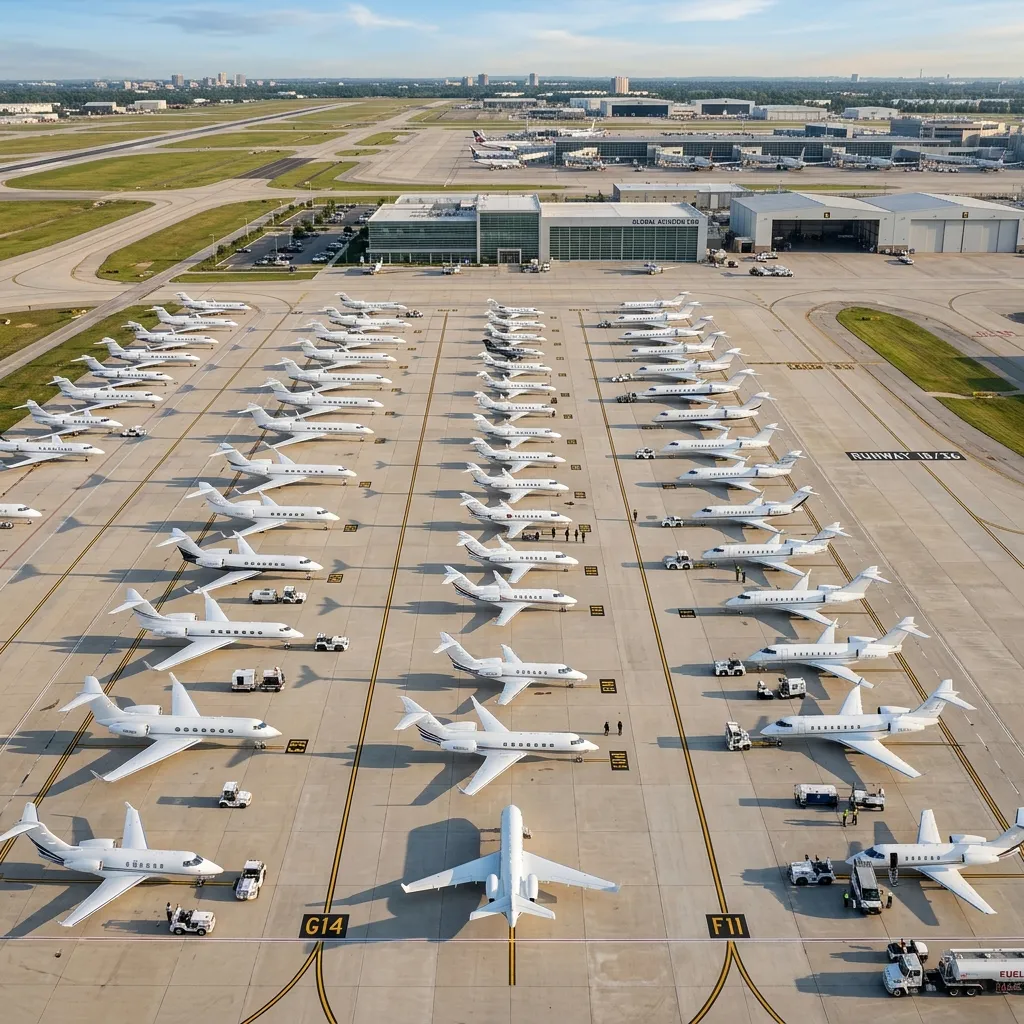
When filtered to operators with at least one turbojet or turbofan aircraft available for passenger charter, the count drops to approximately 870 certificate holders. These 870 operators collectively manage the 4,891 jet aircraft that constitute the U.S. on-demand charter fleet. The remaining 1,277 certificates cover rotorcraft, fixed-wing piston, turboprop cargo, and air ambulance operations that never interact with the typical charter passenger.
2,147
Active Part 135 Certificates
4,891
Charter-Available Jets
68%
Operators with <5 Aircraft
Certificate count has remained remarkably stable over the past five years. The FAA issued 84 new Part 135 certificates in 2025, while 71 were surrendered, suspended, or revoked. Net growth: 13 certificates. The charter industry is not expanding through new entrants. It is consolidating through existing operators adding aircraft to their existing certificates.
Most Operators Are Smaller Than You Think
The charter industry's public image is shaped by large operators: NetJets, Flexjet, Wheels Up, and Jet Linx. These names dominate advertising, sponsorships, and media coverage. They represent a fraction of the total operator count.
Sixty-eight percent of jet charter operators manage fewer than five aircraft. These are typically regional operators running one to three jets under a single certificate, serving a specific geographic market. A two-jet operator based at Centennial Airport (APA) in Denver might manage a Citation CJ3 and a Challenger 300, covering light and super-midsize demand across the Rocky Mountain region.
This fragmentation has direct implications for charter pricing and availability. When you request a quote from a broker, the broker is often reaching out to 15 to 25 individual operators to find an available aircraft. Each operator sets its own rates, applies its own positioning logic, and maintains its own maintenance schedule. There is no central dispatch.
What the Fleet Actually Looks Like
The 4,891 charter-available jets in the U.S. fleet break down by category in predictable patterns. Light jets dominate. They are cheaper to operate, easier to crew, and serve the highest volume of domestic routes under three hours.
- Light Jets (39%): Citation CJ series, Phenom 300, Learjet 45, HondaJet. Approximately 1,907 aircraft. The backbone of domestic charter.
- Midsize Jets (22%): Citation XLS, Hawker 800XP, Learjet 60. Approximately 1,076 aircraft. The workhorse category for 3-4 hour flights with 6-8 passengers.
- Super-Midsize Jets (18%): Challenger 300/350, Citation Latitude, Gulfstream G280. Approximately 880 aircraft. Coast-to-coast nonstop capability.
- Heavy Jets (15%): Gulfstream G550/G650, Global Express, Falcon 900. Approximately 734 aircraft. International range and large-cabin comfort.
- Ultra Long Range (6%): Global 7500, Gulfstream G700, Falcon 8X. Approximately 294 aircraft. The newest and most expensive segment.
The light jet concentration reflects demand patterns. Seventy-one percent of all U.S. charter flights cover fewer than 1,000 nautical miles. A Citation CJ3 or Phenom 300 handles these missions at $2,200 to $3,800 per flight hour. Dispatching a Gulfstream G650 for a two-hour flight is operationally possible but economically wasteful.
Find a Vetted Charter Operator
We work exclusively with operators who meet our internal safety standards. No marketplace. No bidding wars.
Request a Quote →Where Charter Operators Concentrate
Charter operator distribution mirrors population density and wealth concentration, but not perfectly. Florida leads with 127 jet charter operators, followed by Texas at 98, California at 87, and New York/New Jersey at 72 combined. These four regions account for 44% of all U.S. jet charter certificates.
Florida's 127 charter operators manage more jets than the next two states combined. The combination of seasonal demand, favorable tax treatment, no state income tax for pilots, and year-round flying weather makes the state the center of gravity for U.S. charter aviation.
Within these states, operator concentration narrows further. In Florida, Fort Lauderdale Executive Airport (FXE), Opa-locka Executive (OPF), and Naples Municipal (APF) host the majority of charter-based aircraft. In Texas, operators cluster around Dallas Love Field (DAL), Addison (ADS), and Sugar Land (SGR). California's fleet concentrates at Van Nuys (VNY), Long Beach (LGB), and San Jose (SJC).
Geographic concentration creates pricing asymmetries. Chartering a light jet out of Fort Lauderdale is competitive because 40+ operators are fighting for the same routes. Chartering a light jet from Bozeman, Montana involves one or two operators with limited fleet, and rates reflect the reduced competition.
The Age Problem
The average age of a jet in the U.S. charter fleet is 14.2 years. That number masks a bifurcation. Large operators like NetJets and Flexjet maintain average fleet ages of 6 to 8 years by cycling aircraft every 10 to 12 years. Smaller operators frequently run aircraft well past their 20th birthday.
An older aircraft is not inherently unsafe. FAA maintenance standards apply regardless of age, and a well-maintained 25-year-old Hawker 800XP meets the same airworthiness requirements as a factory-fresh Challenger 3500. The difference manifests in cabin experience, avionics capability, and fuel efficiency. A passenger stepping onto a 2003 Learjet 45 will notice worn carpet, analog displays, and louder cabin noise compared to a 2023 Phenom 300E.
What Fleet Age Means for Your Quote
When a broker presents three quotes for the same route and one comes in 25% below the others, fleet age is often the explanation. The lower-priced option is likely a higher-time airframe with older avionics and a functional but dated interior. This is not a safety concern. It is a product differentiation question. The $4,500-per-hour Challenger 350 and the $3,200-per-hour Challenger 300 fly the same route at the same speed. The cabin experience is where you see the price gap.
Consolidation Is Accelerating
The single-aircraft operator is under pressure. Rising insurance premiums, pilot recruitment costs, and maintenance inflation make it increasingly difficult to profitably operate one or two jets under a Part 135 certificate. Operators that cannot spread fixed costs across a larger fleet face margin compression that eventually forces a sale or a certificate surrender.
The result is acquisition activity from mid-size and large operators. Jet Linx added 38 aircraft in 2025 by absorbing smaller operators and their customer books. Wheels Up acquired three regional operators in the Southeast during Q4 2025. Flexjet expanded its managed fleet by 52 aircraft through direct owner agreements.
For charter passengers, consolidation has mixed effects. Fewer operators can mean reduced price competition in regional markets. Larger operators, however, offer better digital booking infrastructure, standardized safety protocols, and more consistent fleet quality. The industry is moving toward a model where 50 operators control 60% of the available fleet, while 800 smaller operators split the remainder.