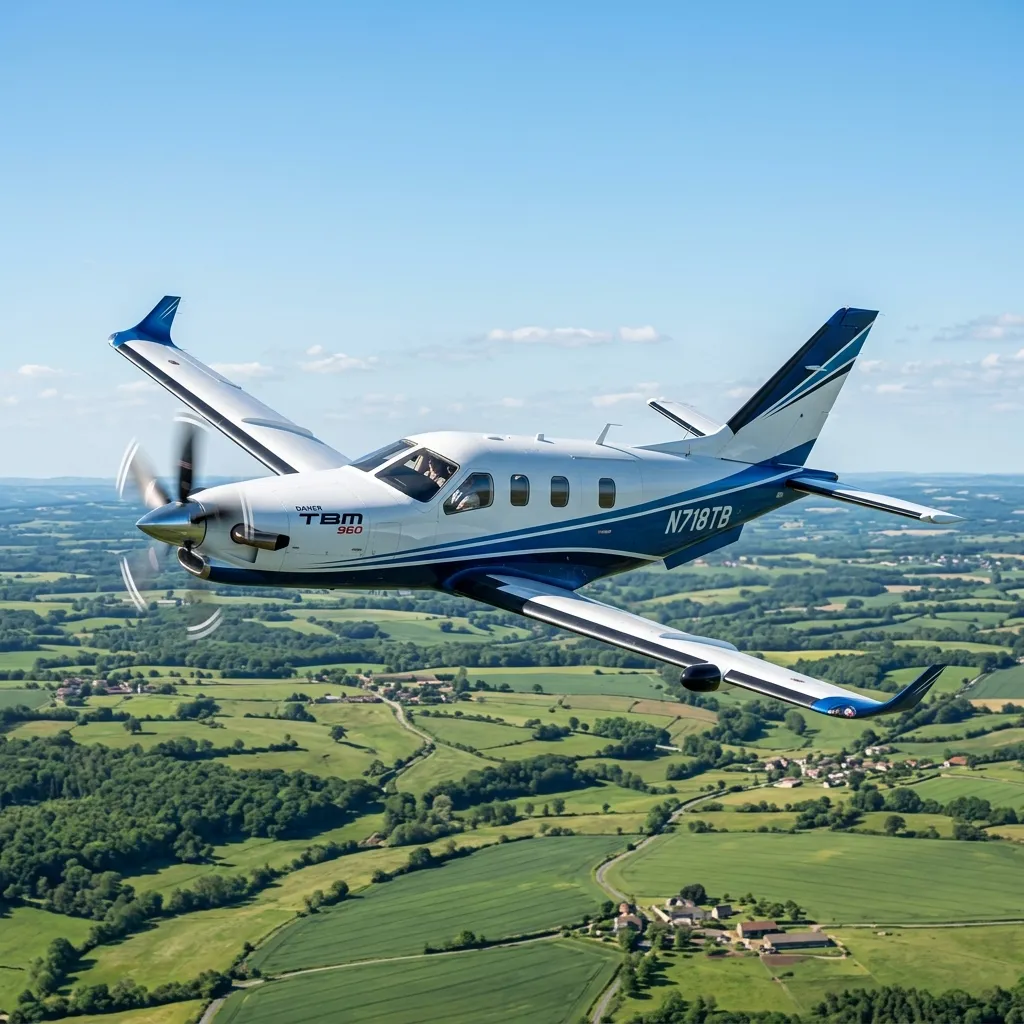
Daher TBM 960 turboprop in flight above a green landscape with clouds

undefined

undefined

In This Article

Speed That Embarrasses Light Jets The PT6A-66D: One Engine, Absolute Reliability The Cockpit: Garmin G3000 NXi with Autothrottle Cabin and Payload Who Buys a TBM 960 Pre-Owned Market Frequently Asked Questions

Speed That Embarrasses Light Jets

The TBM 960 cruises at 330 kts true airspeed at FL310, which is faster than the Cessna Citation Mustang (340 kts max cruise, but 300 kts typical long-range cruise), the Eclipse 550 (375 kts max but 340 kts typical), and within 50 kts of the HondaJet Elite S (422 kts). It achieves this speed on a single Pratt & Whitney Canada PT6A-66D engine producing 850 shaft horsepower, burning 60 gallons per hour at high cruise.

The comparison to light jets is not theoretical. The TBM 960 competes directly with very light jets for owner-pilot missions under 1,000 nm. Its $4.8 million new price is lower than the HondaJet Elite S ($5.9 million) and the Phenom 100EV ($4.95 million). Its operating cost is approximately $1,100 per flight hour versus $1,800 to $2,200 for VLJs. On missions under 800 nm, the TBM delivers comparable block times at 40% lower operating cost.

The PT6A-66D: One Engine, Absolute Reliability

The Pratt & Whitney Canada PT6A engine family is the most produced turbine engine in aviation history, with over 60,000 units delivered and more than 430 million flight hours accumulated across the family. The -66D variant in the TBM 960 produces 850 shaft horsepower and drives a five-blade Hartzell composite propeller with a 93-inch diameter.

The engine has a 3,600-hour time between overhaul (TBO) and an overhaul cost of approximately $350,000 to $400,000. Divided across the TBO interval at 400 flight hours per year, the engine reserve is approximately $100 per flight hour. This is roughly one-third the engine reserve cost of twin-engine light jets, where two engines each carry their own overhaul reserve.

Single-engine reliability is the question that every prospective buyer asks. The PT6A family's in-flight shutdown rate is approximately 0.5 per 100,000 engine hours. That translates to one in-flight shutdown every 200,000 flight hours of operation. The TBM 960 is certified for flight into known icing and all-weather IFR operations, meaning the FAA considers its single-engine reliability sufficient for commercial-level mission profiles.

The Cockpit: Garmin G3000 NXi with Autothrottle

The TBM 960 was the first aircraft to receive Garmin's autothrottle system integrated into the G3000 NXi avionics suite. The autothrottle manages power settings from takeoff through climb, cruise, descent, and approach. Combined with the GFC 700 autopilot and GWX 80 weather radar, the cockpit reduces single-pilot workload to a level that approaches twin-engine jet simplicity.

The avionics include three 14.1-inch landscape displays, dual WAAS GPS receivers, ADS-B In/Out, TCAS II traffic advisory, Iridium satellite datalink, and SurfaceWatch runway monitoring. The Emergency Autoland system (Garmin Autoland) is available as an option. If the pilot becomes incapacitated, a passenger presses a single button and the aircraft autonomously flies to the nearest suitable airport, executes an approach, lands, and stops on the runway.

The Garmin Autoland option adds approximately $150,000 to the aircraft price. For single-pilot operators, it is the most consequential safety feature available in any turboprop. The system has been certified since 2020 and has been exercised in training and demonstration flights but has not yet been activated in an actual emergency.

Need a Charter Quote?

Contact our team for a personalized quote.

Get a Quote

Cabin and Payload

The TBM 960 cabin seats 6 passengers in a club-four plus two aft-facing configuration. The cabin measures 13.5 feet long, 4.1 feet wide, and 4.1 feet tall. It is not a stand-up cabin. Passengers taller than 5'10" will duck when moving through the cabin. The seats are leather, heated, and reclinable, but the dimensions are closer to a large SUV than a business jet.

Useful load is 1,580 pounds with full fuel (291 gallons). With 4 passengers at 200 pounds each (including baggage), the aircraft has 780 pounds of fuel margin, which is enough for approximately 1,400 nm of range. At maximum fuel, the range extends to 1,730 nm with 4 passengers and their luggage.

The baggage compartment holds 33 cubic feet and is accessed through an external door on the left aft fuselage. For comparison, the Pilatus PC-12 NGX offers 40 cubic feet in its aft baggage area plus additional cabin storage. The TBM is tighter on luggage than any competing turboprop, a trade-off for its speed advantage.

The TBM 960 is designed for 4 passengers with briefcases, not 6 passengers with golf bags. Load it for speed, not capacity.

Who Buys a TBM 960

The typical TBM 960 buyer is an experienced pilot who flies 200 to 400 hours per year, operates primarily in the eastern United States, and values speed above cabin size. The aircraft is almost exclusively owner-flown; fewer than 5% of TBMs in the United States operate under Part 135 charter certificates. Daher sells approximately 50 to 55 new TBMs per year globally.

The competing aircraft are the Pilatus PC-12 NGX ($5.4 million, 290 kts, 9 passengers) and the Beechcraft King Air 260 ($7.8 million, 310 kts, 9 passengers, twin engine). The PC-12 offers a larger cabin, more payload, and unpaved runway capability. The King Air 260 offers twin-engine redundancy and a wider cabin. The TBM offers the highest speed-to-cost ratio of any turboprop in production.

Charter availability for the TBM 960 is limited. Because most are owner-operated, the Part 135 fleet is small. When available, charter rates are $1,400 to $1,800 per flight hour. For charter passengers seeking turboprop access to short runways, the PC-12 is far more commonly available on the charter market.

Pre-Owned Market

A 2022 TBM 960 with 400 hours sells for $4.0 to $4.4 million on the pre-owned market. Earlier TBM variants (TBM 930, TBM 900) sell for $2.8 to $3.8 million depending on year and hours. The TBM 850, which preceded the 900-series with a different engine variant, trades at $1.5 to $2.5 million.

Residual value retention on the TBM family is strong: approximately 85 to 90% of new price after 3 years. This is driven by limited production (50 to 55 per year), a dedicated owner community, and minimal direct competition in the high-speed single-engine segment. The TBM holds its value better than any turboprop except the Pilatus PC-12.

Buyers should inspect the propeller de-ice boots, landing gear actuators, and PT6A hot section condition as the primary maintenance cost items. A TBM approaching its 3,600-hour engine TBO with a pending hot section inspection may require $100,000 to $200,000 in near-term maintenance investment. This should be reflected in the asking price.

Brian Galvan

Written By

Brian Galvan

Founder, The Jet Finder ยท Private Aviation Operations & Technology

Former Director of Technology at FlyUSA (Inc. 5000 fastest-growing private jet company). Decade of hands-on experience across Part 135 operations, charter sales, fleet management, and aviation data systems.

LinkedInRead Full Profile →
Common Questions

Frequently Asked Questions


6 questions about chartering this aircraft

At $375,000 average overhaul cost divided by 3,600 hours, the per-hour engine reserve is approximately $104. For an owner flying 350 hours per year, that translates to roughly $36,000 annually set aside for the eventual overhaul. Twin-engine light jets carry reserves on two engines, typically $200 to $300 per hour combined, making the TBM single-engine reserve roughly one-third the jet equivalent.

Approximately $104 per hour in engine reserves. An owner flying 350 hours per year sets aside roughly $36,000 annually for the eventual overhaul, which comes due every 9 to 12 years at that utilization. By comparison, twin-engine light jets carry reserves on two powerplants at $200 to $300 per hour combined, making the TBM single-engine program one-third the jet equivalent cost.

Garmin Autoland is available as an option on the TBM 960, adding approximately $150,000 to the aircraft price. When activated, the system autonomously navigates to the nearest suitable airport, flies an instrument approach, lands, and brings the aircraft to a stop on the runway. The system has been certified since 2020 and demonstrated extensively in training scenarios. As of early 2026, it has not been activated in an actual pilot incapacitation emergency.

Fewer than 5% of U.S.-registered TBMs operate under Part 135 charter certificates. The aircraft is designed and marketed as an owner-flown airplane for pilots who fly 200 to 400 hours per year. The PC-12 has a larger cabin (9 passengers), more payload, and a cargo door that makes it versatile for charter operations. Charter operators prefer the PC-12 because it accommodates more passengers and earns more revenue per flight hour.

Four passengers at 200 pounds each including baggage consumes 800 pounds, leaving 780 pounds of fuel margin for approximately 1,400 nm of range. With 6 passengers and luggage, useful load is consumed and fuel must be reduced, cutting range to approximately 900 nm. The practical passenger limit for full-range missions is 4. Six passengers is possible on short legs under 500 nm.

The TBM 960 operates at approximately $1,100 per flight hour. The Phenom 100EV runs $1,800 to $2,200 per hour. The HondaJet Elite S runs $1,600 to $2,000 per hour. The Beechcraft King Air 260 (twin engine turboprop) runs $2,000 to $2,500 per hour. The TBM delivers the lowest cost-per-mile of any pressurized turbine aircraft in its speed class.

Continue Reading

Related Articles


Your Next Mission

Ready to Fly?


Whether you need a charter quote or want to explore aircraft options, our team is here.

Contact Us