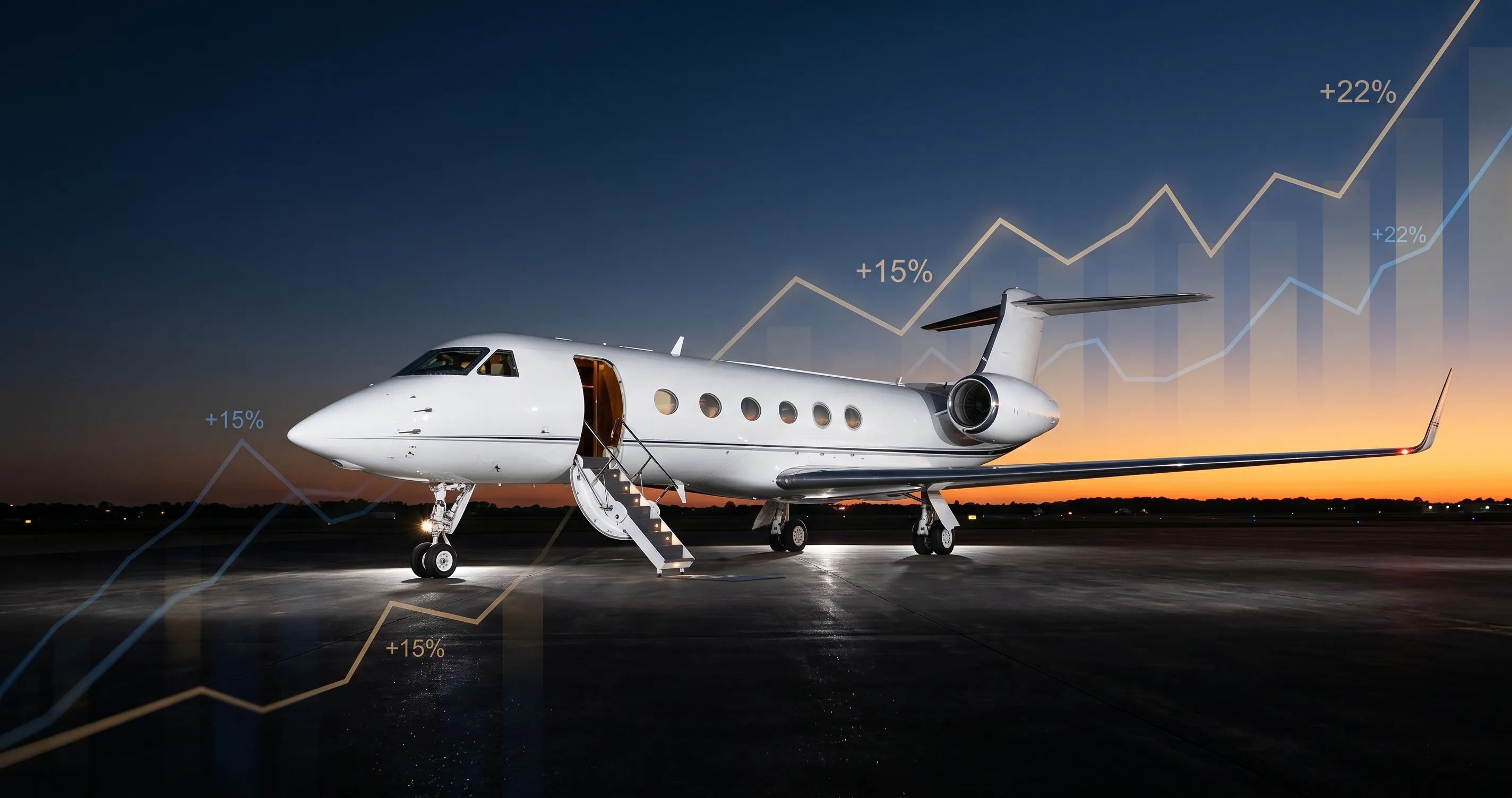
Business jet on ramp with financial charts overlay in blue and gold

How Rising Interest Rates Are Reshaping Aircraft Financing in 2026

A 360 basis point increase since 2022 added $1.2 million in interest to a $25 million aircraft loan. The financing playbook has changed.

In This Article

The Rate Environment: 4.2% to 7.8% in Four Years Impact on Pre-Owned Aircraft Pricing Lender Landscape: Who Is Still Lending Financing Strategies in a High-Rate Environment Refinancing Existing Aircraft Loans Outlook: When Will Rates Come Down? Frequently Asked Questions

The Rate Environment: 4.2% to 7.8% in Four Years

In early 2022, qualified borrowers financed business jets at 4.0% to 4.5% fixed rates on 10-year terms. By mid-2026, the same borrower profile is seeing 7.5% to 8.2% fixed rates. On a $25 million aircraft with 15% down and a 10-year amortization, that rate increase adds approximately $1.2 million in total interest paid over the life of the loan.

Variable-rate aircraft loans tied to SOFR (Secured Overnight Financing Rate) have fluctuated even more aggressively. Borrowers who locked variable rates in 2021 at SOFR + 200 bps were paying roughly 2.5% all-in. The same SOFR + 200 bps structure now costs 7.3% as the Fed funds rate has climbed. Some borrowers who chose variable rates have seen their monthly payments increase by 40-60% since origination.

The Federal Reserve's monetary tightening cycle, which began in March 2022, was the primary driver. Business aviation lending rates track Treasury yields with a spread of 200-350 basis points depending on borrower creditworthiness, aircraft type, and loan-to-value ratio.

Impact on Pre-Owned Aircraft Pricing

Higher financing costs have suppressed pre-owned aircraft demand at the upper end of the market. Aircraft priced above $30 million are sitting longer on the market: average days-to-sale increased from 90 days in 2022 to 165 days in early 2026. Sellers of large-cabin and ultra-long-range jets are accepting 5-15% less than they would have received two years ago.

The light and midsize jet segments have been more resilient. Sub-$10 million aircraft often involve smaller loans or cash purchases, making them less sensitive to rate changes. The Citation CJ series, Phenom 300, and Learjet 75 markets have seen minimal price erosion because many buyers in this segment finance less than 50% of the purchase price.

Higher rates did not destroy demand. They revealed which buyers are price-sensitive and which are not. Cash buyers and low-leverage operators continued purchasing without hesitation. Highly leveraged buyers deferred or downsized. The net effect is a bifurcated market where premium aircraft hold value and marginal aircraft depreciate faster.

Lender Landscape: Who Is Still Lending

The major aircraft lenders, Global Jet Capital, TVPX, Western Pacific Leasing, and Chase Commercial Term Lending, remain active but with tighter underwriting. Loan-to-value ratios have compressed from 85-90% in 2021 to 75-80% in 2026. Minimum credit standards have increased, and lenders are requiring more extensive aircraft appraisals before committing.

Regional banks that entered aircraft lending during the low-rate era have largely exited. Aircraft loans are specialized assets that require type-specific collateral knowledge. Banks that treated aircraft loans like commercial real estate loans discovered that aircraft depreciate faster and have higher collateral risk. The flight capital, the ability for the borrower to literally fly the collateral out of the country, makes aircraft lending uniquely risky.

  • Global Jet Capital: largest dedicated aviation lender, $3B+ portfolio, rates 7.5-9.0% fixed
  • TVPX: specializes in owner trust structures for non-US buyers, competitive on large-cabin jets
  • Western Pacific Leasing: mid-market focus, King Air through Challenger-class, 7.0-8.5% range
  • PNC Aviation Finance: bank-affiliated lender, relationship pricing available, 7.0-8.0% for top-tier borrowers
  • Chase Commercial Term Lending: selective, prefers existing Chase private banking clients, 6.5-7.5% range

Need a Charter Quote?

Contact our team for a personalized quote.

Get a Quote

Financing Strategies in a High-Rate Environment

Larger Down Payments

Increasing the down payment from 15% to 30% on a $20 million aircraft reduces monthly payments by approximately $16,000 and saves over $500,000 in interest over a 10-year term. Buyers who have the liquidity to put 30-40% down are seeing the best rate offers from lenders, as the lower LTV reduces the lender's risk exposure.

Shorter Loan Terms

Moving from a 10-year to a 7-year term increases monthly payments by 20-25% but reduces total interest paid by 30-35%. For buyers who can absorb the higher monthly cash outflow, shorter terms are the most effective way to reduce the total cost of borrowing. Some lenders offer 0.25-0.50% rate reductions on 7-year versus 10-year terms.

Lease-Back Structures

Operating leases are gaining popularity as an alternative to ownership. The buyer leases the aircraft from a leasing company for a fixed monthly payment, with a purchase option at the end of the term. The lease payment is fully deductible as an operating expense, and the buyer avoids carrying the aircraft as an asset on the balance sheet. Monthly lease payments on a $20 million jet run $180,000 to $220,000 on a 7-year term.

7.8%
Avg Aircraft Loan Rate
+360 bps
Since 2022
$1.2M
Added Interest ($25M/10yr)
15-20%
Typical Down Payment

Refinancing Existing Aircraft Loans

Owners who locked low fixed rates in 2020-2022 have no incentive to refinance. Those rates are now below market and the existing loan is a valuable financial position. Prepayment penalties on most aircraft loans run 2-3% of the outstanding balance in the first three years, declining to zero by year five.

Owners on variable-rate loans should evaluate refinancing to fixed rates if they plan to hold the aircraft for more than three years. The break-even analysis depends on current SOFR levels, the fixed-rate offer, refinancing costs (typically $15,000-$25,000 in legal and appraisal fees), and the owner's rate outlook. If the Fed begins cutting rates in late 2026 or 2027, variable-rate holders may benefit from patience.

Cross-collateralization, using other assets (real estate, portfolios) to secure the aircraft loan, can reduce rates by 50-100 basis points. Private banks like J.P. Morgan, Goldman Sachs, and UBS offer preferential aircraft lending terms to clients with substantial assets under management.

Outlook: When Will Rates Come Down?

The Federal Reserve has signaled two potential rate cuts in late 2026, which would reduce SOFR by 50 basis points. Fixed aircraft loan rates would follow with a lag of 1-2 months. Even with two cuts, aircraft lending rates would remain above 7.0% for most borrowers, well above the sub-5% levels of 2020-2022.

Buyers waiting for a return to 4% rates will wait indefinitely. The 2020-2022 rate environment was an anomaly driven by pandemic-era monetary policy, not the norm. Historical average aircraft lending rates over the past 20 years are approximately 5.5-6.5%. A return to this range by 2028 is plausible; a return to 4% is not.

The practical advice for 2026 buyers: if the aircraft serves a genuine operational need, buy now and refinance later when rates moderate. The cost of waiting, depreciation on the aircraft you would have purchased, opportunity cost of not having air transportation, and the risk that the right aircraft sells to another buyer, often exceeds the interest savings from delayed financing.

Brian Galvan

Written By

Brian Galvan

Founder, The Jet Finder ยท Private Aviation Operations & Technology

Former Director of Technology at FlyUSA (Inc. 5000 fastest-growing private jet company). Decade of hands-on experience across Part 135 operations, charter sales, fleet management, and aviation data systems.

LinkedInRead Full Profile →
Common Questions

Frequently Asked Questions


8 questions about aircraft financing and interest rates

Total payments on a $16 million loan at 7.8% over 10 years: approximately $23.1 million, meaning $7.1 million in interest. Monthly payments run approximately $192,000. At the 2022 rate of 4.2%, the same loan would have cost $19.5 million total with $3.5 million in interest. The rate increase effectively doubled the interest cost.

Fixed rate for buyers planning to hold the aircraft more than 5 years. The certainty of payment is worth the premium. Variable rate only for buyers with a 2-3 year hold horizon who believe the Fed will cut rates in that window. Variable-rate borrowers should have the financial capacity to absorb a further 100-200 bps increase if rates move against them.

Yes, through owner trust structures administered by companies like TVPX or Wells Fargo. The aircraft is registered in the trust's name under an FAA-approved non-citizen trust. The trust structure adds legal complexity and approximately $15,000-$25,000 in setup costs. Rates for non-US borrowers are typically 50-100 basis points higher than for US citizens, reflecting the additional collateral risk.

For operators flying 200-400 hours per year, operating leases have become more competitive. The lease payment is fully deductible, there is no residual value risk, and the operator avoids tying up capital in a depreciating asset. For operators flying 400+ hours who plan to hold the aircraft 7-10 years, ownership still makes sense because the total cost of ownership declines as the aircraft ages and the loan amortizes.

Top-tier rates (below 7.5%) require a personal net worth of $10 million+, FICO above 750, and demonstrated liquidity of at least 6 months of loan payments. Mid-tier rates (7.5-8.5%) are available to borrowers with $5 million+ net worth, FICO above 700, and strong income documentation. Lenders also evaluate the aircraft type, age, and projected residual value as part of the collateral analysis.

Variable rates tied to SOFR adjust within 30-60 days of a Fed rate cut. Fixed rates offered by lenders adjust with a lag of 1-3 months as the Treasury yield curve shifts. A 50 bps Fed cut would likely translate to a 25-40 bps reduction in fixed aircraft lending rates, not a full pass-through. Lenders absorb part of the cut as margin improvement.

Yes. Interest on aircraft loans used for business purposes is generally deductible under IRC Section 163. Additionally, financing preserves capital that can be invested elsewhere, potentially at returns exceeding the after-tax cost of borrowing. Buyers in the highest tax brackets may find that the after-tax cost of a 7.8% aircraft loan is effectively 4.5-5.0% after the interest deduction.

The lender's security interest is recorded with the FAA and, under the Cape Town Convention, with the International Registry. In theory, the lender can repossess the aircraft wherever it is located. In practice, repossession of aircraft in foreign jurisdictions can be complex, time-consuming, and expensive. This is why lenders charge higher rates for borrowers who fly extensively internationally or base aircraft outside the US.

Continue Reading

Related Articles


Your Next Mission

Ready to Fly?


Whether you need a charter quote or want to explore aircraft options, our team is here.

Contact Us