The Napkin
In 1976, Gerald Genta sat down at a restaurant and sketched a watch on a napkin. He had done this before. The year prior, he designed the Audemars Piguet Royal Oak, the watch that invented the luxury steel sports watch category. Now he was doing it again, this time for Patek Philippe, the oldest and most conservative watchmaker in Geneva.
The sketch was an octagonal bezel with rounded "ears" on each side, inspired by a ship's porthole. The case would be steel. The bracelet would be integrated, meaning the lugs and links were designed as a single visual unit rather than separate components. The dial would be horizontal, with an embossed pattern that caught light differently depending on the angle. It would be called the Nautilus.
Patek Philippe, a house that had built its reputation on gold dress watches and minute repeaters, was being asked to sell a steel sports watch at a premium price. The industry thought it was absurd. The collectors who bought it thought otherwise.
The reference 3700, the original "Jumbo" Nautilus, ran from 1976 until the early 2000s. It was never a best-seller. It was a cult object. And when Patek introduced the reference 5711 in 2006, updated for the 30th anniversary with a 40mm case, in-house movement, and sapphire caseback, they lit a fuse that would take 15 years to detonate.
The Watch
The 5711/1A is deceptively simple. Steel case, 40mm. Blue-black gradient dial with horizontal embossing. Date window at 3 o'clock. Luminous hour markers and hands. Integrated steel bracelet with a fold-over clasp. Water resistance to 120 meters. That is the entire specification sheet.
There is no chronograph. No moon phase. No tourbillon. No complications of any kind beyond the date. The 5711 is a time-and-date watch. It tells you what time it is, and it tells you the date. That is all it does. And it does it with a level of finishing that renders every other steel watch in the world a concession.
The 5711 does not need complications. It is the complication.
The case is finished with alternating brushed and polished surfaces. The transitions between these finishes are executed at a tolerance that requires hand-finishing under magnification. The bezel's octagonal shape is not stamped. It is machined, then polished, then hand-checked. The bracelet links are individually finished. The clasp is engineered to sit flush when closed. Nothing protrudes. Nothing catches. Nothing is unresolved.
The Movement
Inside the 5711 sits the Caliber 26-330 SC, a self-winding movement with a 35-45 hour power reserve. It operates at 28,800 vibrations per hour. It is finished with Geneva stripes, beveled edges, and a 21-karat gold rotor. The Patek Philippe Seal, the brand's proprietary quality standard, guarantees accuracy to -3/+2 seconds per day, a tolerance stricter than COSC chronometer certification.
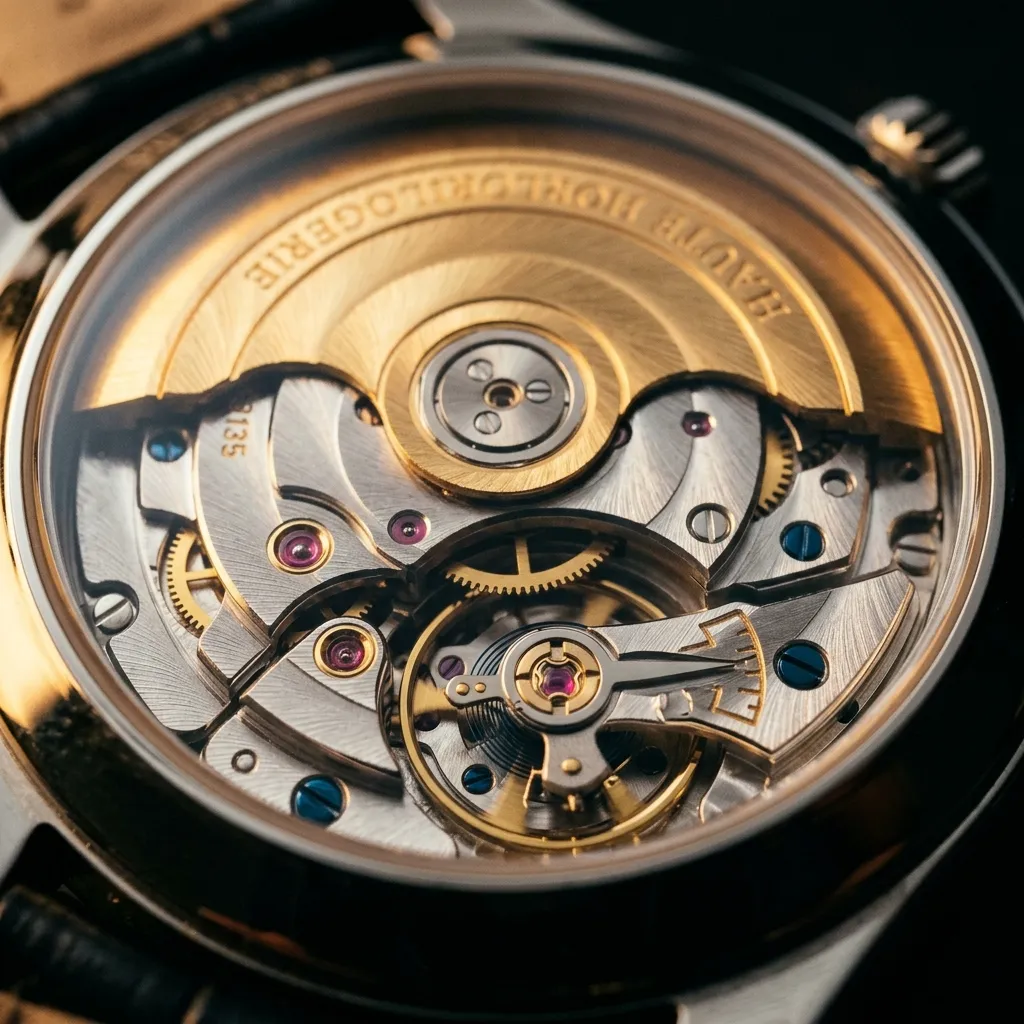
The sapphire caseback is not a gimmick. It is an invitation to examine the finishing. The Geneva stripes on the mainplate are ruler-straight. The anglage on the bridges is polished by hand, not by machine. The screws are blued. The perlage on the base plate is consistent in diameter and spacing. This level of decoration is applied to every movement that leaves the Patek Philippe manufacture, regardless of whether the caseback is transparent or solid. The finishing is not for the wearer. It is for the watchmaker who services it in 30 years.
The Market
Patek Philippe discontinued the 5711 in 2021. The retail price at the time was approximately $35,000. The waiting list was years long. Authorized dealers had stopped accepting new names. The secondary market had already pushed prices above $100,000.
The discontinuation did not reduce demand. It compressed it. The olive green dial 5711/1A-014, one of the final variations, immediately traded at multiples of retail. The Tiffany Blue 5711/1A-018, produced in a run of 170 pieces for the 170th anniversary of the Patek-Tiffany partnership, became the single most valuable modern wristwatch overnight. One sold at auction for $6.5 million.
As of early 2026, the standard blue-dial 5711/1A trades between $95,000 and $130,000 on the secondary market, depending on condition and provenance. Box and papers matter. The original purchase receipt matters more. A 5711 with an unbroken chain of documentation from an authorized dealer commands a premium that a "no papers" example does not.
The successor, reference 5811/1G in white gold, was introduced in 2022. It returned to the two-piece case construction of the original 3700, with a slightly larger case and updated movement. It is a worthy continuation. But it is not the 5711. And the market knows the difference.
The Signal
The Nautilus 5711 occupies a specific cultural position. It is not the most expensive watch you can buy. It is not the most complicated. It is not the rarest. What it is, and what makes it trade at multiples that defy rational pricing models, is the clearest single-object signal in the material world.
A person wearing a 5711 is not announcing wealth. A gold Rolex does that. A 5711 announces taste, patience, access, and the specific kind of restraint that comes from choosing a steel watch at six figures when a gold one was available for less. The people who recognize it are the people who matter. The people who do not are not the audience.
It is a $120,000 steel watch that weighs 115 grams. It tells you the time. It tells you the date. And it tells everyone in the room exactly who you are without saying a word.