Airport Overview: Why OPF Exists
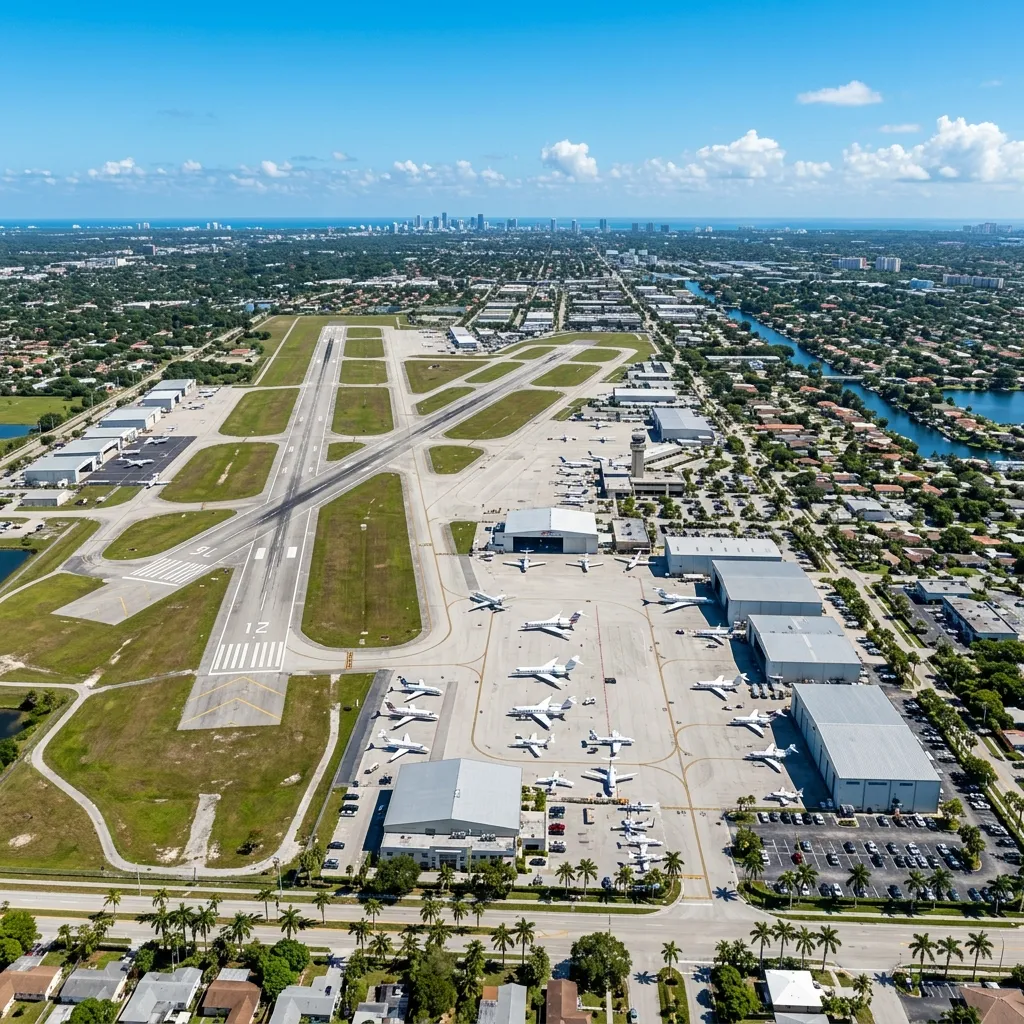
Opa-locka Executive Airport (OPF) logged more than 90,000 operations in 2025, making it the busiest general aviation airport in Miami-Dade County. Located 12 miles north of downtown Miami, OPF operates four runways, the longest at 8,002 feet, and hosts five FBOs competing for transient business jet traffic. That competition drives average Jet A pricing to $6.00-$6.80 per gallon, approximately $0.40-$0.80 below Fort Lauderdale Executive (FXE) and $1.00+ below Miami International (MIA).
OPF has four runways. Runway 12/30 at 8,002 feet handles every business jet in production, including ultra-long-range aircraft departing for international destinations. Runway 9L/27R at 6,800 feet serves as the secondary instrument runway. Two shorter runways handle training traffic and light aircraft. The multi-runway configuration means OPF rarely experiences holding delays, unlike MIA where commercial traffic creates 15-30 minute slots for GA aircraft.
The airport's heritage is notable. Built in 1927, OPF served as a Naval Air Station during WWII. The Art Deco-style administration building (now part of the OPF complex) is listed on the National Register of Historic Places. Amelia Earhart departed from OPF on her final, ill-fated circumnavigation attempt in 1937. The operational character has shifted from military to general aviation, but the infrastructure retains its scale.
FBO Options: Five Choices on One Field
OPF's five FBOs create genuine competition for transient business jet traffic. This competition benefits passengers through lower fuel prices, better ramp service, and amenity upgrades that FBOs at monopoly airports cannot justify. Average Jet A pricing at OPF runs $6.00-$6.80 per gallon, approximately $0.40-$0.80 below FXE and $1.00+ below MIA.
FBO Comparison
Fontainebleau Aviation is the largest facility on the field, with 120,000 square feet of heated hangar space and a full MRO (maintenance, repair, overhaul) operation. For passengers arriving on transient charters, Fontainebleau offers the most polished terminal experience. National Jets operates a substantial Part 135 charter fleet from OPF, making it both an FBO and an operator. This dual role means National Jets aircraft are always on the field, reducing positioning times for Miami-originating charters.
Ground Transportation: OPF to Miami Destinations
OPF's location in the Opa-locka neighborhood, 12 miles north of downtown Miami, places it closer to Miami Beach (18 miles/30-40 minutes), Aventura (10 miles/20 minutes), and Bal Harbour (14 miles/25 minutes) than FXE or MIA. South Beach is reachable in 30-45 minutes depending on traffic. The Brickell financial district takes 20-25 minutes via I-95.
All five FBOs coordinate ground transportation. Black car services, SUVs, and Sprinter vans are standard requests. During Art Basel (December), the Super Bowl (variable), and Ultra Music Festival (March), ground transportation demand spikes and pre-booking 48 hours ahead is advisable. Helicopter transfers to South Beach are available through HeliNY and other operators for approximately $900-$1,500 per flight, reducing the transit time to 8 minutes.
Need a Charter Quote?
Contact our team for a personalized quote.
Get a Quote →Operational Considerations for Pilots and Dispatchers
OPF operates in Class D airspace under Miami Center's TRACON. Arriving IFR traffic should expect vectors from Miami Approach to either Runway 12 or Runway 27R depending on winds. The airport has a voluntary noise abatement program that requests pilots avoid overflight of residential areas north and east of the field below 2,000 feet. There is no mandatory noise curfew; OPF accepts arrivals and departures 24/7.
Customs and Immigration
OPF is a designated Airport of Entry (AOE) with U.S. Customs and Border Protection available by appointment. CBP processing is handled at the FBO level, not a dedicated federal inspection facility. International arrivals require advance APIS filing and a minimum 60-minute CBP notification window. For flights arriving from the Caribbean or Latin America, OPF's customs clearance is typically faster than MIA (15-30 minutes versus 45-90 minutes at MIA's GA terminal).
Hurricane Season Preparedness
South Florida's hurricane season (June 1 through November 30) affects OPF operations and aircraft parking decisions. When a hurricane threatens, FBOs close 12-24 hours before projected landfall. Aircraft on the field must be evacuated or hangared. Transient jets visiting during hurricane season should monitor tropical weather and have evacuation routing pre-planned. OPF's hangars reach capacity quickly during evacuation events, and operators without pre-arranged hangar contracts may be unable to secure indoor space.
OPF vs Fort Lauderdale Executive: Which Miami Airport?
The OPF versus FXE decision depends on final destination. For Miami Beach, Aventura, Brickell, and Wynwood, OPF saves 15-25 minutes of ground time compared to FXE. For Fort Lauderdale Beach, Las Olas, and Boca Raton, FXE is closer. Fuel pricing slightly favors OPF (FBO competition drives prices $0.30-$0.80 lower per gallon). FXE has newer FBO facilities (Banyan Air Service and Sheltair both completed renovations in 2024-2025). OPF has more runway capacity and less congestion.
Charter operators based in South Florida split between both airports. Operators with heavy jets or international routing tend to prefer OPF for its 8,002-foot runway and customs capability. Operators serving Fort Lauderdale-centric clientele use FXE. Price-sensitive operators use OPF for fuel savings. During peak season events (Art Basel, boat shows, Super Bowl), both airports operate at capacity and slot availability determines the choice.
Maintenance and Aircraft Services at OPF
OPF hosts several MRO (maintenance, repair, overhaul) facilities that serve the South Florida business aviation fleet. Fontainebleau Aviation operates a full-service MRO capable of scheduled inspections, avionics upgrades, and interior refurbishment on most Gulfstream, Bombardier, and Cessna/Textron models. National Jets provides line maintenance and AOG (aircraft-on-ground) support for its charter fleet and transient aircraft.
Paint and interior shops at OPF can complete full aircraft repaints in 3-4 weeks and interior refurbishments in 4-8 weeks, depending on scope. The airport is a practical choice for owners planning extended maintenance because South Florida offers year-round VFR test flight conditions and the FBO competition keeps parking and hangar costs reasonable during downtime. Monthly hangar rates at OPF run ,000-,000 for midsize jets, compared to ,000-,000 at FXE.