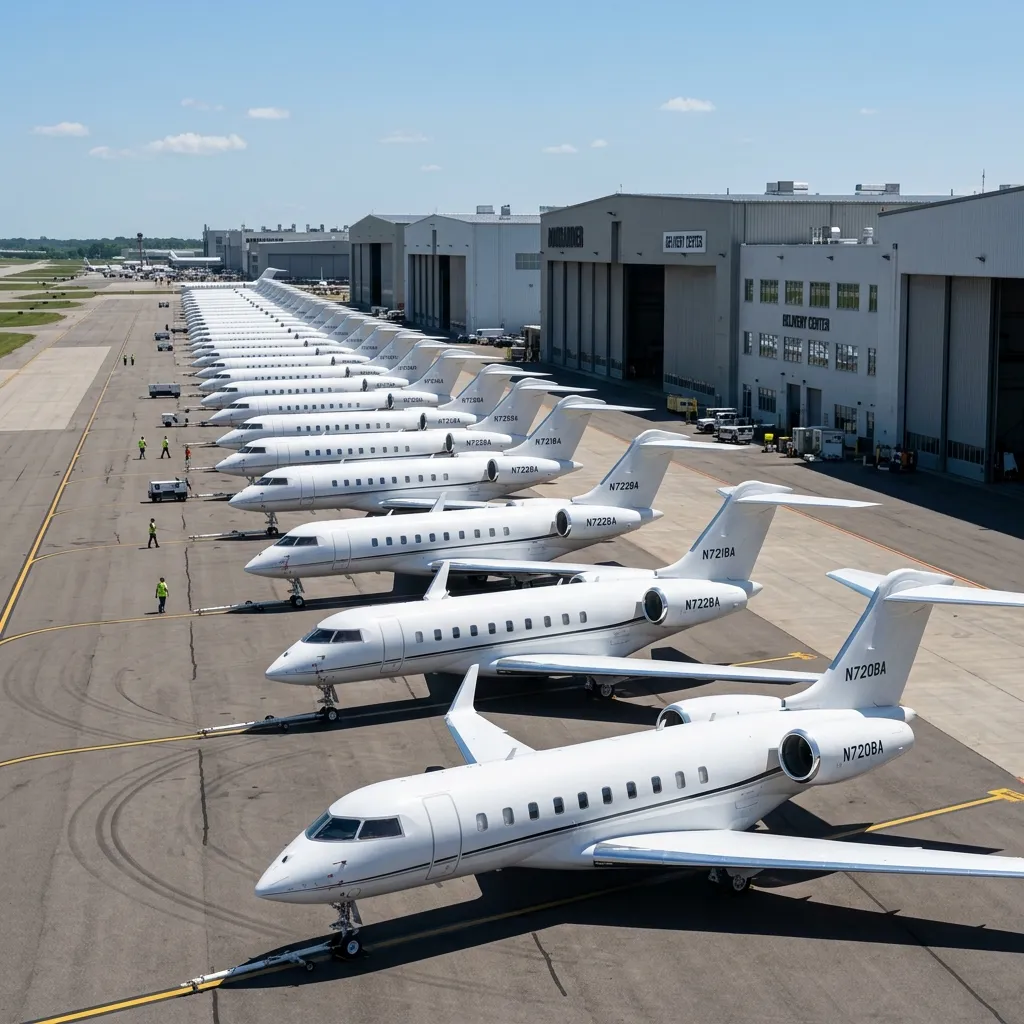
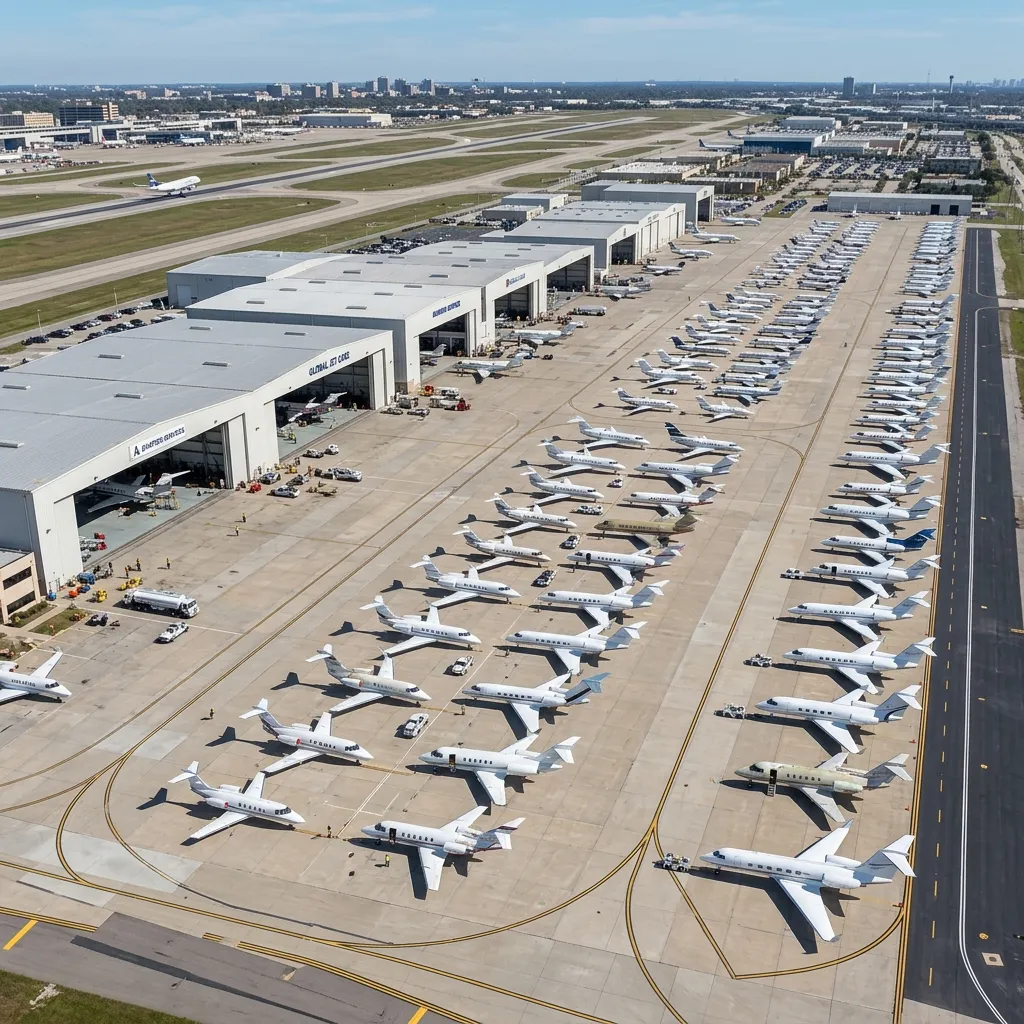
2025 Full-Year Delivery Numbers by Manufacturer
The business jet industry delivered 722 new aircraft in 2025, down 2.8% from 743 in 2024 but up 14% from pre-pandemic 2019 levels. Total delivery value reached an estimated $24.7 billion, a record driven by the mix shifting toward larger, more expensive aircraft. The average delivery value climbed to $34.2 million per unit, up from $29.8 million in 2023.
Textron leads in unit volume because its lineup spans the Citation Mustang/M2 at the entry level through the Citation Longitude at the top. But Gulfstream dominates by revenue. Its 170 deliveries at an average value of $55 million generated more revenue than Textron's 193 units at an average of $12 million.
Gulfstream: G700 Ramp and G650 Wind-Down
Gulfstream's 170 deliveries in 2025 included 48 G650/G650ER units, 37 G700s in its first full production year, 33 G500s, 28 G600s, and 24 G280s. The G700 ramp has been slower than initially projected. Gulfstream originally targeted 45 to 50 G700 deliveries in 2025 but encountered supply chain delays for the Rolls-Royce Pearl 700 engine and custom cabin completion bottlenecks.
The G650 production line is scheduled to close in late 2026 as the G700 and G800 absorb its market position. Remaining G650ER delivery slots command premiums of $2 to $4 million over list price because buyers want the last factory-new examples of a model with proven residual value. Approximately 30 to 40 G650/ER deliveries are expected in 2026 before the line shuts down.
The G800, Gulfstream's 8,000 nm range flagship, began customer deliveries in Q4 2025 with 8 units shipped. Full-rate production targeting 25 to 30 units annually is expected by mid-2027.
Bombardier: Global 7500 Dominance and Challenger Refresh
Bombardier delivered 138 aircraft in 2025: 46 Global 7500s, 25 Global 6500s, 42 Challenger 350/3500s, and 25 Challenger 650s. The Global 7500 remains the highest-revenue single model in Bombardier's lineup, with each delivery valued at approximately $75 million. Its backlog extends into late 2027.
The Challenger 3500, Bombardier's refreshed super-midsize entry, accounted for all new Challenger 300-series deliveries. The original Challenger 350 production ended in early 2025. The 3500 adds the Bombardier Smooth Flex wing, an eco-friendly cabin, and Bombardier's new sustainment program. Early operator feedback has been positive, though the 3500's list price increase of $1.5 million over the 350 has pushed some buyers toward the pre-owned 350 market.
Bombardier's stated production target for 2026 is 150 deliveries, a modest 8.7% increase. The company has prioritized margin expansion over volume growth, focusing on higher-value Global deliveries rather than unit count.
Considering a New or Pre-Owned Acquisition?
We track production slots, delivery timelines, and pre-owned alternatives across every OEM.
Contact Acquisitions →Textron and Embraer: Volume and Market Share
Textron Aviation's 193 deliveries spanned 12 models from the Citation M2 Gen2 through the Citation Longitude. The M2 Gen2 and CJ3+ accounted for 68 units combined, reflecting persistent demand in the owner-pilot light jet segment. The Citation Longitude delivered 31 units, establishing itself as Cessna's super-midsize anchor. The Citation XLS+ continues to sell well at 28 units, proving the midsize workhorse still has market relevance.
Embraer delivered 84 executive jets: 52 Praetor 500/600s and 32 Phenom 300E/100EVs. The Praetor 600 has gained significant traction in markets that previously defaulted to the Challenger 350, particularly in Europe and Latin America where its 4,018 nm range covers key city pairs. Embraer's Phenom 300E maintained its position as the best-selling light jet globally for the eleventh consecutive year.
Dassault and Honda
Dassault delivered 43 Falcon jets, including the first 12 Falcon 6X units. The 6X, Dassault's new wide-body large-cabin entry, has drawn buyers from both the Falcon 7X replacement market and Gulfstream G500 cross-shoppers. Honda Aircraft delivered 42 HondaJet Elite S units, continuing to dominate the very light jet segment with its over-the-wing engine design and class-leading performance.
Order Backlogs: Where They Stand and What It Signals
Industry-wide backlog entering 2026 stands at approximately $42 billion, down from the peak of $48 billion in late 2023. The decline reflects normalized ordering patterns after the pandemic-era surge, not weakness. Gulfstream's backlog alone exceeds $19 billion, the largest in company history, driven by G700 and G800 demand.
- Gulfstream: $19.2B backlog. G700 slots sold through 2028. G500/G600 availability in 12-18 months.
- Bombardier: $14.8B backlog. Global 7500 sold through late 2027. Challenger 3500 available in 10-14 months.
- Textron: $4.2B backlog. Most Citation models available in 8-12 months. Longitude wait is 14-18 months.
- Dassault: $3.1B backlog. Falcon 6X sold through mid-2027. Falcon 900LX production ended.
- Embraer: $1.8B backlog. Praetor 600 lead time approximately 12 months. Phenom 300E available in 8-10 months.
The backlog compression creates an interesting dynamic in the pre-owned market. Buyers who placed orders during the 2021-2022 frenzy are now taking delivery of aircraft they may no longer need at the same intensity. Several G700 and Global 7500 positions have been resold at premiums, but the practice is declining as lead times shorten.
What Delivery Trends Mean for Buyers and Charter Clients
For prospective owners, the delivery landscape entering 2026 is significantly more favorable than 2022-2023. Wait times have shortened across most manufacturers, and the negotiating environment has shifted from seller's market to balanced. Textron and Embraer offer the shortest lead times at 8 to 14 months. Gulfstream's flagship G700 remains a 2+ year wait.
For charter clients, new deliveries are quietly improving the charter fleet. Operators receiving new G700s and Challenger 3500s are cycling their older G550s and Challenger 350s into the charter fleet at lower rates. A 2018 G550 that would have been owner-operated is now available for charter at $10,000 to $12,000 per hour, $2,000 to $3,000 below what the same cabin would cost in a G700.
The mix shift toward larger, longer-range aircraft also means more international charter capability entering the fleet. Every G700 delivery adds a 7,500 nm platform to the global charter pool. The practical result: nonstop routes that previously required a fuel stop are increasingly available as single-leg charters. New York to Dubai nonstop. Los Angeles to London nonstop. São Paulo to Paris nonstop.
The Pre-Owned Cascade Effect
Every new delivery creates a corresponding pre-owned aircraft entering the secondary market. When an owner takes delivery of a G700, their previous G550 or G650 often goes to a broker within 90 days. This cascade effect has added approximately 180 to 220 large-cabin pre-owned aircraft to the market annually since 2023, creating downward price pressure on jets that are 8 to 15 years old.
For buyers who do not need the latest avionics suite or cabin design, this cascade creates acquisition opportunities. A 2014 G550 with 4,000 hours, pushed onto the market by its owner's G700 delivery, might trade for $22 to $26 million. The aircraft has 85% of the G700's capability at 35% of its price. The pre-owned market rewards patience and timing.