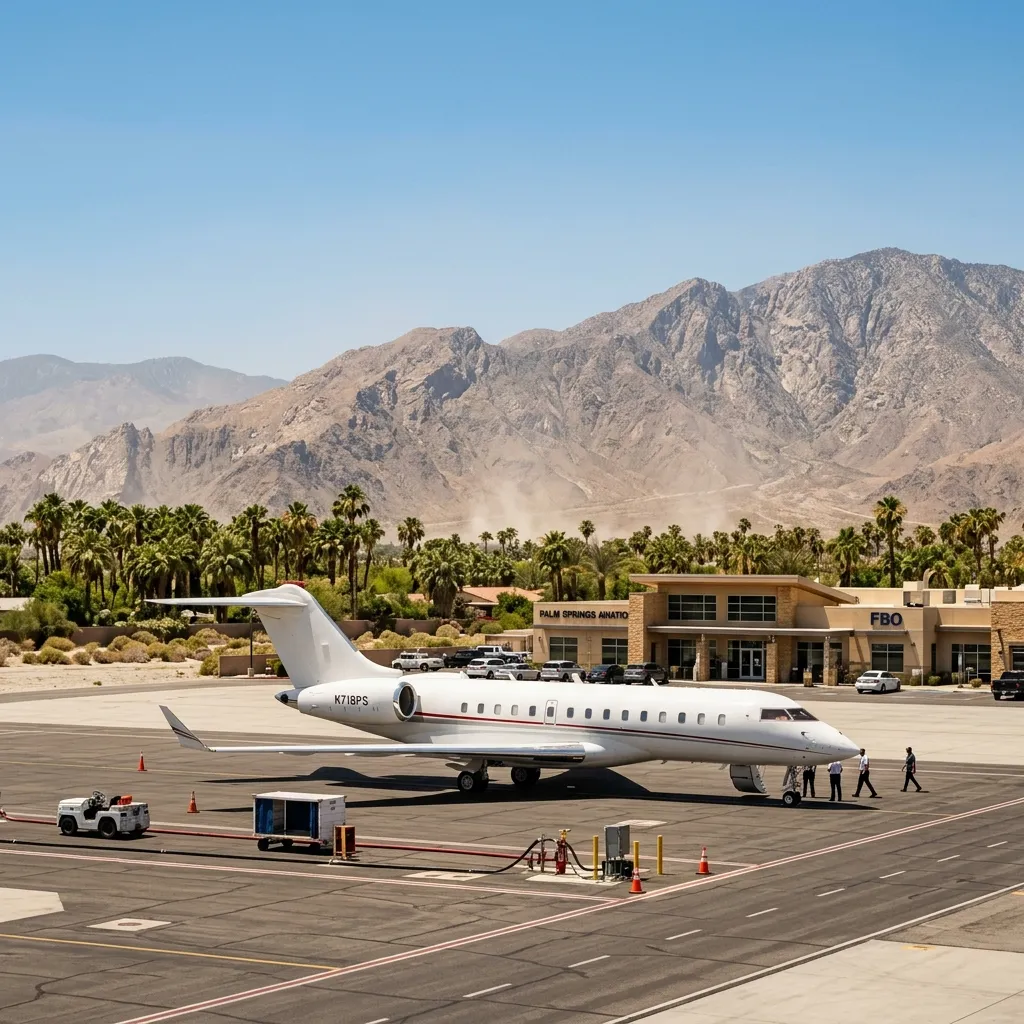
Coachella: Palm Springs Under Siege
Palm Springs International Airport (PSP) handles approximately 150 to 200 general aviation movements on a normal Friday. During Coachella weekends, that number exceeds 500. The two-weekend festival in April creates the single largest temporary surge in private jet traffic at any airport in the western United States.
The primary FBOs at PSP (Atlantic Aviation and Signature Flight Support) impose special event surcharges during Coachella. Ramp fees double. Overnight parking fees for jets over 60,000 pounds can reach $2,500 per night. Fuel availability is generally not an issue, but ramp space is. FBOs begin turning away transient parking requests 48 to 72 hours before the festival starts.
The alternative airports are Thermal (TRM, also called Jacqueline Cochran Regional), which is 15 miles from the festival site and operates with minimal services, and Bermuda Dunes (UDD), a private airport that opens for limited use during Coachella. Some operators stage at Ontario (ONT) or San Bernardino (SBD) and arrange ground transportation, adding 90 minutes of drive time but avoiding the PSP congestion entirely.
Stagecoach: The Hangover Weekend
Stagecoach falls on the weekend immediately after Coachella Weekend 2, using the same venue in Indio, California. The private jet traffic is roughly 40% lower than Coachella but still significantly elevated above normal PSP operations. The FBO surcharges remain in effect.
The key difference for charter passengers is timing. By Stagecoach weekend, the FBO ramp crews at PSP have been running extended operations for three consecutive weekends. Service levels can slip. Fueling delays that take 20 minutes during normal operations may stretch to 45 minutes during Stagecoach. Experienced operators book fuel in advance and request specific ramp positions to minimize turnaround time.
The Stagecoach audience skews differently from Coachella, which affects aircraft types on the ramp. Coachella draws heavy jet traffic (G650, Global 6000, Falcon 7X) from Los Angeles, New York, and Miami. Stagecoach draws more light and midsize jets (Phenom 300, Citation XLS, King Air 350) from Texas, Nashville, and Phoenix. The ramp looks different, but the congestion is real.
Bonnaroo: The Nashville Ground Game
Bonnaroo takes place on a 700-acre farm in Manchester, Tennessee, which has no airport capable of handling business jets. The nearest suitable airport is Nashville International (BNA), 65 miles northwest. Tullahoma Regional (THA), 35 miles east, has a 6,000-foot runway that accommodates light jets and turboprops but no FBO services beyond fuel.
The ground transportation from Nashville to Manchester takes 75 to 90 minutes by car. Helicopter transfers are an option: Nashville-based operators offer charter helicopter service to the festival grounds for $3,500 to $5,000 per trip (up to 4 passengers). The flight takes 25 minutes. For passengers arriving by jet and wanting to avoid the drive, the helicopter transfer is the standard play.
Nashville's FBO market (Signature at BNA, Atlantic at John C. Tune/JWN) does not experience the same Coachella-level surge. Bonnaroo draws a younger demographic that is less likely to charter full aircraft. The private jet traffic increase is noticeable but manageable, adding perhaps 50 to 80 extra movements across the weekend.
Need a Charter Quote?
Contact our team for a personalized quote.
Get a Quote →Lollapalooza, Austin City Limits, and Urban Festivals
Urban festivals present the opposite challenge. Lollapalooza (Chicago, Grant Park) and Austin City Limits (Austin, Zilker Park) take place in cities with robust private aviation infrastructure. Chicago Midway (MDW), DuPage (DPA), and Chicago Executive (PWK) absorb Lollapalooza traffic without special event pricing. Austin-Bergstrom (AUS) and Austin Executive (EDC) handle ACL traffic as part of normal heavy-weekend operations.
The constraint in urban festival markets is not airport capacity. It is ground transportation. Getting from any Chicago-area airport to Grant Park during Lollapalooza weekend takes 45 to 90 minutes depending on traffic. Getting from Austin-Bergstrom to Zilker Park takes 30 to 60 minutes. Helicopter transfers are not practical in congested urban airspace with active commercial operations.
The real bottleneck at music festivals is never the runway. It is the last 10 miles on the ground.
Booking and Timing
Charter demand for Coachella Weekend 1 spikes 6 to 8 weeks before the festival. By 3 weeks out, aircraft availability for Friday afternoon arrivals and Sunday evening departures narrows significantly. The pricing premium for Coachella weekend charters from Los Angeles to Palm Springs (a 35-minute flight) is approximately 40 to 60% above standard rates. From New York, the premium is 20 to 30% because the positioning cost is already high.
Empty legs are available during festival weekends, particularly for repositioning flights from Palm Springs back to base after dropping off passengers. A Los Angeles-based operator who positions an aircraft to PSP for a client arrival may offer the return leg at 50 to 70% off. These empty legs appear 1 to 2 weeks before the festival and sell quickly.
For departure timing, Sunday is the highest-demand window. Festival attendees who chartered in on Friday want to leave Sunday evening. The FBO queues for departure between 5 PM and 9 PM on Coachella Sundays can include 30 to 40 aircraft waiting for fueling and clearance. Passengers who depart Monday morning avoid the Sunday crush entirely and pay standard rates.
What to Tell Your Operator
When booking a festival charter, specify arrival and departure windows rather than exact times. A 2-hour arrival window gives the operator flexibility to slot your departure around congestion and avoid the most expensive ramp holds. Ask the operator whether they have an existing relationship with the FBO at the destination. Operators who pre-book ramp space receive priority over walk-in traffic.
Ground transportation should be coordinated through the operator or FBO, not booked independently. FBOs at festival airports maintain relationships with car services that have airport access credentials. A car booked through Uber or a third-party service may not be cleared to enter the FBO ramp area, adding 10 to 20 minutes of walking and waiting at the airport perimeter.
Luggage is always a consideration for festival travel. Business jets have limited baggage compartments. A Phenom 300 holds 84 cubic feet of baggage. Four passengers with festival gear (camping equipment, coolers, multiple bags) will fill that compartment. Discuss luggage volume with the operator when booking. Upsizing from a light jet to a midsize jet may be driven by baggage requirements rather than passenger count.