How Often It Happens
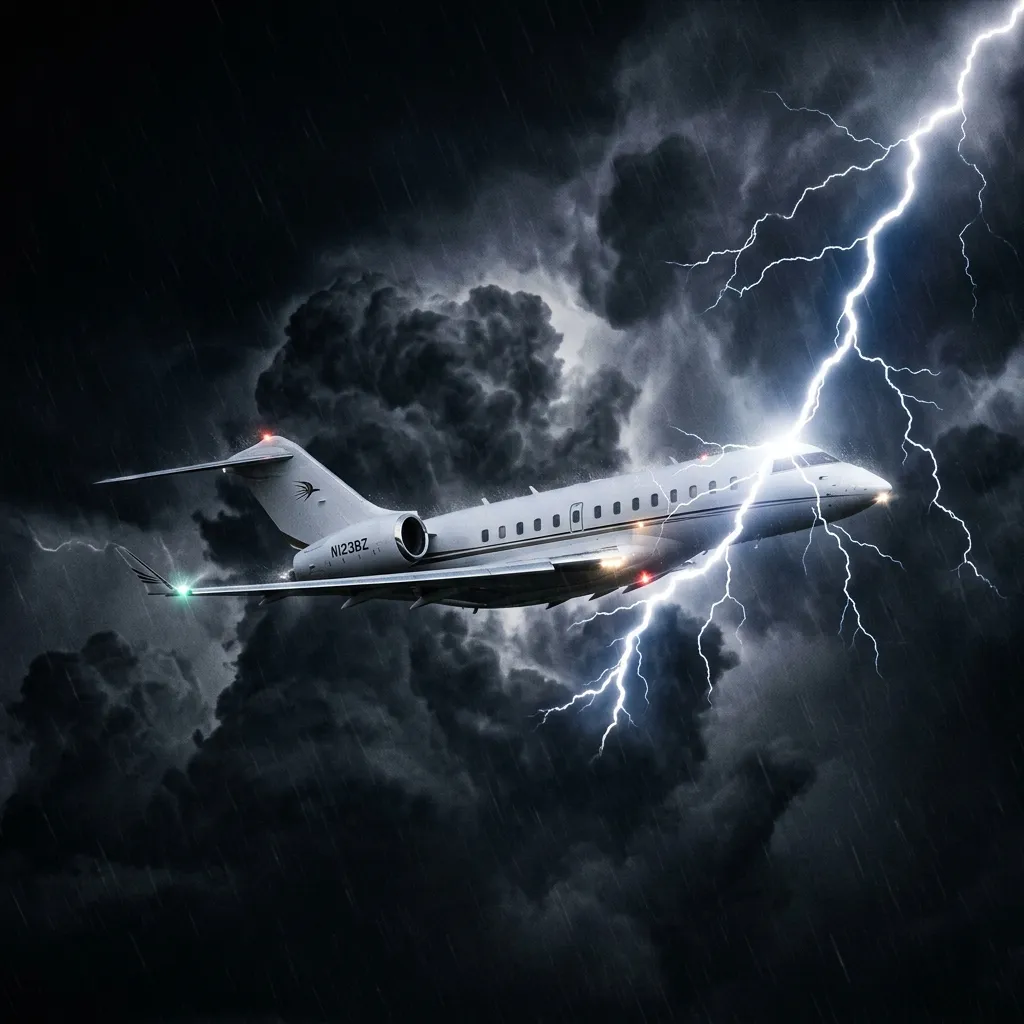
The average commercial or business aircraft is struck by lightning once every 1,000 to 3,000 flight hours. For a charter jet logging 800 hours per year, that translates to roughly one strike every 1 to 4 years. Peak current ranges from 20,000 to 200,000 amperes. The FAA and EASA both require every certificated aircraft to withstand lightning strikes without catastrophic structural failure.
Lightning strikes on aircraft are not the same event as ground-based lightning. In most cases, the aircraft actually triggers the strike. When a jet flies through a region with strong electric field gradients, the aircraft's extremities (nose radome, wingtips, tail cone) can initiate a bidirectional leader that completes the discharge path between charge regions in the cloud. The aircraft does not passively receive a bolt from the sky; it participates in creating the discharge channel.
The peak current in a typical aircraft lightning strike ranges from 20,000 to 200,000 amperes with a duration measured in microseconds for the initial return stroke. The total energy transfer is relatively low despite the enormous current because the duration is extremely short. A standard lightning event lasts 200 to 300 milliseconds total, including the initial stroke and subsequent re-strikes.
What the Passengers Experience
Passengers typically see a bright flash and hear a loud bang. The flash comes from the arc channel passing along the aircraft skin. The bang is the localized thunder generated at the entry and exit points on the fuselage. Some passengers report a brief acrid smell from ozone generated by the electrical discharge.
The cabin lights may flicker for a fraction of a second as avionics systems experience a transient electromagnetic pulse. On modern business jets with solid-state avionics (Garmin G5000, Collins Pro Line Fusion, Honeywell Primus Epic), the systems are designed to ride through lightning transients without rebooting. Older analog instruments are even more resilient because they have no digital circuits to disrupt.
The aircraft continues flying normally. There is no loss of control, no emergency, and no change in flight path in the vast majority of lightning events. The crew will note the strike in the aircraft log and notify maintenance for a post-flight inspection.
Where Lightning Enters and Exits
Lightning enters the aircraft at one extremity and exits at another. The most common entry points are the nose radome, wingtips, and horizontal stabilizer tips. The most common exit points are the tail cone, engine nacelles, and static discharge wicks (static dischargers) on the trailing edges of the wings and empennage.
The aluminum skin of the aircraft acts as a Faraday cage, conducting the lightning current along the exterior surface from entry to exit without allowing it to penetrate the cabin or fuel tanks. The current flows through the skin panels, across rivet joints, and through bonding straps that connect structural components. The entire path is designed to keep the current on the outside.
Composite structures (carbon fiber) present a different challenge. Carbon fiber is 1,000 times less conductive than aluminum. Aircraft with composite fuselages (HondaJet, Hawker 4000, portions of the Gulfstream G700) incorporate embedded copper or aluminum mesh in the composite layup to provide a conductive path for lightning current. This expanded copper foil adds weight but is required for certification.
Need a Charter Quote?
Contact our team for a personalized quote.
Get a Quote →The Post-Strike Inspection
After any lightning strike, the aircraft must be inspected before the next flight. This is not optional. The inspection follows the aircraft manufacturer's Lightning Strike Inspection procedure, typically found in the Aircraft Maintenance Manual (AMM) Chapter 5 or a dedicated structural repair manual section.
The mechanic inspects the entire aircraft exterior for burn marks, pitting, or melted spots at attachment points. Common damage includes small burn marks (1 to 3 mm diameter) at rivet heads, eroded or melted static wicks, punctured radome (the fiberglass nose cone that covers the weather radar antenna), and discolored paint at entry/exit points.
Minor damage (burned static wicks, small paint marks) is typically repaired on-site within 2 to 4 hours. The static wicks are replaced, the burn marks are cleaned and repainted, and the aircraft returns to service. A punctured radome requires replacement, which can take 1 to 3 days depending on parts availability. Radome replacements cost $15,000 to $40,000 depending on the aircraft type.
The most expensive lightning strike repair is not structural. It is avionics. If the transient surge damages a magnetometer, weather radar transmitter, or navigation antenna, the parts and labor can exceed $100,000 on a large-cabin jet.
Fuel Tank Protection
The primary safety concern with aircraft lightning strikes is fuel ignition. Every certificated aircraft must demonstrate that a lightning strike cannot ignite fuel vapors in any tank, including partially empty tanks where fuel-air mixtures exist in the ullage space above the liquid fuel.
Protection is achieved through multiple layers: bonded skin panels that prevent sparking at joints, sealed fuel tank access panels with conductive gaskets, spark-resistant fuel filler caps, and lightning-resistant fuel vent outlets. The fuel system is designed so that no spark-producing gap exists anywhere that fuel vapor could be present.
Modern business jets undergo extensive lightning certification testing during the type certification process. The manufacturer subjects test articles to simulated lightning strikes at every fuel tank boundary, filler point, and vent location. FAA Advisory Circular 20-53B governs the test standards. No business jet has experienced a lightning-related fuel ignition in the modern certification era.
When Lightning Grounds the Flight
Pilots avoid thunderstorms for turbulence, hail, and wind shear, not primarily for lightning. A business jet's onboard weather radar (typically Collins WXR-840 or Honeywell RDR-4000) shows precipitation intensity, and pilots route around cells with moderate to heavy returns. The standard avoidance minimum is 20 nautical miles laterally from any cell showing red returns on radar.
Ground operations are more restrictive. Most FBOs and airport operators halt ramp activities (fueling, loading, passenger boarding) when lightning is detected within 3 to 5 miles of the airport. The delay typically lasts 15 to 30 minutes after the last detected strike. During peak summer thunderstorm season in Florida, Texas, and the Southeast, these ground stops can delay departures by 1 to 3 hours on afternoon flights.
For charter passengers, the practical impact is scheduling. Afternoon departures from Miami, Dallas, Houston, Atlanta, and Denver between June and September carry the highest probability of weather-related delays. Morning departures (before noon) from these airports avoid the peak convective period. Experienced charter operators in these markets build 90-minute weather buffers into afternoon scheduling.