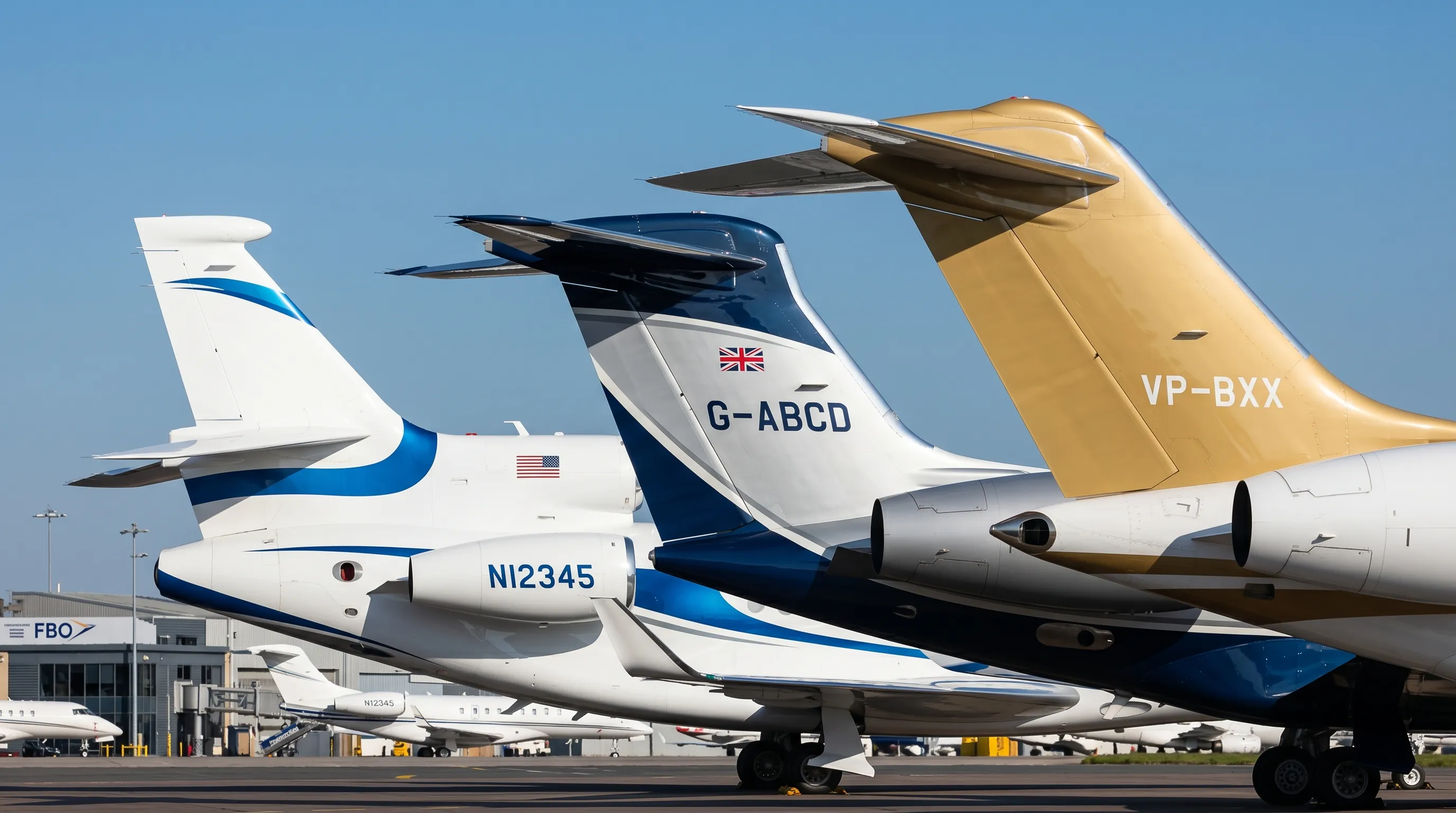
The Global Fleet Beyond U.S. Borders
The United States accounts for approximately 62% of the world's business jet fleet, with over 15,000 aircraft on the FAA registry. The remaining 38% is distributed across 67 countries, totaling approximately 9,030 business jets registered internationally as of the latest OpenSky Network data. This international fleet includes everything from Cessna Citations operating regional charters in Brazil to Gulfstream G650ERs based in the UAE for ultra-long-range sovereign travel.
International registration patterns reveal economic, regulatory, and geographic factors that shape business aviation outside America. Some countries, like Brazil and Mexico, have deep domestic business aviation cultures. Others, like the Isle of Man and Cayman Islands, serve as registration-of-convenience jurisdictions for aircraft owned by international operators seeking favorable regulatory or tax environments.
Europe: The Largest International Market
Europe accounts for approximately 3,418 registered business jets across the continent, making it the largest international market. The fleet is concentrated in five countries: Germany (498), United Kingdom (412), France (387), Austria (264), and Switzerland (198). Each country's fleet composition reflects its economic structure and geography.
9,030
International Biz Jets
Registration Trends Across the EU
Germany's fleet skews toward midsize and large-cabin jets (Challenger 604, Global Express, Falcon 900) reflecting corporate aviation demand from industrial conglomerates. The UK fleet includes a higher proportion of charter-managed aircraft because London's four business aviation airports (Luton, Farnborough, Biggin Hill, Oxford) support a dense charter market. France's fleet is heavily influenced by Dassault's domestic presence: Falcon variants account for approximately 40% of French-registered business jets.
Austria and Switzerland punch above their economic weight in business jet registrations. Austrian registrations benefit from favorable operational and tax treatment, attracting aircraft owners from neighboring countries. Switzerland's Geneva and Zurich airports serve as major business aviation hubs for the European financial sector, supporting a fleet that is disproportionately composed of ultra-long-range jets.
Latin America: Brazil Dominates the Hemisphere
Brazil operates the largest business jet fleet outside the United States with approximately 1,247 registered aircraft. The Brazilian fleet is distinctive in its composition: turboprops (King Air 350, PC-12) and light jets (Phenom 100, Phenom 300, Citation CJ series) dominate because Brazil's vast interior is served by thousands of small airstrips rather than highway infrastructure. Business aviation in Brazil is a transportation necessity rather than a luxury alternative to commercial service.
Mexico registers approximately 487 business jets, concentrated in Mexico City, Monterrey, Guadalajara, and Toluca. The Mexican fleet includes a significant proportion of midsize and heavy jets used for cross-border travel to the United States. Embraer's presence in the region (headquartered in Sao Jose dos Campos, Brazil) gives Phenom and Legacy/Praetor variants strong market share throughout Latin America.
Emerging Markets: Colombia, Chile, and Argentina
Colombia (89 registered jets), Chile (72), and Argentina (64) represent growing markets. Colombian registrations have increased 30% since 2019, driven by economic growth in Bogota and Medellin. Chile's fleet serves the mining and agriculture sectors, with turboprops particularly favored for access to remote northern mining operations. Argentina's fleet has contracted slightly due to currency instability and import restrictions on new aircraft.
Need a Charter Quote?
Contact our team for a personalized quote.
Get a Quote →Middle East and Africa: Sovereign and Corporate Fleets
The Middle East registers approximately 680 business jets, led by the United Arab Emirates (312), Saudi Arabia (198), and Qatar (74). These fleets are dominated by large-cabin and ultra-long-range aircraft: the Gulfstream G650, Global 7500, and Boeing BBJ are disproportionately represented compared to any other region. The average aircraft value in the Middle Eastern fleet exceeds $30 million, roughly triple the global average.
The Middle Eastern business jet fleet is the youngest and most expensive per-aircraft of any region. Average fleet age is 8.2 years compared to 15.6 years globally. Sovereign and royal family fleets account for approximately 35% of the region's registrations, skewing the data toward the newest and largest aircraft types available.
Sub-Saharan Africa registers approximately 340 business jets, with South Africa (148), Nigeria (87), and Kenya (42) as the largest markets. The African fleet serves a unique mission profile: long-range travel between major cities separated by limited commercial airline connectivity. Lagos to Johannesburg, a 2,800 NM routing, is one of the most common African business aviation city pairs and requires large-cabin jets for the nonstop leg.
Asia-Pacific: Underpenetrated Despite Economic Weight
The Asia-Pacific region registers approximately 1,180 business jets despite containing several of the world's largest economies. Australia (245), India (186), China (178), Japan (112), and Hong Kong (89) are the leading markets. Business aviation penetration in Asia is approximately one-tenth that of the United States on a GDP-adjusted basis.
China's business jet fleet has stalled below 200 aircraft due to airspace restrictions, limited landing slots at major airports, and regulatory complexity. India's fleet is growing at approximately 10% annually but remains small relative to its GDP because helicopter transport dominates short-range corporate travel in congested Indian cities. Japan's fleet is concentrated around Narita and Haneda airports, serving primarily transpacific routing to the United States.
Growth Potential
Industry forecasts project Asia-Pacific business jet registrations will reach 1,800-2,000 by 2030, driven by economic growth in India and Southeast Asia. Infrastructure limitations, particularly the lack of dedicated business aviation airports in most Asian capitals, remain the primary constraint. Singapore's Seletar Airport is the region's closest analog to Teterboro or Le Bourget, but no other Asian city has a comparable dedicated business aviation facility.
Offshore Registrations: Isle of Man, Cayman, and Aruba
Approximately 620 business jets carry registrations from offshore jurisdictions: Isle of Man (287), Cayman Islands (198), Aruba (67), and Bermuda (54). These registrations do not reflect where the aircraft physically operate; most offshore-registered jets are based in Europe, the Middle East, or Africa and registered offshore for regulatory, tax, or operational reasons.
The Isle of Man's M-prefix registration has become the preferred choice for European-operated business jets owned by non-EU entities. The IoM Aircraft Registry offers English-language documentation, common-law legal framework, favorable mortgage registration for lenders, and EASA-aligned maintenance standards without full EU regulatory burden. Approximately 40% of all large-cabin jets operating in Europe carry Isle of Man registrations.
- Isle of Man (M-prefix): 287 jets, favored by European operators and international lessors
- Cayman Islands (VP-C prefix): 198 jets, common for Middle Eastern and African operators
- Aruba (P4 prefix): 67 jets, used by CIS and Eastern European operators
- Bermuda (VP-B prefix): 54 jets, historically favored for transatlantic operations