The Part 135 Certificate Is the Hardest License in Aviation to Obtain
A Part 135 air carrier certificate authorizes a company to conduct on-demand charter flights for compensation or hire. It is issued by the FAA under 14 CFR Part 135 and represents the regulatory framework that separates a private aircraft owner from a commercial charter operator. Obtaining this certificate is one of the most complex, expensive, and time-consuming processes in American aviation.
The FAA processes approximately 100-150 new Part 135 applications annually. Roughly 50-60% are approved. The rest are withdrawn, denied, or indefinitely delayed due to documentation deficiencies, management personnel issues, or applicant financial instability. The timeline from initial application to first revenue flight ranges from 12 to 24 months, with costs between $500,000 and $2 million before a single charter passenger boards the aircraft.
Phase 1: Pre-Application and Statement of Intent
The process begins when the applicant submits a formal Statement of Intent to the local Flight Standards District Office (FSDO). This document announces the applicant's plan to operate under Part 135 and requests a pre-application meeting. The FSDO assigns a Principal Operations Inspector (POI) and Principal Maintenance Inspector (PMI) to the project. These two inspectors will manage the application through all five phases.
The FSDO assignment matters. Some FSDOs have more experience with Part 135 certifications and process applications more efficiently. FSDOs in Florida, Texas, and California handle the highest volume of 135 applications and tend to move faster. FSDOs in regions with fewer charter operators may take longer due to less familiarity with the certification process.
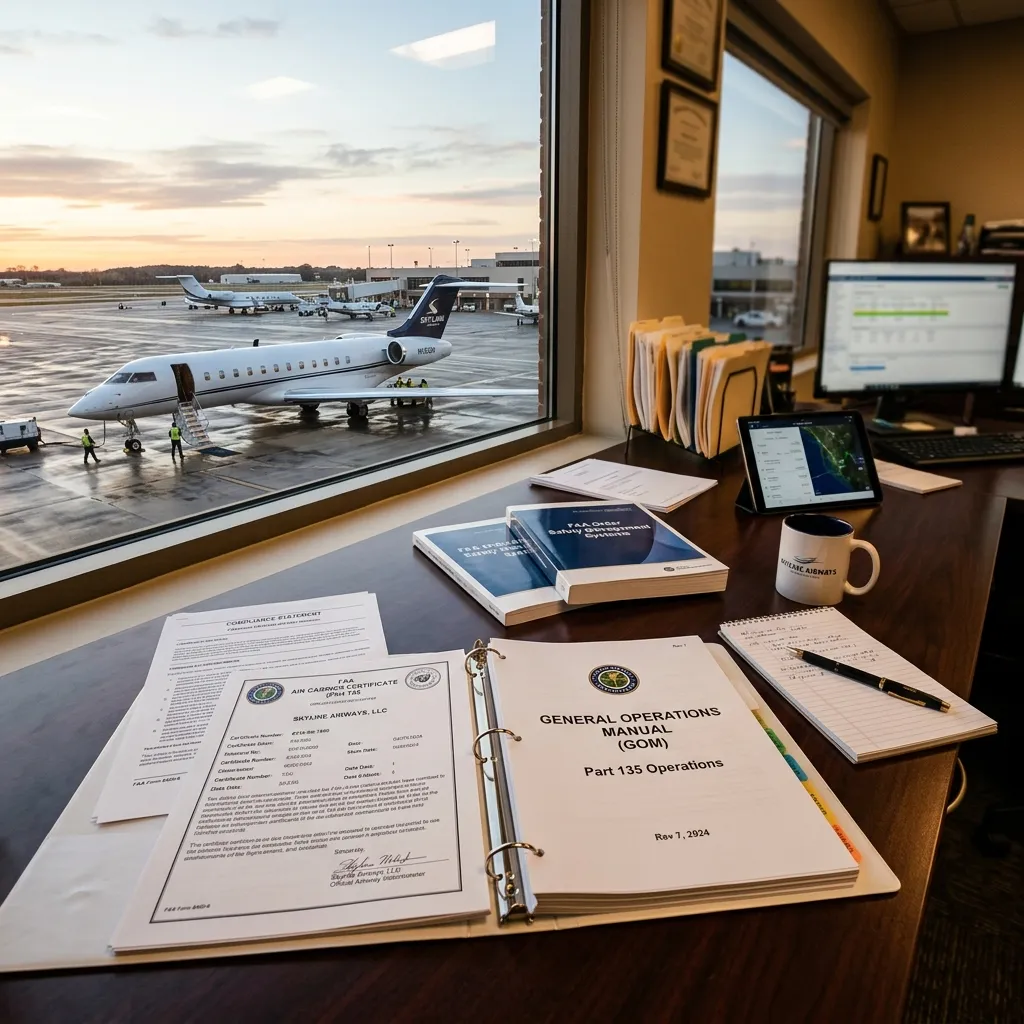
Phase 2 is the documentation gauntlet. The applicant submits FAA Form 8400-6 (Application for Air Carrier Certificate) along with a complete package of required manuals, documents, and evidence of financial capability. This phase typically takes 3-6 months to complete because the documentation volume is substantial and the FAA reviews every page.
- General Operations Manual (GOM): Company policies, management structure, duty time policies, training programs, and safety procedures. Minimum 100+ pages for a basic operation.
- Aircraft Operating Manual: Procedures for each aircraft type on the certificate, including normal, abnormal, and emergency procedures.
- Minimum Equipment List (MEL): FAA-approved list of equipment that may be inoperative for dispatch.
- Training Manual: Initial and recurrent training syllabi for pilots, flight attendants, dispatchers, and ground personnel.
- Maintenance Program: Continuous airworthiness maintenance program (CAMP) including inspection intervals, work scope, and parts procurement.
- Drug and Alcohol Testing Program: Required under 14 CFR Part 120, must be established and active before certification.
- Financial documentation: Bank statements, capitalization proof, insurance binders, and 12-month operating budget projections.
The FAA does not provide templates for these manuals. Most applicants hire Part 135 consulting firms (cost: $50,000-$150,000) to develop the manual set. Using a consultant with prior FSDO relationships does not guarantee faster approval, but it reduces the revision cycle. The FAA will return manuals with deficiency letters, and each revision cycle adds 30-60 days.
Need a Charter Quote?
Contact our team for a personalized quote.
Get a Quote →Phase 3: Document Compliance and Personnel Qualification
After the FAA accepts the application package, Phase 3 begins: detailed review of every manual section and verification that key management personnel meet regulatory requirements. The FAA must approve four named positions: Director of Operations (DO), Chief Pilot, Director of Maintenance (DOM), and Chief Inspector. Each person must demonstrate experience, training, and competency for their role.
The Director of Operations must hold an Airline Transport Pilot (ATP) certificate with type ratings in the aircraft to be operated, or equivalent experience. The Chief Pilot must hold an ATP and demonstrate proficiency in all aircraft types. The DOM must hold appropriate FAA mechanic certificates (A&P, IA) with experience on the proposed aircraft. The Chief Inspector must have inspection authorization (IA) and demonstrated knowledge of Part 135 maintenance requirements.
Personnel qualifications are the most common sticking point. The FAA rejects management personnel who lack direct Part 135 experience, even if they have extensive Part 91 backgrounds. Hiring experienced Part 135 managers is expensive: a qualified Director of Operations commands $120,000-$180,000 annually. A qualified Chief Pilot adds $100,000-$160,000. Budget for experienced personnel before you begin the application.
Phase 4: Demonstration and Inspection
Phase 4 is the operational demonstration. The FAA conducts aircraft inspections, tests management personnel's knowledge, and observes the applicant's ability to conduct charter operations safely. This phase includes proving runs: demonstration flights conducted under FAA observation that simulate actual revenue charter missions.
Proving runs typically require 5-10 flights covering the applicant's proposed operations area. The POI flies in the cockpit jumpseat and evaluates pilot performance, CRM (crew resource management), checklist discipline, and emergency procedure knowledge. The PMI inspects the aircraft, maintenance records, and maintenance facility. Failed proving runs require corrective action and rescheduling, adding 30-90 days to the timeline.
The FAA also conducts a base inspection of the applicant's principal operations base, evaluating office facilities, dispatch capability, maintenance capability, record-keeping systems, and drug testing program compliance. Every deficiency noted in the inspection must be corrected before advancing to Phase 5.
Phase 5: Certificate Issuance and Operations Specifications
If the applicant passes all Phase 4 evaluations, the FAA issues the Part 135 certificate and accompanying Operations Specifications (OpSpecs). OpSpecs define exactly what the certificate holder is authorized to do: which aircraft types, which operations (VFR, IFR, day, night), which geographic areas (domestic, international, specific countries), passenger versus cargo authorization, and any special limitations.
New certificate holders typically receive restricted OpSpecs: limited aircraft types, domestic-only authorization, and sometimes geographic radius restrictions. As the operator builds a safety record and demonstrates competency, they apply for OpSpec amendments to expand their authorization. Adding international operations, new aircraft types, or passenger capacity changes requires separate amendment applications, each with its own review cycle.
Receiving the certificate is not the finish line. Most operators describe the first 12 months of operations as the hardest. The FAA conducts enhanced surveillance of new certificate holders, with unannounced ramp inspections, records audits, and flight operations observations. Any safety deficiency during this period can result in enforcement action, fines, or certificate suspension.