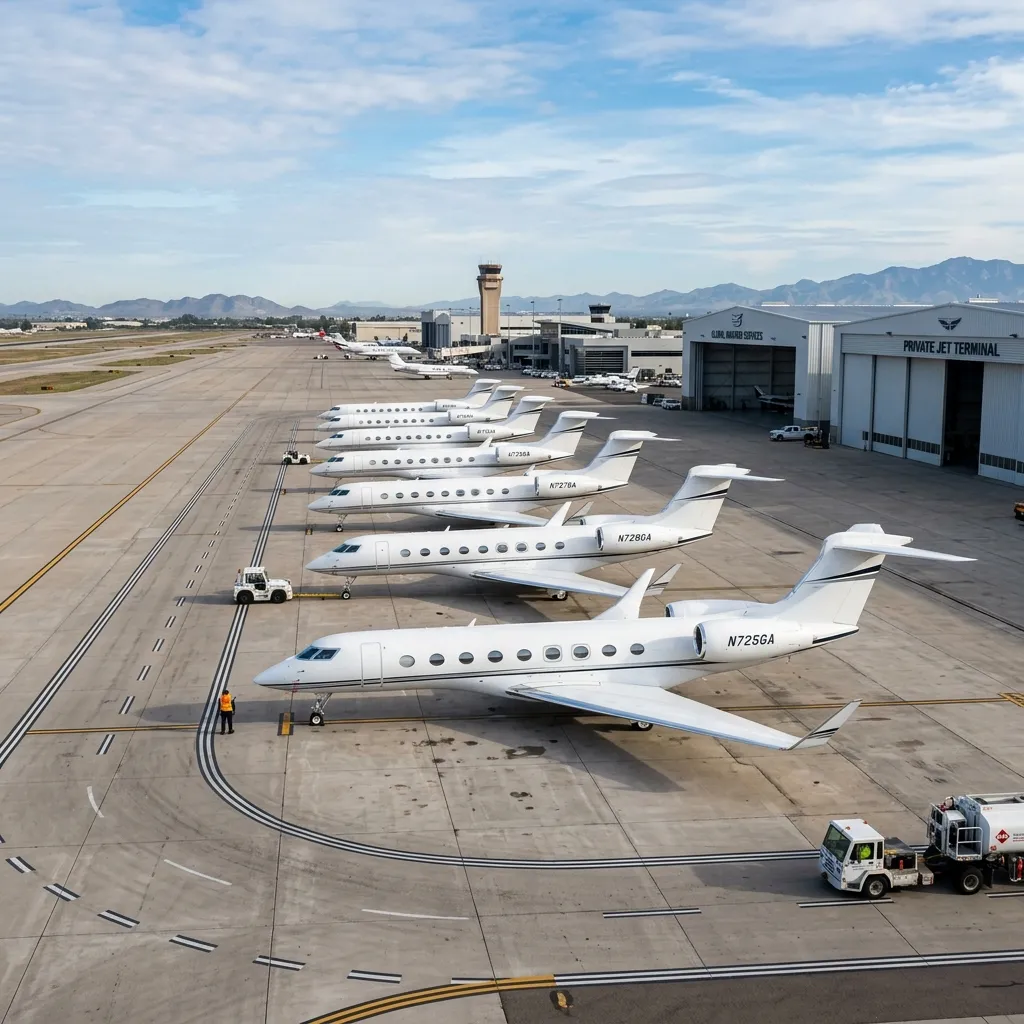
Multiple Gulfstream G650s parked on a large FBO ramp

How Many Gulfstream G650s Exist? A Complete Fleet Census

Gulfstream Aerospace has delivered approximately 460 G650 and G650ER aircraft since the type entered service in 2012. That number places the G650 family among the most commercially successful ultra-long-range jets in history, though production has slowed as the G700 absorbs demand.

In This Article

Total G650 and G650ER Deliveries Geographic Distribution of the Fleet Owner and Operator Breakdown G650 vs G650ER: Fleet Split How the G700 Affects the G650 Fleet Fleet Attrition and Accidents Maintenance Programs and Residual Value Protection Frequently Asked Questions

Total G650 and G650ER Deliveries

Gulfstream began G650 deliveries in December 2012 with serial number 6001. Through mid-2026, approximately 460 aircraft have been delivered across both the standard G650 and the extended-range G650ER variant. Production peaked between 2015 and 2018 at roughly 45-50 deliveries per year. As the G700 program entered service certification, G650 production tapered to approximately 20-25 deliveries per year from 2023 onward.

The G650ER variant, introduced in 2014 with serial number 6101, accounts for roughly 60% of total production. The ER added 500 nm of range (7,500 nm versus 7,000 nm) and increased maximum takeoff weight by 3,600 pounds. Most operators ordering after 2015 selected the ER variant, making the standard G650 the minority configuration in the active fleet.

Geographic Distribution of the Fleet

North America accounts for approximately 55% of the active G650 fleet, with the United States alone holding roughly 240 aircraft. The Middle East represents the second-largest concentration at approximately 15%, driven by demand from Saudi Arabia, the UAE, and Qatar. Europe accounts for 12%, with the United Kingdom, Germany, and Switzerland hosting the largest clusters. Asia-Pacific holds roughly 10%, concentrated in Hong Kong, mainland China, and India.

~460
Total Delivered
55%
Based in North America
7,500 nm
G650ER Range
$39-42M
Pre-Owned Market

Within the United States, the G650 fleet concentrates in predictable locations. Texas, New York, California, Florida, and New Jersey account for over 60% of domestic registrations. Teterboro, Van Nuys, and West Palm Beach serve as primary bases. Corporate flight departments at Fortune 500 companies operate approximately 30% of U.S.-registered G650s, with the remainder split between charter operators, fractional programs (primarily NetJets), and individual owners.

Owner and Operator Breakdown

The G650 fleet divides into three primary ownership categories. Corporate flight departments operate approximately 140 aircraft, using them for executive transport on domestic and international routes. These aircraft rarely appear on the charter market except through management company arrangements. Individual high-net-worth owners hold roughly 180 aircraft, some of which are placed on Part 135 certificates to generate charter revenue when not in personal use.

Charter and management companies, including NetJets, VistaJet, and independent operators, control approximately 100 G650s. NetJets alone operates an estimated 25-30 G650ERs within its fractional fleet. VistaJet's G650 availability fluctuates as the company rotates aircraft through maintenance and global positioning.

The G650's residual value has remained stronger than any other business jet produced in the last 15 years. Early-serial aircraft that sold for $65 million new in 2013 now trade between $28 and $34 million. Low-time G650ERs from 2019 onward hold at $39-42 million, a depreciation curve that outperforms the Global 6000 and Falcon 7X by 15-20 percentage points.

G650 vs G650ER: Fleet Split

Of the approximately 460 total deliveries, roughly 180 are standard G650s and 280 are G650ERs. The standard G650 production ran primarily from 2012 to 2016 before the ER variant absorbed nearly all new orders. In the pre-owned market, this split matters. Standard G650s trade at a 10-15% discount to equivalent-age G650ERs, reflecting the range difference and the market's preference for the extended-range capability.

For charter clients, the ER distinction matters primarily on ultra-long routes. New York to Dubai nonstop requires the ER's 7,500 nm range. New York to London, Los Angeles to Tokyo, and São Paulo to Geneva are within both variants' capability. On domestic U.S. routes, the standard G650 and G650ER perform identically.


Need a Charter Quote?

Contact our team for a personalized quote.

Get a Quote

How the G700 Affects the G650 Fleet

The Gulfstream G700 received FAA type certification in March 2024 and began customer deliveries in mid-2024. The G700 offers a wider cabin (8.2 ft vs 8.0 ft), longer range (7,750 nm), and the Symmetry Flight Deck. As G700 production ramps to 35-40 deliveries per year, it directly displaces G650ER demand from corporate flight departments planning fleet replacements.

This transition creates a predictable wave of G650ER trade-ins entering the pre-owned market between 2025 and 2028. Early G650ERs with 2,000-3,000 flight hours are appearing at $39-42 million as operators take delivery of new G700s. The resulting supply increase will pressure G650ER values downward, potentially opening the aircraft to operators and charter companies that could not afford the type at its initial pricing.

The G650 is not going away. Gulfstream IV production ended in 2003 and the type still flies charter legs daily. The G650 will remain a front-line charter aircraft through at least 2040, with the most desirable ER variants likely operating into the 2045 timeframe.

Fleet Attrition and Accidents

As of mid-2026, the G650 fleet has experienced no fatal accidents in revenue service. Two aircraft have been involved in ground incidents (ramp damage), and one sustained substantial damage during a rejected takeoff. The fleet-wide accident rate is statistically zero across an estimated 1.2 million total flight hours. That safety record is not unique to the G650; the Gulfstream lineup broadly reflects the safety standards of large-cabin corporate aviation.

Fleet attrition from retirement is minimal. The youngest G650 is approximately two years old and the oldest is thirteen. No G650 has been scrapped. Some early-serial aircraft have transitioned to government or military VIP transport roles in countries where they replace aging Boeing BBJ or Airbus ACJ configurations.

Maintenance Programs and Residual Value Protection

G650 operators overwhelmingly enroll in Gulfstream's GFMP (Gulfstream Fleet Management Program) or third-party maintenance programs through JSSI, CAMP, or Conklin & de Decker. GFMP covers scheduled inspections and component replacements at a fixed hourly rate, currently estimated at $800-$1,100 per flight hour depending on the coverage tier. This predictable maintenance cost structure supports residual values because buyers can verify the aircraft's program enrollment and remaining coverage.

The G650's Rolls-Royce BR725 engines have proven reliable through the fleet's first decade of service. Engine overhaul intervals run approximately 6,000-8,000 flight hours depending on operating conditions. A full engine overhaul costs $2.5-$3.5 million per engine. Aircraft approaching overhaul trade at a discount to account for this near-term capital requirement, creating targeted acquisition opportunities for buyers prepared to manage the event.

Brian Galvan

Written By

Brian Galvan

Founder, The Jet Finder · Private Aviation Operations & Technology

Former Director of Technology at FlyUSA (Inc. 5000 fastest-growing private jet company). Decade of hands-on experience across Part 135 operations, charter sales, fleet management, and aviation data systems.

LinkedInRead Full Profile →
Common Questions

Frequently Asked Questions


6 questions about chartering this aircraft

Gulfstream has delivered approximately 460 G650 and G650ER aircraft since initial deliveries in December 2012. The fleet splits roughly 180 standard G650s and 280 G650ERs. Production peaked at 45-50 per year between 2015-2018 and has tapered as the G700 enters service.

Pre-owned G650s (standard variant) trade between $28 and $34 million depending on year, flight hours, and interior condition. G650ERs range from $39 to $42 million for low-time 2019+ examples. Early-serial G650s originally priced at $65 million have depreciated roughly 50% over thirteen years.

The G650ER adds 500 nm of range (7,500 nm vs 7,000 nm) and 3,600 lbs of increased maximum takeoff weight. The cabin, engines, and systems are identical. The ER was introduced in 2014 and accounts for approximately 60% of total production. On domestic routes, there is no operational difference between the two variants.

Approximately 55% of the G650 fleet is based in North America, with 240+ aircraft registered in the United States. Texas, New York, California, Florida, and New Jersey hold the largest domestic concentrations. The Middle East accounts for 15%, Europe 12%, and Asia-Pacific 10%.

The G700 is the G650's successor in the Gulfstream lineup and will absorb new ultra-long-range demand. However, the G650 will remain in active service through at least 2040. Early G650ERs entering the pre-owned market as operators take G700 deliveries are creating acquisition opportunities at lower price points.

As of mid-2026, the G650 fleet has experienced no fatal accidents in revenue service across an estimated 1.2 million total flight hours. Two ground incidents and one rejected takeoff with substantial damage are the only recorded events. The type maintains one of the strongest safety records in business aviation.

Continue Reading

Related Articles


Your Next Mission

Ready to Fly?


Whether you need a charter quote or want to explore aircraft options, our team is here.

Contact Us