Before There Were Jets: 1919 to 1945
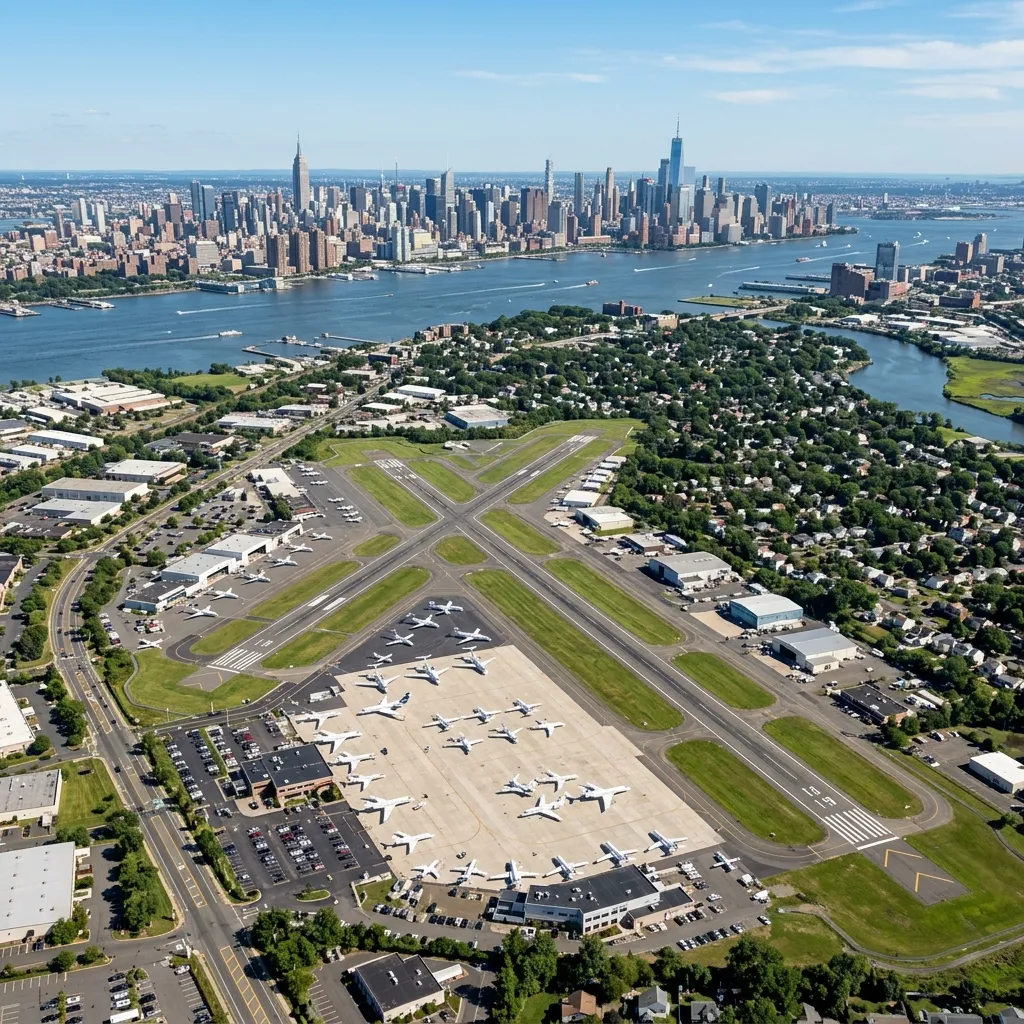
Teterboro Airport was established in 1919, four years before Newark Airport and 20 years before LaGuardia. The original field was a 200-acre grass strip in Bergen County, New Jersey, 12 miles from Midtown Manhattan. It was named after Walter Teter, an early aviation enthusiast who helped develop the site for aircraft use.
Through the 1920s and 1930s, Teterboro served as a general aviation and experimental aircraft hub. Bendix Aviation Corporation acquired the airport in 1937 and renamed it Bendix Airport. Under Bendix ownership, the airport received its first paved runway and permanent hangars. The proximity to New York City made it an obvious choice for corporate and private aircraft operators even before the jet age.
During World War II, the U.S. Army Air Corps used Teterboro as a pilot training facility and aircraft modification center. P-47 Thunderbolts and other military aircraft operated from the field. The military returned the airport to civilian use in 1945, and within a decade, corporate aviation had claimed it as its primary New York area gateway.
The Corporate Aviation Era: 1950s Through 1980s
The introduction of business jets in the 1960s transformed Teterboro from a regional airfield into a national hub. The Learjet 23 (1964), Gulfstream II (1966), and Falcon 20 (1965) each found early homes at Teterboro. Corporate flight departments for Fortune 500 companies headquartered in the New York metro area based their aircraft at KTEB because it offered direct ramp-to-limousine access that LaGuardia and JFK could not.
The Port Authority of New York and New Jersey acquired Teterboro in 1949 for $10 million. That investment proved prescient. By 1970, Teterboro was generating significant landing fee revenue from corporate jets while requiring minimal terminal infrastructure. The airport had no commercial airline service, no TSA, and no passenger terminals. It was pure aviation: hangars, ramps, fuel trucks, and FBOs.
By the 1980s, Teterboro handled more corporate jet traffic than any airport in the country. The three FBOs operating on the field competed aggressively for high-net-worth clients. Hangar space became the airport's most valuable commodity, with waitlists exceeding 18 months for covered spots.
The Noise Wars: Community Resistance and Weight Limits
Teterboro sits in one of the most densely populated metropolitan areas in the United States. The surrounding communities of Teterboro, Moonachie, Little Ferry, and Hasbrouck Heights have populations that live directly under the approach and departure paths. The tension between aviation operations and residential noise complaints has shaped the airport's regulations for decades.
In 1998, the Port Authority implemented a 100,000-pound maximum takeoff weight restriction for all aircraft using Teterboro. That limit excluded the Boeing BBJ, Airbus ACJ, and Gulfstream G650ER at maximum fuel load. The restriction was designed to keep the heaviest, loudest aircraft out of the local pattern. It remains in effect in 2026 and is the single most defining operational limitation of the airport.
Voluntary nighttime noise abatement procedures discourage operations between 11 PM and 6 AM. Pilots are requested to use noise-reducing departure procedures and avoid residential areas during climb. These are voluntary, not mandatory, and compliance varies. The issue resurfaces in local politics every election cycle, with community groups regularly calling for curfews or closure. The Port Authority has maintained operations without a hard curfew by pointing to the $2.2 billion annual economic impact the airport generates.