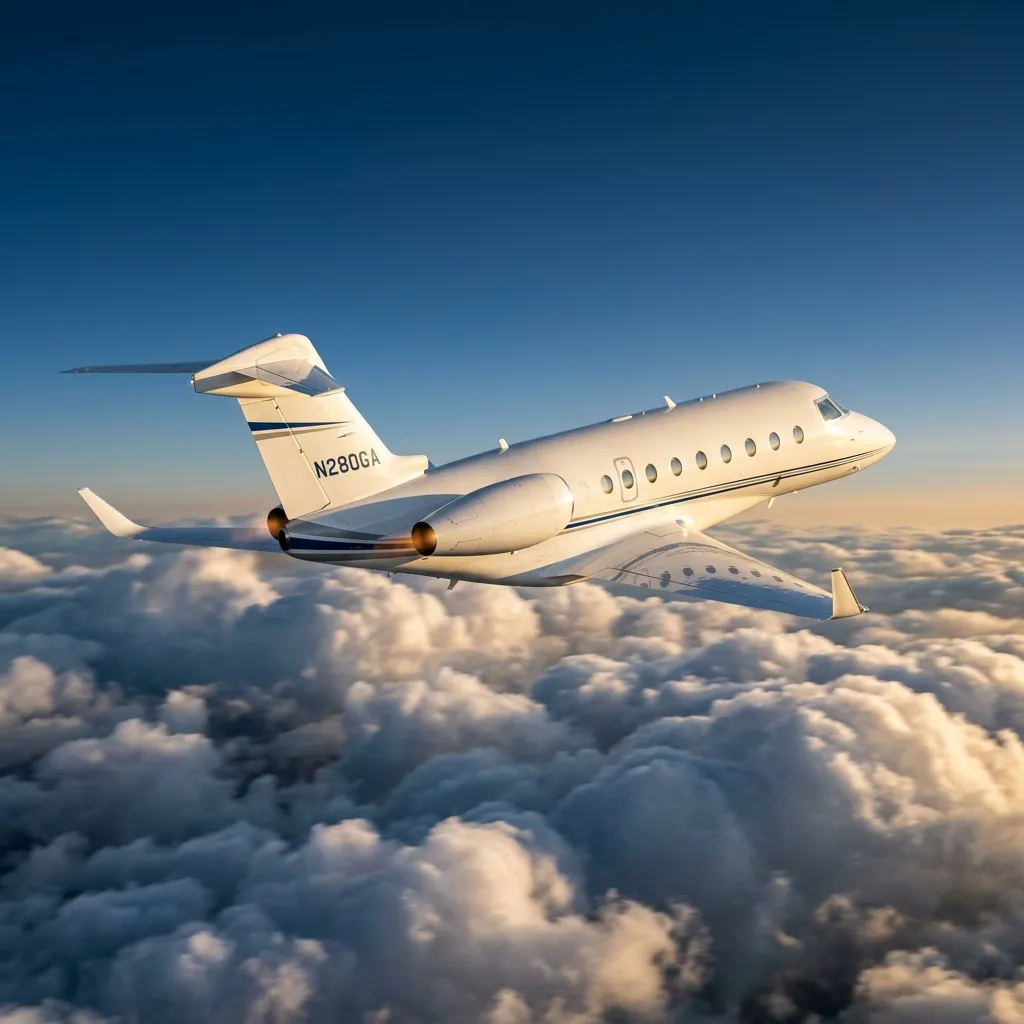
The Aircraft That Crossed a Category Line
The Gulfstream G280 entered service in 2012 as the successor to the G200, and it immediately created a classification problem. On paper, it is a super-midsize jet: 3,600 nm of range, two Honeywell HTF7250G engines, and a cabin configured for eight to ten passengers. In practice, it competes with heavy jets.
The G280 routinely flies missions that the Challenger 350, Citation Latitude, and Praetor 600 cannot reach without a fuel stop. New York to London. Miami to Seattle. Los Angeles to Bogota. These are heavy-jet routes, and the G280 covers them at super-midsize operating costs.
Gulfstream sold the G280 as the entry point to the Gulfstream family, priced below the G450 and G550 while delivering performance that overlapped both. Israel Aerospace Industries (IAI) builds the aircraft in Tel Aviv under Gulfstream oversight, a partnership that began with the Astra and Galaxy programs in the 1990s.
Performance That Changed Expectations
The G280 cruises at 482 knots (Mach 0.80) and reaches a maximum operating speed of Mach 0.85. Its service ceiling is 45,000 feet. These numbers alone do not explain why the aircraft commands attention. The explanation is in the range: 3,600 nm with eight passengers and NBAA IFR reserves.
To put that in context, the Challenger 350 ranges 3,200 nm. The Praetor 600 reaches 3,340 nm. The Citation Longitude covers 3,500 nm. The G280 exceeds all three by meaningful margins that translate to real-world route capability. The difference between 3,200 nm and 3,600 nm is the difference between a fuel stop and a direct flight on a dozen common business routes.
Takeoff performance is equally notable. The G280 requires 4,750 feet at MTOW at sea level, and less than 3,000 feet for landing. That gives it access to airports like Aspen (7,006 ft, high altitude), Teterboro (7,000 ft), and Eagle County (8,000 ft at 6,535 ft elevation) that challenge heavier aircraft.
The Cabin: Where Super-Mid Meets Wide-Body
The G280 cabin is 25.8 feet long, 7.2 feet wide, and 6.3 feet tall. The width figure is the headline. At 7.2 feet, the G280 cabin is wider than the Challenger 350 (7.2 feet, identical), wider than the Praetor 600 (6.8 feet), and meaningfully wider than the Citation Longitude (6.4 feet).
The flat floor runs the full cabin length. No step-downs, no narrowing. Eight passengers sit in a double-club configuration with 28 to 32 inches of legroom depending on tracking position. A ninth seat is available in an optional forward-facing position. A tenth seat exists on the divan, which is a legitimate seat for cruise but not ideal for takeoff and landing.
The baggage compartment holds 120 cubic feet, which is large-cabin territory. Four passengers with full week-long luggage, golf clubs, and carry-ons fit without negotiation. The external baggage door is at fuselage level, requiring no ladder or lift for loading.
The lavatory is fully enclosed with a vacuum-flush toilet, sink, and mirror. It is located at the aft end of the cabin and is separated by a solid door, not a curtain. This is standard for the class but worth noting because some super-midsize competitors cut corners here.