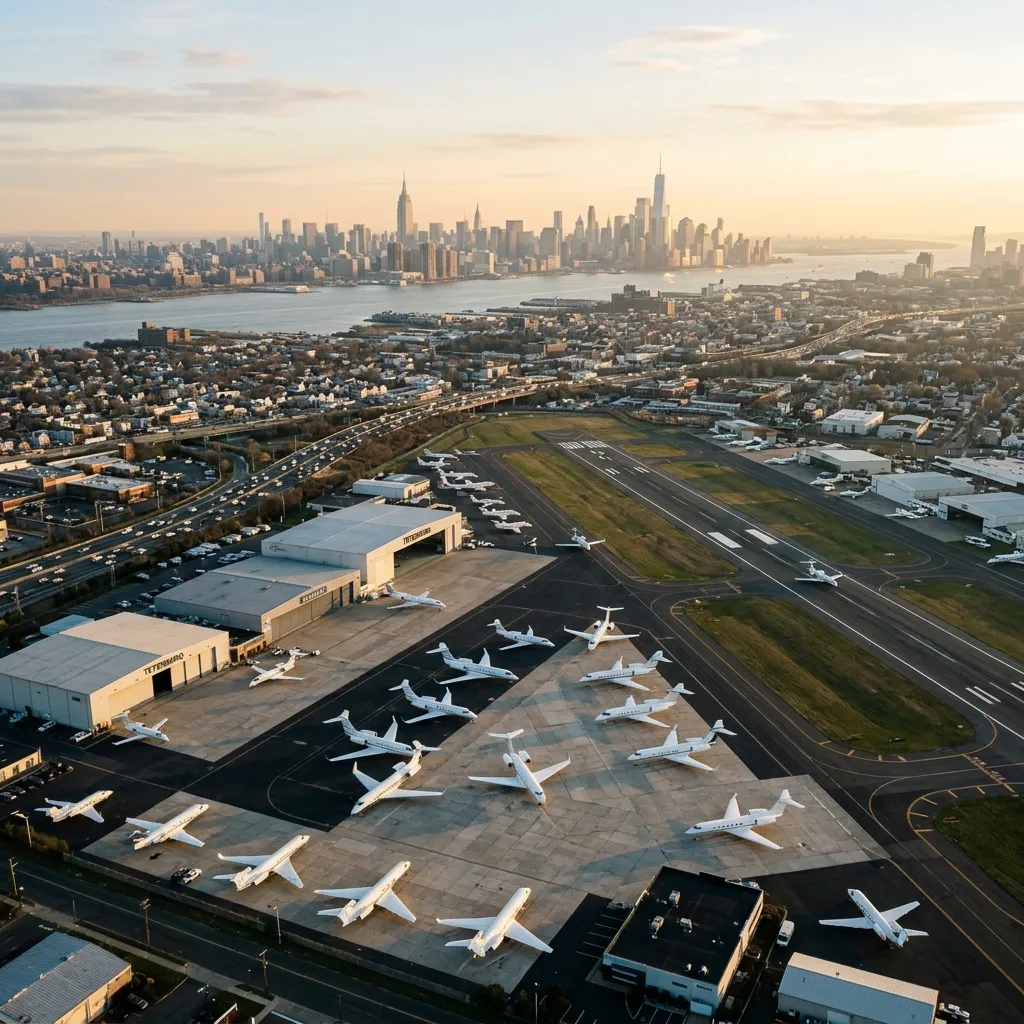
Why Van Nuys Dominates LA Private Aviation
Van Nuys Airport (KVNY) logged 231,894 aircraft operations in 2025, a figure that has exceeded 200,000 every year since 2018. The airport sits in the San Fernando Valley, 20 miles northwest of downtown Los Angeles and 14 miles from Beverly Hills. For the entertainment industry, venture capital, and real estate communities that drive private aviation demand in Southern California, Van Nuys is the default departure and arrival point.
KVNY operates two parallel runways: 16R/34L at 8,001 feet and 16L/34R at 4,003 feet. The longer runway accommodates every business jet in production, including fully-fueled Gulfstream G700s and Global 7500s at maximum takeoff weight. The shorter runway handles light jets and turboprops. Both runways have ILS approaches, enabling operations in low-visibility conditions that would close smaller GA airports.
230,000+
Annual Operations
Eight FBOs: The Most Competitive Market in Aviation
No airport in the United States has more FBOs than Van Nuys. Eight operators compete for fuel sales, hangar space, and passenger services along both sides of the field:
- Signature Flight Support: The largest facility on the field, handling the highest volume of transient traffic. Full-service international customs capability. Premium lounge with private suites. Fuel pricing at the higher end of the Van Nuys market ($7.50-$8.50/gal posted retail, lower with contract).
- Clay Lacy Aviation: Founded by legendary pilot and entrepreneur Clay Lacy, this FBO combines charter operations, aircraft management, and ground handling. Known for the best crew amenities on the field. Strong relationships with the entertainment industry.
- Castle & Cooke Aviation: The newest purpose-built facility at KVNY, opened in 2020. Modern terminal with floor-to-ceiling glass, private suites, and covered ramp parking. Competitive fuel pricing designed to pull volume from Signature.
- Jet Aviation: General Dynamics-owned operation with Gulfstream service center integration. Preferred by Gulfstream operators for warranty-covered maintenance coordination alongside FBO services.
- Helinet Aviation: Primarily a helicopter operator with fixed-wing FBO services. Lower fuel pricing and less congested ramp than the majors. Used by operators positioning aircraft or conducting fuel stops where passenger experience is secondary.
- Aviation Alliance, Encore, Sun Air Jets: Smaller independent operators offering competitive fuel pricing and personalized service. Less ramp congestion during peak periods. Facilities range from functional to basic.
Eight FBOs at one airport creates genuine price competition. Jet-A fuel at Van Nuys ranges from $5.90/gal at the most aggressive independents to $8.50/gal at premium chain locations. A Gulfstream G650 taking 3,000 gallons saves $7,800 by choosing the low-cost FBO over the premium one. That is the value of competition.
The Noise Curfew: Van Nuys' Operating Constraint
Van Nuys enforces a voluntary noise curfew between 10:00 PM and 7:00 AM. Aircraft departing during curfew hours must meet Stage 4 noise standards (the current standard for all jets manufactured after 2006) or face community noise complaint tracking. The curfew is voluntary, not legally binding, but persistent noise violations generate political pressure that threatens the airport's operating flexibility.
For practical purposes, the curfew means late-night departures on older aircraft (pre-2006 Stage 3 jets like the Hawker 800XP, Learjet 45, and early Challenger 300s) face scrutiny. Modern aircraft, including the Phenom 300E, Citation Latitude, Challenger 350, and all current Gulfstream models, meet Stage 4 standards and operate without restriction during curfew hours.
The Los Angeles World Airports (LAWA), which operates Van Nuys, also monitors departure procedures. Pilots are expected to follow noise abatement departure procedures (NADPs) that reduce ground-level noise exposure through specific climb profiles and power management. ATC issues these procedures during curfew hours.
Flying Into Van Nuys?
We coordinate with all eight KVNY FBOs. Tell us your routing and arrival time, and we handle the ground logistics.
Contact Us →Ground Transportation: The 405 Problem
Van Nuys' proximity to key Los Angeles destinations varies dramatically by time of day due to traffic on the 405, 101, and 170 freeways:
| Destination | Off-Peak Drive Time | Peak Drive Time | Distance |
|---|
| Beverly Hills | 25-35 min | 50-90 min | 14 miles |
| Downtown LA | 30-40 min | 60-100 min | 20 miles |
| Santa Monica | 30-40 min | 55-85 min | 18 miles |
| Malibu | 35-50 min | 60-90 min | 26 miles |
| Pasadena | 25-35 min | 45-70 min | 22 miles |
| LAX Area | 35-45 min | 60-120 min | 24 miles |
| Hollywood | 20-30 min | 40-70 min | 12 miles |
Every FBO at Van Nuys coordinates ground transportation, and most maintain relationships with black car services that stage vehicles on the ramp for arrival passengers. The critical variable is departure timing from the FBO: a 2 PM arrival at Van Nuys with a meeting in Beverly Hills at 3 PM is feasible. The same arrival at 5 PM with a 6 PM meeting in Beverly Hills is not.
Helicopter transfers from Van Nuys to downtown LA, LAX, and Santa Monica take 8-15 minutes and bypass surface traffic entirely. Several operators at KVNY offer on-demand helicopter connections at $1,800-$3,500 per transfer. For time-critical arrivals during peak traffic windows, helicopter transfers convert a 90-minute ground transit into a 12-minute flight.
When Not to Use Van Nuys: Alternative LA Airports
Van Nuys is the default for private aviation in LA, but three alternatives serve specific routing and location advantages:
Santa Monica (KSMO)
Closer to the Westside (Beverly Hills, Brentwood, Santa Monica) by 15-20 minutes in traffic. However, the airport shortened its runway to 3,500 feet in 2017, eliminating all jet operations except the very lightest (Citation Mustang, Phenom 100). Turboprops and light jets under 12,500 lbs can still use KSMO. The city has actively tried to close the airport, creating regulatory uncertainty.
Burbank (KBUR)
Hollywood Burbank Airport has FBO service through Atlantic Aviation and handles private jets alongside commercial operations. Closer to Pasadena, Glendale, and the studios in Burbank. A 10 PM mandatory curfew on all operations (commercial and private) limits late-night flexibility. Runway length of 6,886 feet accommodates midsize and super-midsize jets but restricts some heavy jets at maximum weight.
Long Beach (KLGB)
Best option for destinations in Orange County, South Bay, or the Port of LA area. The Ross Aviation FBO provides premium service. Long Beach to Newport Beach is 25 minutes; Van Nuys to Newport Beach is 60-90 minutes. Runway length of 10,000 feet handles any aircraft. The tradeoff: Long Beach is 35+ miles from Beverly Hills and the Westside, making it impractical for the core LA market.
Peak Periods: When Van Nuys Gets Congested
Van Nuys experiences distinct peak demand periods that affect ramp availability, hangar space, and FBO wait times:
- Awards Season (January-March): Golden Globes, Grammys, Oscars, and the associated pre-party circuit generate the highest transient jet volume of the year. Ramp space sells out 48-72 hours before major events. FBOs impose minimum fuel purchases and higher overnight parking fees during awards week.
- Pilot Season (April-June): Television network upfronts and pilot shooting schedules bring studio executives and talent from New York. Sustained moderate-to-high demand over a 10-week window.
- Coachella/Stagecoach (April): The Indio music festivals, 130 miles east of Van Nuys, generate a spike in light jet and turboprop traffic. Some aircraft reposition to Thermal (KTRM) or Palm Springs (KPSP) during the festivals.
- Holiday weekends: Thanksgiving, Christmas, and July 4th produce 30-50% volume increases as LA residents depart for Aspen, Cabo San Lucas, Sun Valley, and Las Vegas.
- Super Bowl/Major Events: When hosted in the LA area, the Super Bowl generates 1,000+ additional aircraft movements over a 4-day period. Van Nuys becomes a controlled-access environment with slot reservations.
Outside these peaks, Van Nuys operates with comfortable capacity. Weekday mornings (6-9 AM) and Sunday evenings (4-8 PM) are consistently the busiest standard traffic windows.