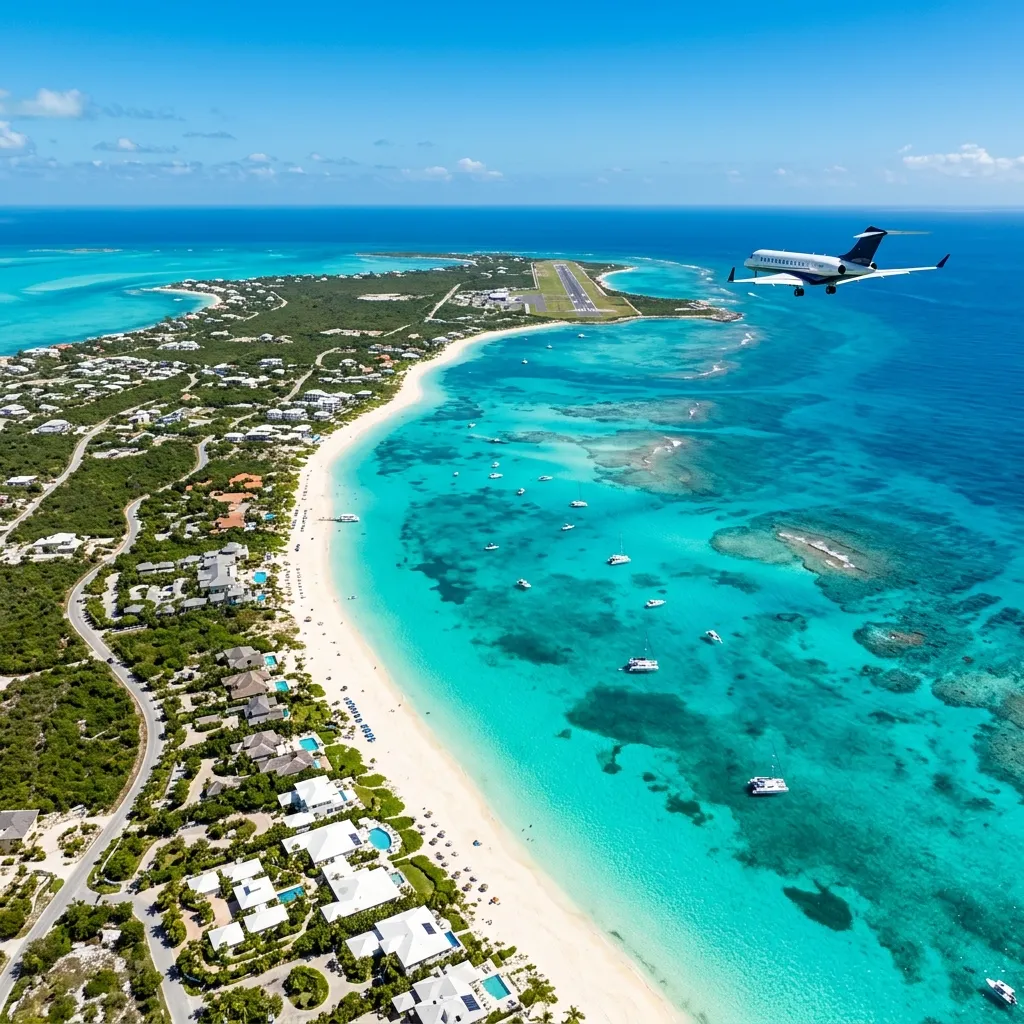
Turquoise ocean and white sand beach at Providenciales Turks and Caicos from aerial view

undefined

undefined

In This Article

Providenciales International (MBPV) FBO and Ground Handling Customs and Immigration: The Process Routing and Flight Times from Major Markets Peak Season and Pricing Pressure On the Ground: What to Arrange Before Landing Frequently Asked Questions

Providenciales International (MBPV)

Providenciales International Airport (PLS/MBPV) is the only airport in Turks and Caicos that routinely accepts private jet traffic. The primary runway, 09/27, is 7,600 feet of asphalt. That accommodates everything from a Phenom 100 to a Global 7500 without restriction.

The airport sits on the north side of Providenciales, three miles from Grace Bay. Ground transportation from the ramp to most resorts takes 15 to 25 minutes. There is no rush hour in the traditional sense, but the two-lane Leeward Highway can slow during midday when commercial flights arrive in clusters.

PLS operates 24 hours for private aviation, though customs and immigration staffing after 6 PM requires advance arrangement. If your arrival is scheduled after hours, your handler must coordinate with TCIG Immigration at least 24 hours in advance. Showing up at 9 PM without prior notice results in a customs hold that can take 90 minutes to resolve.

FBO and Ground Handling

Provo Air Center is the primary FBO at Providenciales. It handles the majority of private jet traffic and offers a dedicated arrivals lounge, customs processing on site, and fuel from a single Jet-A supplier. Ramp space is limited. During peak season (December through April), overnight parking reservations are strongly recommended. Walk-in parking requests during Christmas week and Presidents' Day weekend are regularly denied.

The FBO ramp can hold approximately 15 to 20 business jets depending on size mix. Large-cabin aircraft (Globals, Gulfstreams, Falcon 7Xs) take two to three parking spots. If the ramp is full, the aircraft may be directed to the commercial apron, which adds taxi time and reduces the private aviation experience to something closer to airline operations.

Fuel pricing at PLS runs $7.50 to $9.00 per gallon, depending on volume. Caribbean fuel is consistently more expensive than the continental United States. Operators who uplift full fuel in Fort Lauderdale or Nassau before the final leg to PLS save $1.50 to $2.00 per gallon on the fill.

Customs and Immigration: The Process

Turks and Caicos is a British Overseas Territory with its own immigration authority. U.S. citizens need a valid passport (no visa required for stays under 90 days). The customs process at PLS for private aviation is handled at the FBO, not in the main terminal.

Before departure from the United States, your operator must file an eAPIS manifest with U.S. Customs (CBP) at least 60 minutes prior to departure. Failure to file results in a $5,000 fine per passenger. This is a crew responsibility, but passengers should confirm it is done.

Upon arrival at PLS, immigration officers meet the aircraft at the FBO. Processing takes 15 to 30 minutes for a typical group of four to eight passengers. The officers check passports, review the general declaration, and may inspect luggage. Firearms are strictly prohibited in TCI and carry mandatory imprisonment. Do not bring them.

Return to the United States requires clearing CBP at your first port of entry. If flying direct to Teterboro, you clear customs at KTEB. If stopping in Fort Lauderdale, you clear at KFLL. Your operator must file the return eAPIS and coordinate with the CBP port of entry for an arrival window.
Need a Charter Quote?

Contact our team for a personalized quote.

Get a Quote

Routing and Flight Times from Major Markets

Providenciales is 985 nautical miles from Fort Lauderdale, 1,120 nm from Teterboro, and 1,640 nm from Chicago Midway. A light jet from South Florida reaches PLS in 2.5 hours. From the New York area, plan for 3 hours on a midsize jet. From Chicago or Dallas, a super-midsize or heavy jet is the practical choice at 3.5 to 4 hours.

The southbound leg from the East Coast typically benefits from westerly tailwinds, cutting 15 to 25 minutes from the filed time. The northbound return fights those same winds, adding time. Operators quote the longer northbound leg when pricing the trip.

Direct routing from the West Coast is feasible on heavy jets. Los Angeles to PLS is 2,430 nm, within range of a G550, Global 6000, or Falcon 7X. Most West Coast travelers, however, stop in Miami or Fort Lauderdale to clear customs outbound, top off fuel, and continue to PLS. This adds 45 minutes of ground time but simplifies the return customs process.

Peak Season and Pricing Pressure

Turks and Caicos has one season: winter. December 15 through April 15 is when 70% of private jet traffic arrives. During this window, charter pricing to PLS runs 30 to 50% above off-peak rates. The premium reflects not just demand but positioning costs. Many operators reposition aircraft from the Northeast to Florida or the Bahamas for the winter, and TCI legs compete for those repositioned aircraft.

Christmas week and New Year's Eve are the absolute peak. Aircraft availability tightens two to three weeks before Christmas. By December 20, most heavy jets with PLS availability are committed. If your plans are firm, book by Thanksgiving.

Off-season (May through November) is a different equation. Charter rates drop, ramp space is available, and the weather is still 85 degrees. The trade-off is hurricane season. August through October carries genuine weather risk, and operators will cancel if a tropical system is in the forecast.

On the Ground: What to Arrange Before Landing

Ground transportation should be arranged through the FBO or your charter operator. The island has no rideshare services. Taxi service exists but is unreliable for airport pickups, especially for private aviation arrivals that land off-schedule.

Most private jet travelers to Turks and Caicos book a villa or resort on Grace Bay. The Ritz-Carlton, Shore Club, and Amanyara each offer private airport transfers that meet the aircraft on the ramp. Amanyara, located on the remote northwest coast, requires a 45-minute drive from PLS.

Car rentals are available from agencies at the airport. Driving is on the left side of the road (British territory). The island is small enough that a rental car reaches any point in 40 minutes. For groups staying at a single resort, a hotel transfer eliminates the need for a car entirely.

Brian Galvan

Written By

Brian Galvan

Founder, The Jet Finder ยท Private Aviation Operations & Technology

Former Director of Technology at FlyUSA (Inc. 5000 fastest-growing private jet company). Decade of hands-on experience across Part 135 operations, charter sales, fleet management, and aviation data systems.

LinkedInRead Full Profile →
Common Questions

Frequently Asked Questions


6 questions about chartering this aircraft

Most light jets cannot. The distance from Teterboro to Providenciales is approximately 1,120 nm. Aircraft like the Citation CJ3 (1,875 nm range) can make it with comfortable reserves. The Citation M2 (1,550 nm range) is marginal and may require a fuel stop in the Bahamas or southeastern U.S. depending on winds. Midsize jets like the Citation XLS or Hawker 800XP handle the route comfortably.

Yes. Private aircraft landing at Providenciales pay a landing fee based on aircraft weight (approximately $150 to $400 for typical business jets) and a per-passenger immigration processing fee of $35. Additional fees may apply for after-hours customs clearance. These fees are typically handled by the FBO and included in the handling invoice.

Provo Air Center can accommodate approximately 15 to 20 business jets on its ramp, depending on the aircraft size mix. Large-cabin aircraft like Globals and G650s occupy two to three spots each. During Christmas week and Presidents Day weekend, the ramp regularly fills to capacity. Operators should request overnight parking reservations at least two weeks in advance during December through April. Aircraft that cannot park at the FBO ramp may be redirected to the commercial apron.

The most common divert options are Nassau (MYNN) in the Bahamas at 400 nm northwest, or Grand Turk (MBGT) at 75 nm east. Grand Turk has a 6,335-foot runway and handles business jet diversions, though FBO services are minimal. Nassau has full FBO support through Jet Nassau and Odyssey Aviation. Weather diversions at PLS are rare outside of hurricane season; the airport averages over 340 VFR days per year.

Firearms and ammunition are strictly prohibited and carry mandatory imprisonment upon conviction. Spearfishing equipment requires a permit. Drone operation requires advance authorization from the TCI Civil Aviation Authority. Standard duty-free allowances apply: 1 liter of spirits, 200 cigarettes, and $400 in goods per person. Prescription medications should be carried in original containers with documentation.

No. Turks and Caicos does not have a U.S. CBP preclearance facility. All passengers returning to the United States must clear customs and immigration at their first U.S. port of entry. Common clearing airports include Fort Lauderdale (KFLL), Miami (KOPF), and Teterboro (KTEB). Your operator must file eAPIS and coordinate a CBP arrival window before departure from PLS.

Continue Reading

Related Articles


Your Next Mission

Ready to Fly?


Whether you need a charter quote or want to explore aircraft options, our team is here.

Contact Us