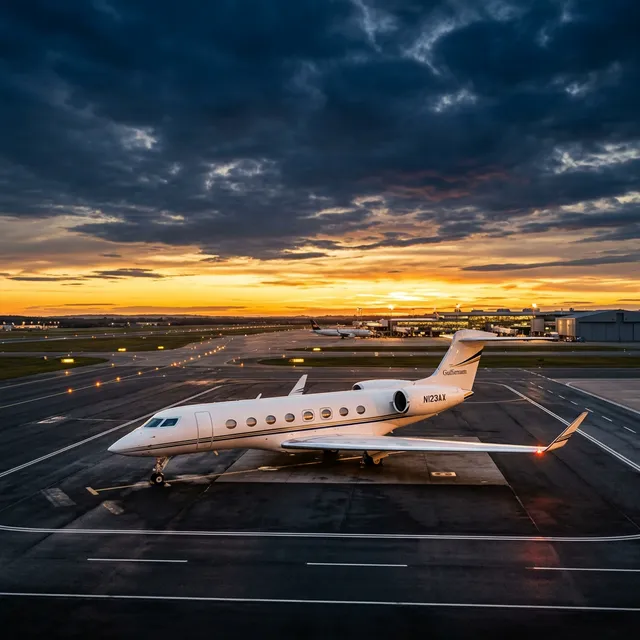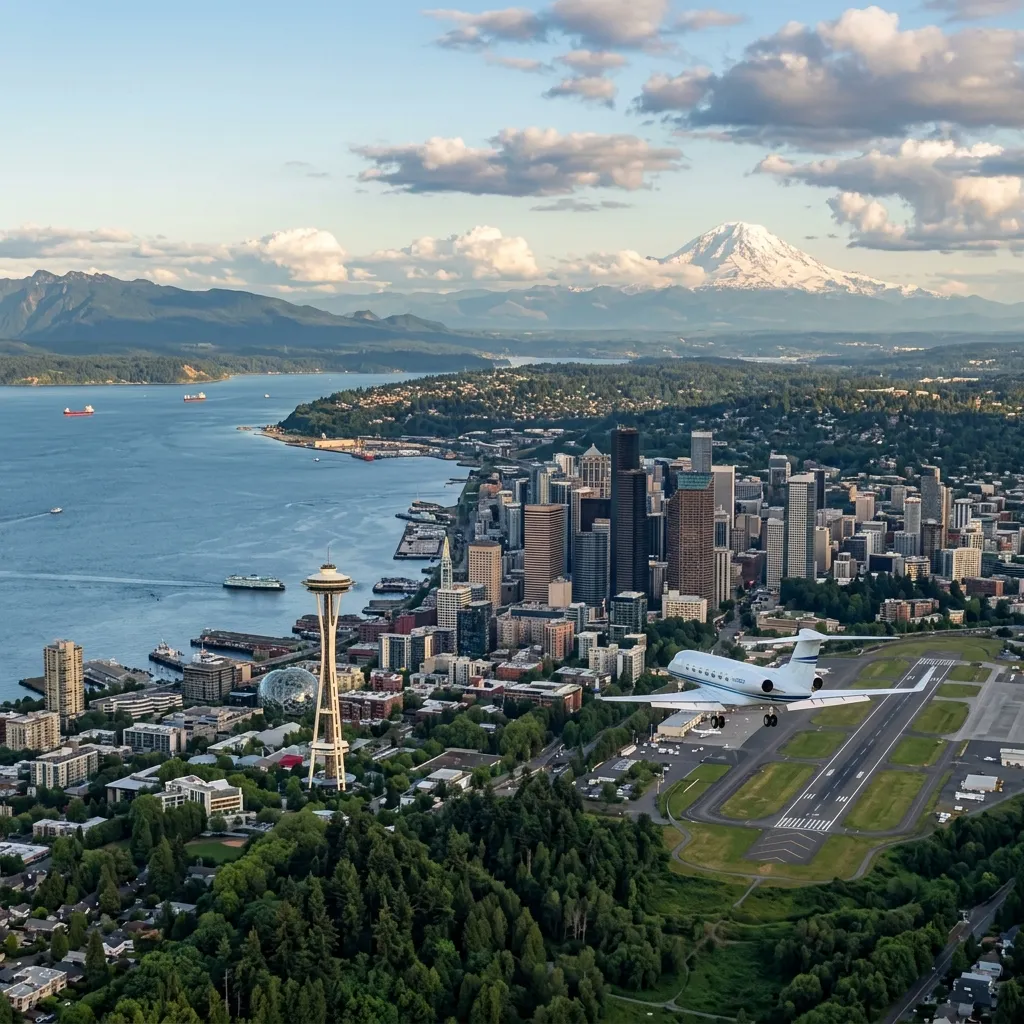
Aerial view of Seattle skyline with Puget Sound and a private jet on approach

Flying Private to Seattle: Airport Strategy and FBO Options

Three airports, nine FBOs, and one rainy city where tech executives keep the charter market alive year-round.

In This Article

Boeing Field (BFI): The Default Choice Paine Field (PAE): The North End Alternative SEA-TAC: When Private Goes Commercial Ground Transportation from Boeing Field Private Aviation Infrastructure and Tech Economy Seasonal Demand and Pricing Common Routes from Seattle Frequently Asked Questions

Boeing Field (BFI): The Default Choice

Boeing Field, officially King County International Airport (KBFI), handles over 90% of private jet traffic in the Seattle metro area. Two runways, the primary measuring 10,000 feet, accommodate everything from a Phenom 300 to a Boeing BBJ. The field sits five miles south of downtown Seattle, a 15-minute drive outside rush hour and 35 minutes during the 7-9 AM and 4-7 PM windows.

Three FBOs operate on the field. Signature Flight Support occupies the largest facility on the east side with a 40,000-square-foot terminal, covered parking, and heated hangar space. Clay Lacy Aviation operates a newer facility focused on managed aircraft and charter clients. Galvin Flying has been on Boeing Field since 1940 and handles a mix of general aviation and business jet traffic. Fuel pricing at BFI averages $6.80 to $7.50 per gallon for Jet-A, competitive for the Pacific Northwest market.

  • Signature Flight Support: largest facility, full-service FBO, conference rooms, crew lounge, 24/7 operations
  • Clay Lacy Aviation: aircraft management focus, charter dispatch, newer terminal building
  • Galvin Flying: legacy operator, competitive fuel pricing, full maintenance shop on site
  • All three offer customs clearance for international arrivals (CBP on field)
  • Noise restrictions: voluntary curfew 10 PM to 7 AM, not enforced but operators respect it

Paine Field (PAE): The North End Alternative

Paine Field in Everett, 30 miles north of downtown, gained commercial airline service in 2019 but has served private aviation for decades. The 9,010-foot runway handles all business jet categories. If your destination is Bellevue, Kirkland, Redmond, or the Microsoft campus, Paine Field cuts 20 to 40 minutes off the ground transfer compared to Boeing Field.

The FBO situation at Paine Field is thinner. Castle and Cooke Aviation operates the primary private aviation facility. The terminal is smaller than Boeing Field's offerings, but the ramp space is adequate and the lack of congestion is an advantage during peak travel periods. Fuel pricing is marginally higher than BFI.

Tech executives heading to the Eastside corridor, Bellevue, or Redmond should seriously consider Paine Field. The time saved on the ground transfer, especially during Seattle's afternoon traffic, often exceeds the flight time itself on short-haul trips.

SEA-TAC: When Private Goes Commercial

Seattle-Tacoma International Airport (KSEA) has a private jet facility, but it is not the first choice. Signature Flight Support operates the FBO on the south end of the field. The 11,901-foot runway handles anything, and customs is immediate. The disadvantage is sharing taxiways and approach sequences with commercial traffic.

SEA-TAC makes sense in two scenarios. International arrivals where CBP processing needs to be immediate and seamless. And connections to commercial flights where a private jet delivers you to the same airport complex. Otherwise, Boeing Field is faster, cheaper on ramp fees, and less congested.

Ground Transportation from Boeing Field

Downtown Seattle hotels: 15-25 minutes via I-5 North or surface streets. Amazon HQ (South Lake Union): 20 minutes. Bellevue and Microsoft campus: 30-45 minutes via I-90 or SR-520, heavily traffic-dependent. Sea-Tac Airport for commercial connections: 15 minutes south.

All three Boeing Field FBOs arrange car service. Signature partners with Blacklane and local livery companies. Clay Lacy coordinates through their charter operations team. Expect $85 to $150 for a sedan to downtown Seattle, $150 to $250 for an SUV to Bellevue during peak hours.

Helicopter Transfers

Helicopter transfers from Boeing Field to downtown Seattle helipads run $800 to $1,500 per trip. Kenmore Air and Helicopters Northwest operate from BFI. The flight takes 5 minutes. For clients heading to waterfront properties or the San Juan Islands, seaplane service from Lake Union is also available through Kenmore Air, connecting at the lake rather than the airport.

Need a Charter Quote?

Contact our team for a personalized quote.

Get a Quote

Private Aviation Infrastructure and Tech Economy

Seattle's private aviation market is driven almost entirely by the technology sector. Amazon, Microsoft, Boeing, Starbucks, and Costco are all headquartered in the metro area. During earnings season, board meetings, and product launches, Boeing Field experiences traffic spikes that strain FBO ramp capacity. The tech IPO wave of 2020-2021 added a generation of new private jet buyers who based aircraft at BFI.

Despite the demand, Seattle's private aviation infrastructure has not expanded at the same pace as cities like Dallas, Miami, or Scottsdale. Boeing Field's ramp space is finite, bounded by Boeing's manufacturing facilities to the north and the Museum of Flight to the south. New hangar construction is limited. Waitlists for based-aircraft hangar space at BFI run 12 to 24 months.

This constraint creates an opportunity for charter clients. Many Seattle-based owners who cannot secure hangar space at BFI base their aircraft elsewhere, Boise, Portland, or Paine Field, and reposition for trips. The result is a steady supply of empty leg opportunities into and out of BFI from secondary Pacific Northwest airports.

Seasonal Demand and Pricing

Seattle private jet traffic peaks in three periods. Tech conference season (September through November) when Amazon, Microsoft, and cloud computing events draw executives from California and the East Coast. Summer months (June through August) when Pacific Northwest weather cooperates and San Juan Islands, British Columbia, and Alaska charter legs originate from BFI. Year-end holiday travel (mid-December through January 2) to Sun Valley, Palm Springs, and Hawaii.

Off-peak months (February through April) offer the best charter pricing and widest aircraft availability. Empty legs from BFI to Los Angeles, San Francisco, and Scottsdale are common in spring as snowbird clients reposition south.

BFI
Primary Private Jet Airport
10,000 ft
Runway 13R/31L
3 FBOs
At Boeing Field
90%+
Charter Traffic at BFI

Common Routes from Seattle

The Seattle-to-San-Francisco corridor is the highest-volume private jet route from BFI. Tech shuttle traffic between Amazon, Microsoft, Google, and Meta offices keeps this city pair active five days a week. Empty leg availability on this route is among the highest in the country.

Brian Galvan

Written By

Brian Galvan

Founder, The Jet Finder ยท Private Aviation Operations & Technology

Former Director of Technology at FlyUSA (Inc. 5000 fastest-growing private jet company). Decade of hands-on experience across Part 135 operations, charter sales, fleet management, and aviation data systems.

LinkedInRead Full Profile →
Common Questions

Frequently Asked Questions


8 questions about flying private to Seattle

Boeing Field (KBFI), five miles south of downtown. It handles over 90% of private jet traffic in the Seattle area with three FBOs, a 10,000-foot runway, and customs clearance on the field. The airport is purpose-built for general aviation and does not share taxiway congestion with commercial airline traffic.

Boeing Field to downtown Seattle is 15-25 minutes by car depending on traffic. To Bellevue, Redmond, and the Microsoft campus, expect 30-45 minutes via I-90 or SR-520. During rush hour (4-7 PM), the Eastside commute can stretch to 60-75 minutes. Paine Field in Everett is faster for Eastside destinations.

KBFI has a voluntary noise abatement program requesting quiet hours from 10 PM to 7 AM. It is not a hard curfew enforced by regulation, but most operators and FBOs respect it. Stage 3 and Stage 4 aircraft, which includes all modern business jets, are not restricted. Older Stage 2 aircraft are discouraged during voluntary quiet hours.

Yes. U.S. Customs and Border Protection operates at Boeing Field. All three FBOs can arrange customs clearance for international arrivals. Pre-clearance via eAPIS is required. Processing times average 20-30 minutes for private aviation arrivals from Canada, which is the most common international routing from BFI.

Paine Field (KPAE) in Everett. While it is 30 miles north of downtown Seattle, it is closer to the Eastside corridor and avoids the I-5 and I-90 traffic that makes the Boeing Field to Bellevue drive unpredictable. Ground transfer from Paine Field to Microsoft campus is approximately 25-30 minutes on most days.

Frequently. The Seattle-San Francisco corridor is one of the highest-volume private jet routes in the western United States, driven by tech shuttle traffic. Empty legs on this route appear multiple times per week, typically priced at 40-60% below standard charter rates. Monitor empty leg platforms and ask your broker to set alerts for BFI-SFO and BFI-OAK legs.

Signature Flight Support on the east side of the field. Their facility includes a 40,000-square-foot terminal, heated hangars that accommodate aircraft up to Gulfstream G650 size, conference rooms, crew rest areas, and covered passenger loading. They handle the largest volume of heavy jet traffic at BFI.

Yes. The 10,000-foot Runway 13R/31L accommodates Boeing 737 and Airbus A320 family aircraft at typical business jet weights. BBJ and ACJ operations have used Boeing Field, though ramp space for 737-class aircraft is limited and requires advance coordination with the FBO. Signature Flight Support is the preferred handler for VIP widebody operations.

Continue Reading

Related Articles


Your Next Mission

Ready to Fly?


Whether you need a charter quote or want to explore aircraft options, our team is here.

Contact Us