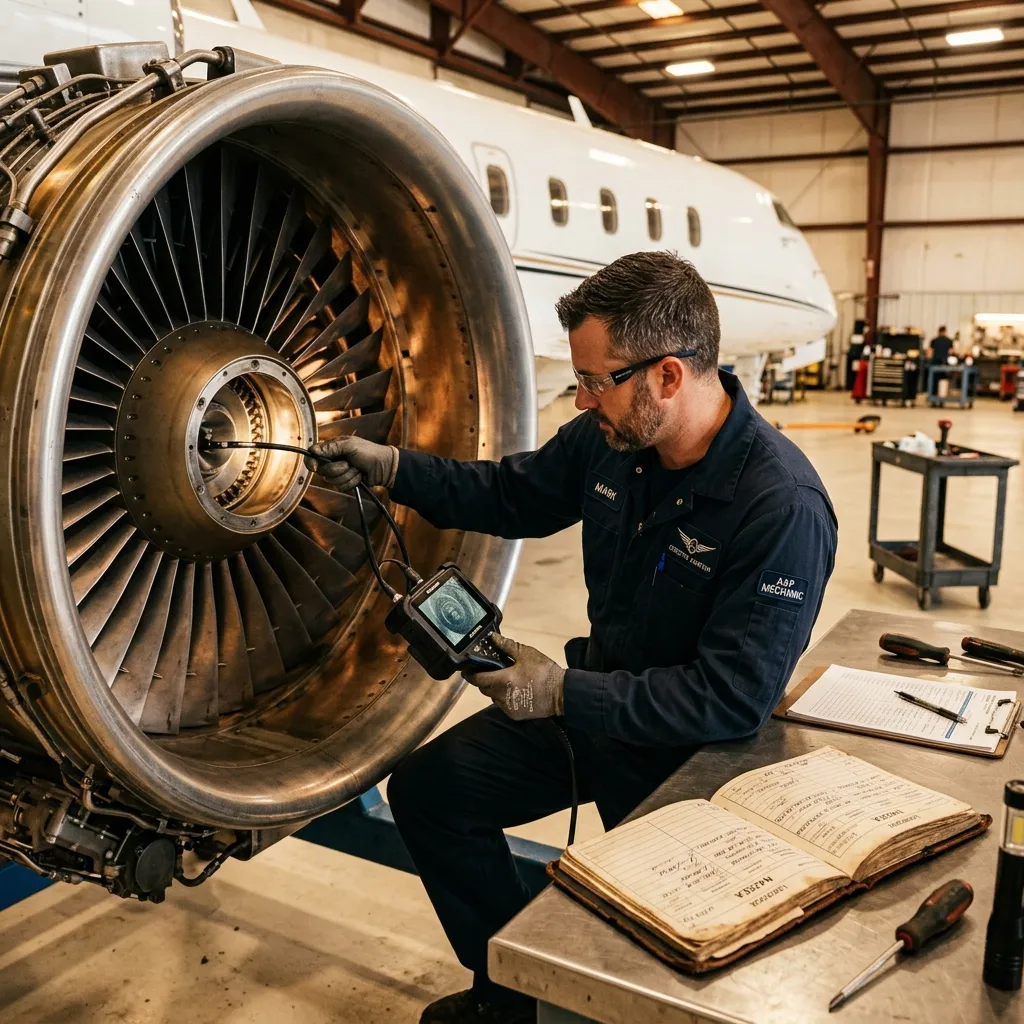
Aviation maintenance professional inspecting a business jet engine in a hangar with maintenance documentation

Director of Maintenance in Business Aviation: What the FAA Requires and What the Job Demands

undefined

In This Article

The Position That Signs for Airworthiness FAA Qualification Requirements: FAR 119.67 and 119.69 Daily Responsibilities Beyond the Regulations Compensation and Career Path The Accountability Weight: When Things Go Wrong Frequently Asked Questions

The Position That Signs for Airworthiness

Every Part 135 certificate holder in the United States is required by FAR 119.69 to designate a Director of Maintenance (DOM). This individual holds personal regulatory responsibility for the airworthiness of every aircraft on the operator's certificate. When a DOM approves an aircraft's return to service after maintenance, that signature carries legal weight: the DOM is personally certifying that the aircraft meets all applicable airworthiness requirements, all discrepancies have been resolved, and all required inspections are current. If an accident investigation traces a cause to deferred maintenance or improper repair, the DOM's signature trail becomes the focal point of the inquiry.

The role exists because the FAA recognized that maintenance decisions in commercial aviation must have a single point of accountability. Unlike Part 91 operations (where the pilot in command has final authority over maintenance decisions), Part 135 operations require a dedicated maintenance executive who can balance operational pressure against airworthiness standards. The DOM reports to the certificate holder's management but answers to the FAA. The tension between these two reporting lines defines the job.

FAA Qualification Requirements: FAR 119.67 and 119.69

The qualifications ladder starts with an Airframe and Powerplant (A&P) certificate, earned through 1,900 hours of training at an FAA-certified school or equivalent practical experience. The Inspection Authorization (IA) adds authority to perform annual inspections and approve major repairs and alterations, requiring at least 3 years of A&P experience and passing a separate FAA examination. The DOM position then requires at least 3 years of maintenance experience within the preceding 6 years on the same category and class of aircraft the operator flies.

The 'same category and class' requirement creates a practical constraint that operators regularly confront. A DOM who spent 15 years maintaining Gulfstream large-cabin jets does not automatically qualify to serve as DOM for an operator flying Cessna Citation light jets. The FAA evaluates whether the DOM's experience matches the operator's fleet. This requirement makes DOM candidates with multi-type experience (across light, mid, and large-cabin jets) significantly more valuable in the market, particularly for management companies operating diverse fleets.

Daily Responsibilities Beyond the Regulations

The FAA defines the DOM's regulatory functions: ensuring maintenance is performed in accordance with the operator's approved maintenance program, reviewing and approving maintenance records, and certifying aircraft airworthiness. The actual job extends far beyond these regulatory requirements. In a typical Part 135 operation managing 5-15 aircraft, the DOM's week includes reviewing incoming and outgoing aircraft discrepancy reports, coordinating unscheduled maintenance events, managing relationships with MRO facilities, tracking engine and component time-limited parts, reviewing parts procurement for PMA versus OEM compliance, and mediating the constant tension between the flight operations team (which needs the aircraft) and the maintenance program (which needs the aircraft in the hangar).

  • Review and approve every work order, inspection report, and return-to-service document before the aircraft flies
  • Maintain the CAMP (Continuous Airworthiness Maintenance Program) or equivalent tracking system with zero deferred items past their extension limits
  • Coordinate with the Director of Operations on aircraft availability, scheduled maintenance windows, and AOG (aircraft on ground) events
  • Manage the MEL (Minimum Equipment List) process: what items can be deferred, for how long, and under what conditions
  • Respond to FAA Airworthiness Directives (ADs) within the mandated compliance timeframe, which can be as short as 10 flight hours
  • Oversee vendor and MRO facility qualifications, ensuring all third-party maintenance providers meet the operator's approved vendor list requirements
  • Prepare for and participate in FAA surveillance inspections, which can occur unannounced and examine every aspect of the maintenance program

AOG events reveal the DOM's value most clearly. When an aircraft breaks in Boise on a Friday afternoon and the client has a Monday morning departure from Teterboro, the DOM must source the part, identify a qualified mechanic, arrange the repair, verify the work, approve the return to service, and coordinate with dispatch. Speed matters. But shortcuts are not an option. The DOM who approves a repair without proper documentation or uses a non-approved part faces personal certificate action from the FAA, regardless of whether the repair was technically sound.


Need a Charter Quote?

Contact our team for a personalized quote.

Get a Quote

Compensation and Career Path

DOM salaries reflect both the regulatory responsibility and the talent scarcity. As of 2026, the business aviation maintenance workforce shortage has pushed DOM compensation upward by 15-20% since 2020. A qualified DOM with multi-fleet-type experience, clean FAA record, and 10+ years in Part 135 operations commands $140,000-$165,000 at mid-size operators. Large management companies (Jet Linx, Priester, Meridian) and fractional operators (NetJets, Flexjet) pay $160,000-$185,000 for senior DOMs managing diverse fleets across multiple bases.

The career path typically follows a 15-20 year trajectory: apprentice or school-trained A&P mechanic, line maintenance, lead mechanic, maintenance supervisor, assistant DOM, and DOM. Some DOMs advance to Vice President of Maintenance or Chief Inspector roles at larger operators. Others transition to OEM field service representative positions or FAA Aviation Safety Inspector (ASI) roles, leveraging their regulatory knowledge and industry relationships. The DOM-to-FAA-inspector pipeline is well established and creates the unusual dynamic of former DOMs inspecting their previous employers.

The Accountability Weight: When Things Go Wrong

The NTSB investigates every business aviation accident, and the maintenance trail is always examined. When the investigation reveals deferred maintenance, missed ADs, improperly installed parts, or paperwork discrepancies, the DOM's decisions come under scrutiny. The FAA can take enforcement action against the DOM's A&P certificate, IA authorization, or both, up to and including permanent revocation. These are not theoretical consequences. Multiple NTSB reports in the past decade have identified DOM-level maintenance decisions as contributing factors to fatal accidents.

The counterbalancing pressure comes from operations. Flight departments and management companies generate revenue when aircraft fly and lose money when aircraft sit in hangars. A DOM who defers maintenance excessively creates risk. A DOM who grounds aircraft too conservatively constrains revenue. The best DOMs develop a reputation for rigorous, defensible decision-making: they ground aircraft when airworthiness is genuinely in question, document their reasoning, and communicate clearly with the Director of Operations about timelines and costs. The worst DOMs develop a reputation for rubber-stamping returns to service under pressure.

An experienced DOM once described the job as 'being paid to say no.' The aircraft owner wants to fly. The charter client has already boarded. The pilot has called dispatch. The part has not arrived. The DOM's job at that moment is to make a decision that they would be comfortable defending in an NTSB hearing room. The best DOMs make that decision quickly, document it completely, and move on to solving the problem rather than compromising the standard.

Brian Galvan

Written By

Brian Galvan

Founder, The Jet Finder ยท Private Aviation Operations & Technology

Former Director of Technology at FlyUSA (Inc. 5000 fastest-growing private jet company). Decade of hands-on experience across Part 135 operations, charter sales, fleet management, and aviation data systems.

LinkedInRead Full Profile →
Common Questions

Frequently Asked Questions


8 questions about chartering this aircraft

No. Part 91 operators (private, non-commercial flight) are not required to designate a Director of Maintenance. Under Part 91, the pilot in command is responsible for determining the airworthiness of the aircraft before each flight. Many corporate flight departments operating under Part 91 voluntarily employ a DOM or equivalent maintenance manager, but this is a business decision, not a regulatory requirement. The DOM becomes mandatory when an operator holds a Part 135 certificate for charter operations.

The FAA generally does not approve an individual to serve as DOM on more than one Part 135 certificate simultaneously, because the position requires full-time dedication to the operator's maintenance program. The FAA's reasoning is that a DOM divided between two certificates cannot adequately oversee either. Exceptions are extremely rare and typically involve very small operators with minimal fleet sizes. In practice, DOM candidates who are offered positions at two operators must choose one.

The operator must notify the FAA immediately and designate an interim replacement who meets FAR 119.69 qualifications within 10 days. If no qualified replacement is available, the operator may request a temporary exemption from the FSDO (Flight Standards District Office), but the FAA can restrict or suspend operations if the position remains vacant. DOM departures create operational emergencies for small operators. Most management companies maintain backup-qualified personnel specifically for this scenario.

The DOM has final authority on airworthiness determinations. If the DOM determines an aircraft is unairworthy, the DO cannot overrule that decision and dispatch the aircraft. This authority is codified in the operator's General Operations Manual (GOM) and is a fundamental principle of Part 135 safety structure. In practice, the DOM and DO negotiate constantly on timing: when maintenance will begin, how long it will take, and which aircraft can substitute. But on the binary question of 'is this aircraft airworthy right now,' the DOM's word is final.

The minimum path from zero experience to DOM eligibility takes approximately 8-10 years. An A&P certificate requires 1,900 hours of training (18-24 months at an accredited school). The IA requires 3 additional years of A&P experience and passing the IA exam. FAR 119.69 then requires 3 years of experience maintaining the same category and class of aircraft within the preceding 6 years, plus at least 1 year of supervisory experience. In practice, most DOMs reach the position after 10-15 years in aviation maintenance.

DOMs face regulatory liability (FAA certificate action) rather than direct personal financial liability in most cases. The FAA can suspend or revoke the DOM's A&P and IA certificates if the investigation reveals the DOM approved maintenance that did not meet regulatory standards. Criminal liability is rare but possible in cases of gross negligence or knowing violation of safety regulations. Civil liability typically falls on the operating company, though the DOM may be named individually in lawsuits. Most operators provide liability insurance covering the DOM's regulatory defense costs.

The most widely used system is CAMP (Continuous Airworthiness Maintenance Program), a cloud-based platform that tracks all scheduled inspections, AD compliance, service bulletins, component time limits, and maintenance history. Other systems include Traxxall, Flightdocs, and Corridor (now part of ATP). These systems provide automated alerts when inspections, AD compliance actions, or time-limited components approach their limits. A DOM managing 10 aircraft may track 500+ individual compliance items across the fleet. The system's reliability is directly proportional to the accuracy of the data entered.

Extremely difficult. The business aviation maintenance workforce has been contracting since 2018 as experienced mechanics retire faster than new A&P graduates enter the field. DOM-qualified candidates (A&P plus IA plus multi-type turbine experience plus supervisory time) represent a small subset of the already-shrinking mechanic pool. Average time to fill a DOM position is 4-8 months for operators in major markets and potentially longer in secondary markets. Compensation has increased 15-20% since 2020 as a direct result of this scarcity, with signing bonuses of $10,000-$25,000 becoming common.

Continue Reading

Related Articles


Your Next Mission

Ready to Fly?


Whether you need a charter quote or want to explore aircraft options, our team is here.

Contact Us