The Hourly Number
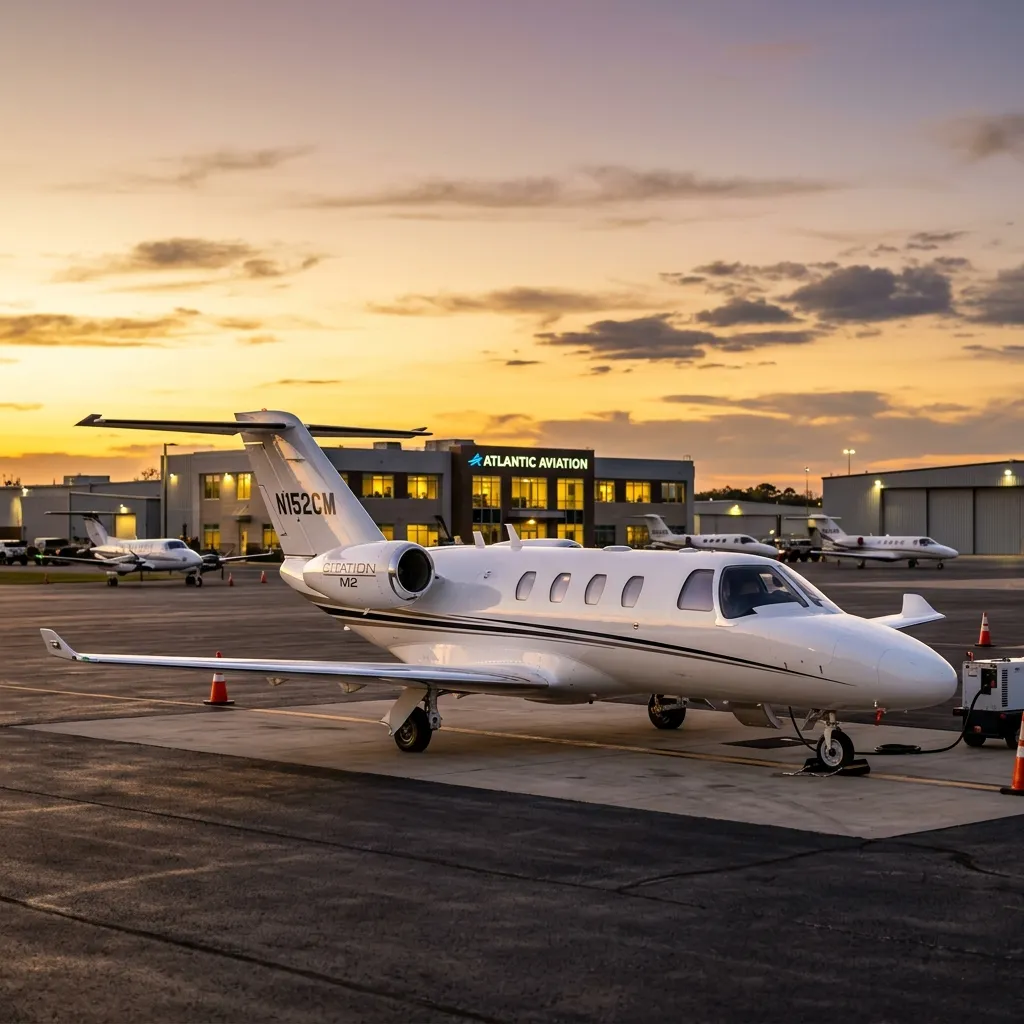
The Citation M2 charters between $2,000 and $2,800 per flight hour, depending on operator, region, and season. That rate covers the aircraft, two pilots (most M2 charter operations are dual-crew despite single-pilot certification), and basic cabin provisioning. It does not cover fuel surcharges, landing fees, overnight charges, or repositioning.
At $2,400 per hour, a two-hour flight from Teterboro to Nantucket runs approximately $4,800 in flight time. Add a fuel surcharge of $200 to $400 and a landing fee at ACK, and the total approaches $5,500. For a group of four, that breaks down to $1,375 per person. First class commercial from JFK to ACK, if it existed, would cost more and take twice as long.
Where the M2 Sits in the Market
The M2 is Cessna's entry-level jet, positioned below the CJ3 and CJ4 in the Citation lineup. It replaced the Citation Mustang in 2013, adding 50 knots of cruise speed and 200 nautical miles of range while keeping the same seven-seat cabin layout.
The competitive set includes the Phenom 100, HondaJet, and Eclipse 550. Among these, the M2 typically charters at the lowest hourly rate because the used market has strong supply. Over 300 M2s have been delivered, and the aircraft holds its value well enough that operators can justify lower hourly pricing.
The M2 Gen2, introduced in 2020, added Garmin G3000 NXi avionics and autothrottles. Charter pricing for Gen2 aircraft runs $200 to $400 higher per hour than original M2s.
The Repositioning Reality
Repositioning is where M2 charter math gets complicated. If you are in Nashville and the nearest available M2 is based in Atlanta, you pay for the empty leg from Atlanta to Nashville before your trip even begins. At $2,400 per hour and a 45-minute positioning flight, that adds $1,800 to your trip cost before a single passenger boards.
One-way trips are particularly expensive on the M2. The aircraft must return to base empty, and you pay for that leg. A one-way New York to Boston trip that takes 55 minutes of flight time costs the equivalent of a 1:50 round trip. Some operators offer one-way pricing at 1.5x the flight time rather than 2x, but that depends on whether they can sell the return leg.
The operators who price M2 charters most competitively are those who base multiple aircraft in high-demand markets and can minimize repositioning. A Florida-based operator chartering an M2 between Miami and Key West faces minimal deadhead. The same operator sending an M2 from Fort Lauderdale to Omaha faces a different equation entirely.
The M2 is a ,400/hour jet that does ,000/hour work on the right routes. The math only breaks down when you ask it to reposition across three states to pick you up.
Need a Charter Quote?
Contact our team for a personalized quote.
Get a Quote →Segment Minimums and Short Hops
Most M2 operators impose a one-hour flight minimum per segment. That means a 22-minute flight from White Plains to Philadelphia bills at one hour: $2,400, not the $880 the actual flight time would suggest. The minimum exists because crew costs, fuel burn during taxi and runup, and FBO fees are fixed regardless of flight time.
This makes the M2 less attractive for very short hops (under 200 nm) unless the alternative is ground transportation taking 3-4 hours. Where the M2 excels is the 300 to 700 nautical mile range: flights of 1.5 to 2.5 hours where the per-hour economics work and commercial alternatives are poor.
What the Cabin Actually Delivers
The M2 cabin is 11 feet long, 4.8 feet wide, and 4.8 feet tall. That is tight. An adult over 6 feet will feel the ceiling on entry, though once seated the headroom is adequate. Four passengers travel comfortably in the club-four configuration. A fifth passenger sits in the forward-facing seat behind the cockpit, which has reduced legroom. Six and seven are technically possible but require using the belted lavatory seat, which is not a seat anyone chooses.
Baggage capacity is 57 cubic feet in the aft compartment, which handles four standard carry-on bags and two garment bags. Golf clubs require the optional ski tube or external pod. If your trip involves equipment, confirm with the operator before booking.
There is no enclosed lavatory on the M2. There is an emergency relief tube behind a curtain. For flights under two hours, this is fine. For longer flights, plan accordingly.
When to Charter Something Else
Skip the M2 if your trip exceeds 1,300 nautical miles. The aircraft's 1,550 nm range sounds adequate, but NBAA IFR range with four passengers, standard fuel reserves, and winter winds drops to approximately 1,200 nm. New York to Miami is 1,090 nm and works well. New York to Denver is 1,620 nm and requires a fuel stop.
Skip it if you regularly travel with more than four people. The CJ3 adds a genuine sixth seat and 500 nm of range for roughly $800 more per hour.
The M2 is the right charter choice for owner-type missions: short to medium trips, two to four passengers, and price sensitivity that rules out midsize jets. It does what it does well. Asking it to do more leads to compromises that a $400/hour premium on a larger aircraft eliminates.
For passengers comparing the M2 to turboprops like the King Air 350 or Pilatus PC-12, the calculus is straightforward. The M2 cruises at 404 knots, roughly 100 knots faster than either turboprop. On a 600 nm trip, that speed difference saves 30 minutes. Multiply that by four trips per month and the time savings justify the hourly premium. The turboprop wins on short-field access and operating cost per mile. The M2 wins on speed and the intangible fact that it is a jet.